

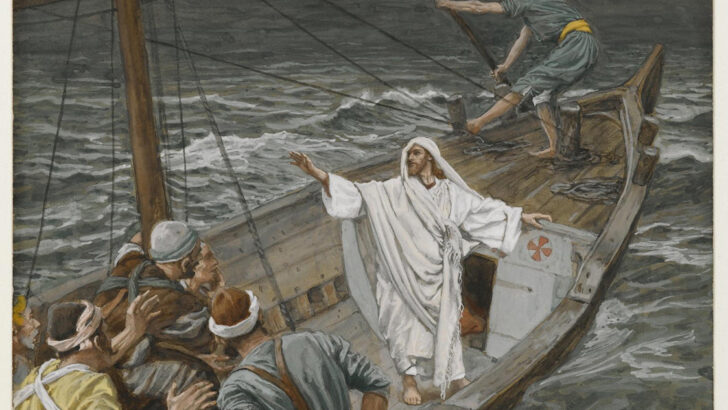
In an anxious age, to stand confidently with Christ is a glorious act of non-conformity, writes Fr Chris Hayden

The capacity for fear is an aspect of our God-given human nature. If I am unable to feel fear, I will not respond to threat or danger, as they will simply have no effect on me. I will be like a person who has no feeling in his arm, and ends up losing it entirely because he has failed to remove it from a flame. It is quite in order to be concerned about excessive anxiety, but this does not mean regarding fear as bad in itself. Let us by all means be afraid when there is reason for fear!
It is another thing entirely to exaggerate danger, to cultivate fear, to talk up anxiety. There are many fearful things in our world, and our communications technology allows us to connect with them constantly. It is only prudent to ask at what point fearfulness and anxiety lead to diminishing returns. If I’m afraid of being in an accident, I can reduce my driving speed and try to avoid taking the car out in hazardous conditions. However, if that same fear begins to paralyse me, then it is no longer leading to sensible behaviour, but has reached the point of diminishing returns.
We need to realise that there is nothing inherently virtuous about being afraid. And this applies across the board, even to something like climate change. It is not inherently virtuous to descent into a state of sadness and anxiety over the condition of our planet. A degree of heathy concern can lead us to act well, to modify our patterns of consumption, to live more simply, to engage politically. But the ecosystem we inhabit is indifferent to human emotions, and there is simply no benefit whatever to shouldering excessive, diminishing-returns anxiety.
Useful
It’s hardly more than common sense to observe that reasonable fear is useful whereas excessive fear is not. Yet this common sense is perhaps not quite as common as it should be, and in a culture of anxiety, it is a somewhat compromised common sense. Fear and anxiety have come to be culturally sanctioned, and many young people have been coached in fragility rather than resilience. Concern for ‘safe spaces’ on college campuses may not be quite as fashionable as it was a few years ago, and concern with so-called ‘microaggressions’ also appears to have moved a little bit away from centre stage. But the broad cultural shift towards anxiety has not reverted towards resilience.
For Christians today, seeking to be wise to culturally sanctioned anxiety can be a form of prophetic witness. Remaining calm in anxious times is not only a gift our faith can offer; it is also a challenge our faith presents to us. Jesus himself, anticipating the most anxious times of human history, said, “When these things begin to take place, stand up straight and hold your heads high, because your redemption is near” (Luke 21:28). We needn’t imagine that any given anxious moment or any given crisis signals the end of the world, but if Christ would have his followers stand with confidence in unimaginably tumultuous times, then so much more should we seek to remain calm during lesser crises.
Culture
Our culture, via the communications technology which can glue our attention to every unfolding crisis, says, “Be afraid; be very afraid.” Our Lord, in contrast, says, “Stand firm; stand confident; stand hopeful.” We will do well to ponder the contrast between these two exhortations, and to ask which is better and more productive, gnawing anxiety or faith-based confidence? Moreover, we will do well to engage in some solid Christian scepticism, shining the clear light of the Gospel on cultural and political tendencies to amplify anxiety, to foster it, to harness it for cultural, social or political ends.
To stand confidently, heads raised, with Christ, is to refuse to be pulled down by the anxiety of the age. To stand confidently with Christ is a glorious act of non-conformity. It is emphatically not to close one’s eyes to the challenges of the times; on the contrary, it is to retain the kind of poise that enables us to do what we can. After all, it is excessive fear that would have us flee, or flee psychologically by sticking our heads in the sand.
Perhaps, then, the most important issue for the believer in an age of anxiety can be summed up as a question of posture and deportment. Which posture will I adopt? Will I cower in fear, or will I stand up straight and walk confidently with – and for! – Christ?
This is the second instalment in Fr Chris Hayden’s series, ‘Faith in a time of anxiety’.