

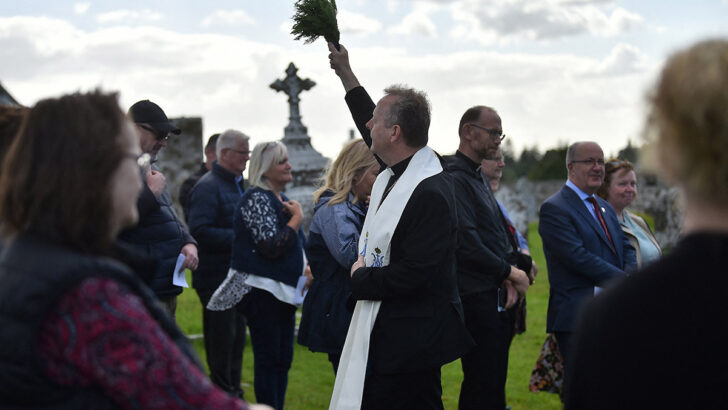
 Archbishop Eamon Martin blesses delegates during a prayer walk at Clonmacnoise in June 2022, at the start of Ireland’s synodal journey that now
continues with the 2025 pre-synodal assembly in Kilkenny. Photo: CNS /Clodagh Kilcoyne, Reuters.
Archbishop Eamon Martin blesses delegates during a prayer walk at Clonmacnoise in June 2022, at the start of Ireland’s synodal journey that now
continues with the 2025 pre-synodal assembly in Kilkenny. Photo: CNS /Clodagh Kilcoyne, Reuters.
The preparatory document for the Pre-Synodal Assembly, Baptised and Sent, was published on Thursday, September 18, a month before the October Assembly in Kilkenny. I will offer a brief summary of the document, some reflections that arise, and two suggestions concerning the next steps.

The document is authored by the National Synodal Team as part of a consultation process in the Irish Catholic Church stretching back to 2021 and in response to the question: What does God want from the Church in Ireland at this time?
More immediately the context includes the Irish National Synthesis of 2022 and the final document of the World Synod in 2024, and the focus now is on what the priorities are for the Irish Church in its implementation of the Synodal Pathway. To this end consultations took place in Spring Gatherings earlier this year, in dioceses and in the wider Church. This document is, first, a distillation of the findings from these gatherings, but then a more creative, communal discernment by the National Team in preparation for Kilkenny. And Kilkenny itself is a staging post for a full Synodal Assembly in the autumn of 2026.
The Document: Content, process and purpose
The main findings of this document are, first, the identification of baptism as the unifying paradigm out of which seven other priorities follow. These are, in alphabetical order: belonging (of all the baptised and especially those who feel marginalised); co-responsibility and lay ministry; family; formation and catechesis; healing (in particular of the wounds of abuse, which affect the whole Church); women; youth.
The process was principally by means of ‘conversation in the Spirit,’ with, however, a more analytic, theological reflection by Fr Liam Bergin which was commissioned by the Team.
Some arising reflections
The timely publication of the document is most welcome: it signals that this belongs to the whole People of God and invited a response in time for Kilkenny as part of that process of circularity so typical of the synodal pathway and true to the characteristics of transparency and accountability.
The predominant tone is one of joy and energy, with the rootedness in Baptism giving confidence”
It is clear that while there were considerable convergences, both in the Spring Gatherings and in the deliberations of the National Team, still there were also striking divergences. The document is honest about the latter. And so, with respect to the experience of synodality itself, there was disappointment in the refusal of some communities and clergy in particular to engage fully in the process or at all (n 42), and a sense of fatigue and weariness was evident in some quarters, with some scepticism expressed about future progress (n 43). Nonetheless, the predominant tone is one of joy and energy, with the rootedness in baptism giving confidence that various other tensions can be handled well.
As had already been noted in the Synthesis Document of the World Synod, and later in the Final Document, ‘conversation in the Spirit’ is a very effective process, particularly in dealing with conflict. But, as noted there, it has its limitations, and is not the only way to practise communal discernment. While strong on the affective level, it needs complementing on the analytic, intellectual side, so that contributions from theology and other disciplines are recommended. In this context the Team did well to commission the piece on baptism by Fr Liam Bergin, but arguably more can be done in this direction.
Priorities
In my own Jesuit experience communal discernment works best when the question is well focussed and the required analysis, research and theological reflection is done in advance. This will include discussion and debate, as well as the later moments of dialogue and listening so characteristic of ‘conversation in the Spirit.’
We owe a great debt of gratitude to all who actively shaped it, in particular to Fr Declan Hurley”
The priorities listed are mainly intra-Church. Issues like social justice, ecology, war and peace, ecumenism and so on are mentioned but not given any substantial treatment. In a sense this is understandable: it would seem that there is a backlog of internal ecclesial housekeeping to be sorted as we break a long silence about these matters, and this will take time. Nonetheless, as the document is well aware, we cannot afford to be overly self-referential, to use the phrase of Pope Francis, and the encounter with Jesus expressed in baptism must inevitably lead to missionary outreach to our wounded world.
In terms of formation, the language refers to faith formation (the affective side of things and liturgical expression), and to catechetics and religious education on the cognitive side. It seems to me that we need to be a bit more nuanced here: catechetics and religious education (both necessary) can on their own suggest the learning and handing on of truths already discovered. I think it would be good to make some mention of theology here – think of Anselm’s maxim, tweaked a little by the late Enda McDonagh – “Faith (and hope and love) seeking understanding.” This makes allowance for the generative power of questioning and doubt, the dialogue with the signs of our times, the sense that the Spirit is alive and leading us into a fuller grasp of the truth and the mystery of our encounter with the person of Jesus.
This is a rich document and a significant step forward from the 2022 Irish Synthesis. We owe a great debt of gratitude to all who actively shaped it, in particular to Fr Declan Hurley (chair) and the National Synodal Team and to Julieann Moran, General Secretary of the Irish Synodal Pathway. And to the bishops who have remained committed to the project and facilitated it to this point.
Two suggestions
Arising from the document itself and from these reflections I offer two suggestions about how to proceed from here.
First, it is clear that one major source of tension and divergence is the whole area of Church teaching, particularly evident in the discussion around the role of women and the attitude to sexuality and the LGBTQ+ community. It seems to me that underlying this tension is the common, operative assumption (in Ireland but also much wider in the Church) that orthodoxy in Church teaching requires that it does not change. We need to unpack this assumption in a way that avoids any simplistic understanding. Those against change in teaching are concerned about ‘doctrinal integrity’ (n23), ‘the integrity of authentic church teaching’ (14), the risk of ‘a dilution of message’ (n 44). And so, while there is an acknowledgment that teaching in these areas affects ecclesial credibility and hence mission, there is a fear of over-accommodation to ‘the world’ or the prevailing culture.
This kind of development is not always logically linear in appearance but can indeed go beyond”
We need not remain paralysed by this constantly occurring tension but would do better to face it head on. These days we are celebrating the anniversary of the Council of Nicaea (325), where the key teaching on the ‘consubstantiality’ of Jesus Christ was resisted by many at the time because it seemed to represent change and was ‘unbiblical’. Reflecting back on those times Newman was able to note with approval the reality of doctrinal development, often spurred on by the ‘sense of faith of the faithful.’ This kind of development is not always logically linear in appearance but can indeed go beyond ‘reformulation’ and instead look more like ‘revision’ (see International Theological Commission on the Sense of Faith in the Life of the Church, 2014). This is clear from many historical examples, the change concerning slavery and the shift from understanding the husband as head of the wife in marriage to one where the two are equal being but two examples of many. And so just as the ‘novelty’ of consubstantiality is now viewed as impeccably orthodox, we must avoid any simplistic understanding of the non-changeability of Church teaching.
Forward
It would help then – along the lines of greater theological input mentioned several times already- if the Synodal Team commissioned a theological paper on what is permanent and what can and should change in Church teaching, a paper like Fr Bergin’s, short and accessible to all. This could be commissioned in late November, when the Team has had a chance to digest the Assembly findings, with a deadline for say mid-February in time to help influence further discussion. The Australian theologian Ormond Rush did a similar exercise to good effect during the Synod on Synodality around the topic of ‘tradition’. There are many fine theologians practising in Ireland these days, including some distinguished and very welcome immigrants. The paper could be written by one person or, preferably perhaps, by a small group.
These have generally been found to be unpersuasive, and the teaching remains in the category of ‘not received’”
My second suggestion is related and refers more directly to the October Assembly itself. It is not a surprise that many see the equality afforded by baptism as leading on logically to female ordination. And neither is it a surprise that others, a ‘vocal minority’ (n 24) shy away from this, often for the reasons cited about dilution of Church teaching and the sense that this can be a distraction from other more important issues. What is perhaps surprising and most interesting – and may represent a way forward- is the view of some who ‘expressed acceptance of the exclusion of women from ordination while asking that people be told why this is so’ (n 24). Now, there’s the nub: can we at least ask that this question be revisited without prejudice to the final outcome but with a view to articulating reasonable grounds for whatever emerges as Church teaching? Of course, various attempts, including by popes, have been made to ground current teaching, but these have generally been found to be unpersuasive, and the teaching remains in the category of ‘not received.’ So, why not put this question to the participants at Kilkenny:
Progress
Is it not time to request the Vatican to revisit the question of the ordination of women, in creative fidelity to the tradition and to the signs of our times?
We are running out of road on this one. Why not stop beating about the bush and do what we can”
This would need, of course, to be done by, among other sources, listening with open minds and hearts to the experiences and stories of women who feel called in this way to serve the Church.
We really need to lance this boil. The document speaks about ‘frustration over slow progress,’ a ‘matter of justice and credibility’ (n 18), its continued resurfacing as a theme is ‘inadequate or patronising’ leading to lack of trust and transparency’ (n 24). We are running out of road on this one. Why not stop beating about the bush and do what we can at our national level by taking responsibility now for what we can do as an Irish Church?
Fr Gerry O’Hanlon, SJ theologian, and member of the former Steering Committee of the Irish Synodal Pathway.