

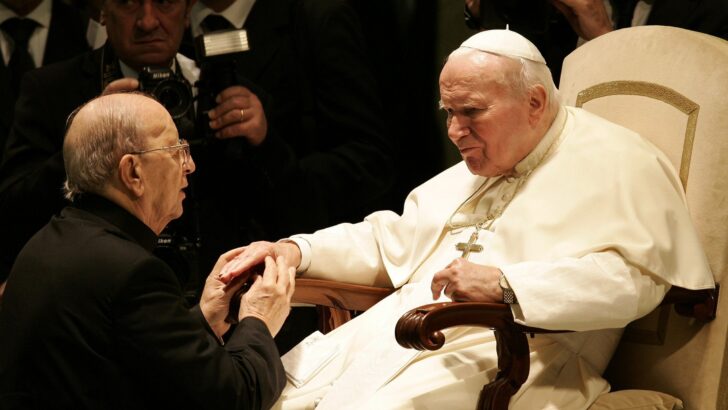
 Pope John Paul II blesses Father Marcial Maciel Degollado, founder of the Legionaries of Christ, at the Vatican in 2004. The new HBO docuseries "Marcial Maciel: The Wolf of God," which premiered Aug. 14, 2025, delves into the life and crimes of the founder of the Legionaries of Christ and Regnum Christi. Father John Connor, general director of the congregation. sees it as "a cathartic experience" that "challenges us to face our history again." (OSV News photo/Tony Gentile, Reuters)
 Fewer and fewer cardinals and papal electors from Central and Eastern Europe

The death of the Romanian Grand Archbishop Muresan throws a new spotlight on the fact that the era of John Paul II is fading as its defining figures disappear. Central and Eastern Europe are receding into the background.
It was the message of a newly grown self-confidence: Christian Europe must breathe on “both lungs”, according to the famous words of the Pope from Poland at the time, John Paul II. On “both lungs”: the Roman-Latin and the Slavic-Byzantine. A significant gesture in terms of intellectual history, as it revised the widespread theory of the three pillars on which Europe stood: antiquity, Christianity and Germanism.
The fall of communism in 1989/90, an ideological triumph for John Paul II, was also a “zero hour” for the local churches in Central and Eastern Europe. In many places, a self-sacrificing reconstruction began: spiritually, in terms of personnel and materially.
And John Paul II (1978-2005) cranked up this wave: he appointed the Slavic apostles Cyril and Methodius from the 9th century as “co-patrons of Europe”. They had made the Christian message comprehensible to Slavic ears, carried Christianity with their “School of Ohrid” and the “Cyrillic alphabet” via Romania to the region of Kievan Rus and via Moscow deep into present-day Russia. The fact that they introduced Slavic as a liturgical language was one of the reasons why nations such as Bohemia, Moravia and Slovakia later became attached to Rome.
Cardinals over cardinals
In many post-communist countries, Karol Wojtyla, the Pope from Poland, restored church structures, established dioceses – and honoured many who had remained faithful to the church during persecution: He proclaimed saint after saint and appointed cardinals after cardinals from countries that had never before been represented in the Pope’s Senate. In the College of Cardinals, Europe breathed “on both lungs”.
But a good 30 years later, the right wing is whistling – the left wing anyway. The death of the only Romanian cardinal, Grand Archbishop Lucian Muresan from Transylvania, at the age of 94 sheds new light on the fact that the era of John Paul II is fading with the disappearance of its formative figures. Central and Eastern Europe are once again receding into the background.
Let’s take a look at the countries: Romania, Ukraine, Slovakia, Belarus: no cardinal left. In Latvia, Slovenia, Albania, the Czech Republic, Bosnia-Herzegovina, and even in the traditional East-West hub of Austria, the only cardinal has already passed the age limit of 80 to be elected pope.
The only Latvian cardinal is almost 95, the Albanian – a priest and forced labourer appointed by Pope Francis – almost 97. Two of the three Lithuanians are closer to 90 than 80. That leaves 17 cardinals, 7 of whom are papal electors: from Poland (3), Hungary, Croatia, Serbia and Lithuania.
Three conclaves under their belts
Most recently, Stanislaw Rylko from Krakow and Vinko Puljic from Bosnia left the circle of papal electors in July and early September respectively. Both were confidants of John Paul II and had already held two and three conclaves respectively. At the end of 1994, in the middle of the Bosnian war, the then 49-year-old Puljic became the first Bosnian bishop in history to be admitted to the College of Cardinals, at the time as the youngest cardinal in the universal church.
The Pope’s successors from Poland – Benedict (2005-2013), Francis (2013-2025) and now Leo XIV – were and are also aware that the young, old church in Central and Eastern Europe continues to need attention and solidarity. Many countries in the region are struggling with nationalism, populism, unbridled materialism and Russian influence.
The former “Eastern bloc” is no longer firmly aligned with Europe and the West, but has long been torn between the EU and Vladimir Putin’s warmongering Russia, between democracy and right-wing populism à la Viktor Orban, Robert Fico or Karol Nawrocki.
Some sand also seems to have got into the gears of the church’s revival after decades of communist oppression. The initial enthusiasm is faltering in the face of huge challenges. Cardinal Peter Erdö from Budapest speaks bluntly about the society of his Hungarian homeland: communism has “wiped out civic decency”.
“Writing on water”
Similar to the Slavic apostles Cyril and Methodius – who complained that it was impossible to write on water and first had to develop their own Slavic script – today’s missionaries have to try to write on water and develop their own language; in other words, to reach people without existing religious foundations. A serious problem that has long since threatened to paralyse the left lung.
Many people, including many who have suffered human damage under socialism, are no longer prepared to forfeit their new freedom through a perceived submission to a Christian set of values. Some Christian flourishing, such as the spectacular expansion of the Church in eastern Slovakia, which is linked to Rome (“united”), could prove to be a dry bloom in the medium term. John Paul II, the visionary from Wadowice, can now no longer crank.