

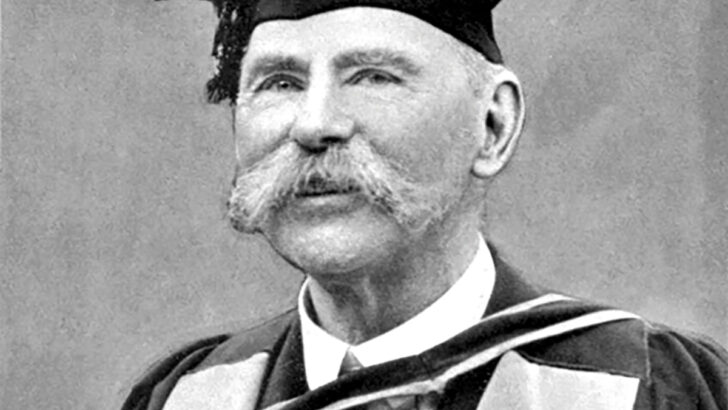
 Irish scholar and poet Douglas Hyde, first President of Ireland in 1937. Photo: Wiki Commons.
 New Perspectives on Conflict and Ireland in the Nineteenth Century,
edited by Paul Huddie, Cathal Billings and Arlene Crampsie
(Liverpool University Press, £105.00 / €121.00)

This collection of essays is the product of a conference of historians at Liverpool University. The subject for discussion was “Conflict in Ireland in the Nineteenth Century”. The contributions are classified under three broad headings: Religious Conflict, Conflict in Society, and Warfare.
Patrick Maume, who has complied more than five hundred entries with the Dictionary of Irish Biography, reviews the sectarian and agrarian conflict in Nineteenth Century Ireland through the lens of the life and commitments of John Duncan Craig (1830-1909).
He was a Church of Ireland clergyman, Provençal language student, Orangeman and writer in the Fenian and Land War era. The main theme in his lecturing, preaching and prolific publications was his fear that the Catholic majority on the island would rise up and overwhelm the Protestant minority. It was admirably summed up in the following stanza from his pen:
For mine’s the opinion, that Rome’s the foundation
Of two-thirds our trouble, our discord, our woe;
And that Ireland would be the cream of creation
If the Priest and the ‘Patriot’ from Ireland would go.
Máire Nic an Bhaird and Liam Mac Mathúna comment on ‘Douglas Hyde and his Inner Conflicts’. Douglas Hyde was born on January 17, 1860.
He was a folklorist, a poet, a philologist, a playwright, a literary historian, a university professor, a leader of the Gaelic Revival, an antiquarian, a senator of the Irish Free State and its’ first president after 1937.
Roscommon
But first and foremost, he was a ‘Roscommon’ man. To learn Irish he befriended and spent a lot of time with the local people who spoke Irish. From them he acquired strong nationalist and Fenian sympathies.
Furthermore, the authors of this article claim that Douglas Hyde was much more nationalist-minded than he is given credit for. This they set out to prove from a review mainly of his writings over the pseudonym “Géagán Glas” (“the little green branch”).
In his contribution “Recreation and Public Space” Julien Clenet records how the legislation that had favoured the enclosure of commons and privatised land in the mid-eighteenth century prompted the public authorities to create public parks and playgrounds from the mid-nineteenth century onwards.
It seems that Dublin Corporation was to the fore to this end. He also tracks the working-class attitudes to recreation in the late nineteenth century.
They were active during the Fenian Risings and the Land War, in the Napoleonic periods, in the Crimea and South Africa. There was never any doubt about their readiness to fight and fight bravely”
William Butler provides a history of the Irish militia in “More Irish than the Irish Themselves: Conflict, Discipline and the Image of the Irish Militia during the Nineteenth Century”.
Numbering between twenty and thirty thousand men, the Irish militia were deployed both at home and abroad by the British government. They were active during the Fenian Risings and the Land War, in the Napoleonic periods, in the Crimea and South Africa. There was never any doubt about their readiness to fight and fight bravely.
However, they had a propensity to also fight with each other, and they were frequently involved in riots, mutinies and disturbances. Following the dismal performance of the British army in the Boer War they were finally stood down in 1902.
Timothy Hoyt writes about the longevity of the IRB (Irish Republican Brotherhood). It was founded in 1858 and wound-up in 1924. He ascribes its longevity to three of its qualities: persistence, adaptability and resilience.
However, the cause for which its members fought remains an important and central element in Irish politics today both in the constitutional realm in the form of Sinn Féin and in the physical force dimension in the form of the remaining traditionalist or dissident republican paramilitary groups that make themselves felt from time to time.