

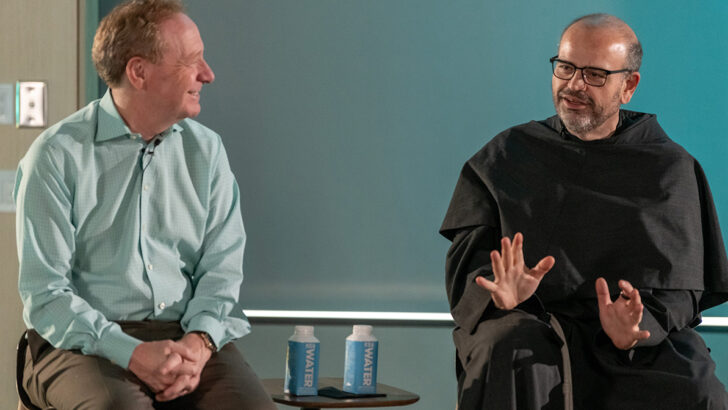
 Franciscan Fr Paolo Benanti, an adviser to Pope Francis on ethics and technology, speaks with Microsoft President Brad Smith about AI ethics at Microsoft’s campus in Redmond, Washington, July 23, 2024. Photo: OSV News/Blake Manning, Seattle University
 AI offers new possibilities, but technology must remain a servant of human dignity, not its master

Artificial intelligence (AI) is rapidly transforming the modern world. It is reshaping how people access knowledge, form beliefs, communicate with one another and discern what is true. Yet it also raises profound ethical, socio-anthropological and spiritual questions. As machines grow increasingly intelligent, a deeper question emerges: will humanity also grow in wisdom?
The Church now faces a pastoral challenge: proclaiming the Gospel in an AI-mediated culture.
The human person
AI can analyse enormous quantities of data, recognise patterns, generate language and perform complex tasks. Yet despite these capabilities, AI systems remain fundamentally different from human beings.
Machines do not possess consciousness, moral awareness or spiritual depth. They cannot love, forgive, hope or pray. Algorithms may process information, but they do not possess a conscience.
Christian teaching offers a clear foundation for this distinction. The human person is created in the image and likeness of God: “Let us make man in our image, after our likeness” (Gen. 1:26). Because of this divine origin, every human being possesses an inherent dignity that cannot be reduced to biology or computation.
As Gaudium et Spes teaches, the human person is “the only creature on earth that God has willed for its own sake”; no machine can replicate that dignity.
Intelligence and wisdom
A key challenge in the age of AI is understanding the difference between intelligence and wisdom.
Intelligence refers to the ability to acquire, process and apply knowledge. In this respect, AI systems are becoming increasingly powerful. They can analyse vast datasets and detect patterns far beyond ordinary human capacity.
For the Lord gives wisdom; from his mouth come knowledge and understanding”
Wisdom, however, is deeper than intelligence. It is the moral and spiritual capacity to judge rightly and to use intelligence for the good of others. It involves conscience, humility, responsibility and love.
Scripture reminds us that true wisdom ultimately comes from God: “For the Lord gives wisdom; from his mouth come knowledge and understanding” (Prov. 2:6).
Reflecting on the rise of AI, Pope Leo XIV has reminded humanity that technological progress does not eliminate moral responsibility. AI may assist human reasoning, but it cannot replace the human heart.
High-tech idolatry
The global race to develop ever increasingly powerful AI systems raises fundamental theological and ethical concerns. Technological progress can sometimes create the illusion that humanity can solve all problems through scientific power alone. There is a growing temptation to treat technology as the ultimate authority in decision-making.
Yet Christian teaching warns against placing ultimate trust in human creations. In Laudato Si’, Pope Francis cautioned against what he called the “technocratic paradigm,” a mindset that assumes technological power can replace moral reflection and human responsibility.
When societies place excessive trust in technology, a subtle form of modern idolatry can emerge: human creations begin to command the trust and reverence that properly belong to God alone.
Ethical challenges
The rapid development of AI also presents serious ethical concerns, including misinformation, algorithmic bias, privacy, surveillance and autonomous weapons.
AI-generated texts, images and videos can imitate reality with remarkable accuracy, while systems trained on existing datasets can reproduce social inequalities in sectors such as employment, healthcare or law enforcement.
The large-scale collection of personal data gives governments and corporations unprecedented power to monitor human behaviour.
Even more disturbing is the development of autonomous weapons systems capable of selecting and attacking targets without direct human control. Such technologies raise grave moral questions about accountability and the sanctity of human life.
The Church engages AI
Recognising these realities, the Catholic Church has highlighted the ethical implications of AI. The Vatican doctrinal note Antiqua et Nova, emphasises human dignity, moral responsibility and the common good must always guide technological innovation.
Hence, technology must never be steered solely by efficiency, profit or power, but always be ordered towards truth and justice.
The Rome Call for AI Ethics, promoted by the Pontifical Academy for Life, calls for AI systems to adhere to principles such as transparency, responsibility, inclusion, reliability and security.
Catholic organisations and research institutions are also fostering dialogue among scientists, AI developers, philosophers, and theologians. Such interdisciplinary engagement reflects the Church’s long tradition of bringing faith and reason into fruitful conversation.
Pastoral questions
Besides global ethical debates, AI is already entering the daily pastoral life of the Church. Clergy, pastoral workers, and youth ministers are beginning to encounter practical questions about how AI tools should be used.
Empathy, listening, grace and human presence. Authentic spiritual accompaniment cannot be delegated to machines”
Some priests may be tempted to experiment with AI systems to assist in preparing homilies or generating sermon outlines. While such tools may help with research or language refinement, the homily itself remains a deeply pastoral and spiritual act. It must arise from personal prayer, reflection on the Word of God, and the lived experiences of the faith community. No algorithm could replace the discernment of a shepherd who knows his flock.
Similarly, AI chatbots are increasingly used in society for emotional support or counselling. While such systems might offer general advice or information, pastoral care involves something far deeper: empathy, listening, grace and human presence. Authentic spiritual accompaniment cannot be delegated to machines.
AI-driven platforms can generate educational materials, design programmes or create interactive learning tools. Yet Christian formation is not merely the transmission of information. Faith is nurtured through witness, relationships and encounter with Christ within a living community. AI should not be rejected, but technology must remain a servant of pastoral ministry, never its substitute.
Christian formation
The rise of AI calls for renewed wisdom and formation among Christians. The faithful must cultivate critical thinking, deepen their understanding of Catholic Social Teaching and practise spiritual discernment. Prayer and reflection remain essential for navigating complex ethical questions in a rapidly changing technological world. As St Paul advises: “Test everything; hold fast what is good” (1 Thes. 5:21).
The Church must also continue promoting intellectual formation, particularly among clergy, educators and young people. Future leaders must be equipped not only with technological awareness but also with ethical wisdom and spiritual insight.
A call for wisdom
AI will continue to reshape the modern world. The deeper question is whether humanity will possess the wisdom to guide these powerful tools toward the service of life, truth and human dignity.
AI may expand our knowledge and capabilities, but it cannot replace the human heart, the human conscience or the human capacity for compassion”
As Pope Francis emphasised in his 2024 World Day of Peace message, AI must serve human fraternity and peace.
Reflecting on the future of technology, Pope Leo XIV, in his message for the 2026 World Day of Social Communications, offers a powerful reminder: no machine, however advanced, can grasp the full mystery of the human person, whose identity and dignity come from being created by God and called to love.
AI may expand our knowledge and capabilities, but it cannot replace the human heart, the human conscience or the human capacity for compassion.
In a world fascinated by intelligent machines, the Church must continue to proclaim a deeper truth: the future of humanity will not be determined by algorithms, but by the wisdom, compassion and moral courage with which human beings choose to use them.