

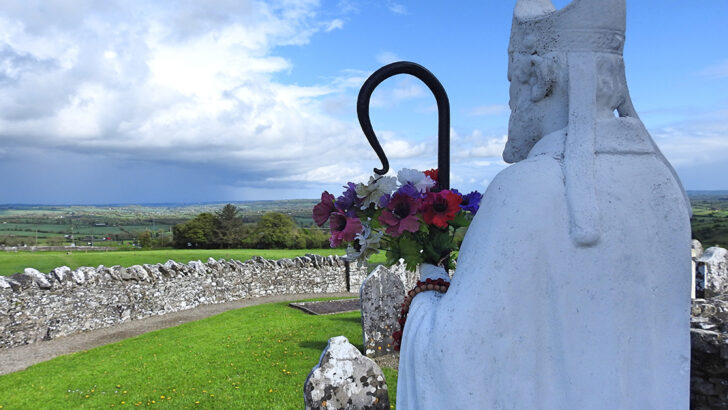
 St Patrick on the Hill of Slane with panoramic views of the Irish countryside in the background. Photo: iStock.
 Love of country is not nationalism, but a Christian duty rooted in gratitude, responsibility and charity, writes Fr Chris Hayden

Is there a love of country that occupies a sensible, reasonable, humane space, away from the extremes of unbridled nationalism on one hand, or nation-dissolving globalism on the other? For Catholics, the answer is a clear – yes. And not only are we allowed to love our country, we are obliged to do so. Properly understood and lived, love of country is a manifestation of love of God and of our fellow men and women. As the Catechism of the Catholic Church puts it, “The love and service of one’s country follow from the duty of gratitude and belong to the order of charity.”
This is an important point to assert, in this time when love of country is not uncommonly regarded as problematic, a rather low-status business. The expression of pride in our Irishness is regarded as acceptable; but love for Ireland? Is that a not a mask for some kind of political agenda?
Tainted
Indeed, love for one’s country can, like any human quality, become tainted. Just over a hundred years ago, Pope Pius XI wrote: “Patriotism – the stimulus of so many virtues and of so many noble acts of heroism when kept within the bounds of the law of Christ – becomes merely an occasion, an added incentive to grave injustice when true love of country is debased to the condition of an extreme nationalism.” Virtue of all kinds can be ‘debased,’ and when this happens to love for one’s country, the result can be an extreme nationalism.
Yet the teaching of the Church, which recognises this risk, does not go to the opposite extreme of suspicion or rejection; love of country has not been struck off the list of civic virtues. Again, as Christians, we can and must love our country, and it is no harm to assert this in the face of any political tendency to conflate love of country with extreme nationalism.
But how should we love our country? What does such love look like in practice? For the most part, it’s a rather humdrum, unglamorous affair, and in its sketch of the features of love of country, the Catechism lists submission to legitimate authority, sharing responsibility for the common good, payment of taxes, voting, and – when necessary – defending one’s country from aggression.
Esoteric
There is nothing terribly romantic – or, for that matter, terribly esoteric – about any of these. The last one, defending one’s country from aggression, might not be to the liking of committed pacifists, but this simply reminds us that the Church, while committed to peace-making, does not propose a thoroughgoing pacifism. While radical pacifism is a stance that has been held by many people of the highest integrity, the problem is that it runs the risk of allowing evil to thrive.
What light does love of country shed on the subject of immigration? Again, let’s hear the Catechism: “The more prosperous nations are obliged, to the extent they are able, to welcome the foreigner in search of security and the means of livelihood which he cannot find in his country of origin.” Here, an important moral principle is both asserted and qualified. And it is the qualification that prevents us from applying the principle simplistically, in support or rejection of any given immigration policy.
What is “the extent that they are able?” This, of course, is debatable, and in a small polity like Ireland, it is desirable that such debate take place – without the sacrifice of the moral principle. It would seem divisive and dogmatic to dismiss as ‘right-wing’ the mere wish to debate as significant a matter as an immigration policy. Moreover, such a refusal would hand the field over to more reactionary elements in our society.
The Catechism, we should also note, invites immigrants to share in the love of country; it states that they are obliged to esteem the “material and spiritual heritage” of their country of adoption, and to assist in “carrying civic burdens”. Properly read, this invites immigrants to make themselves very much at home.
Love of country is not an uncritical stance, and our Catholic tradition realistically acknowledges that public authority can overstep itself, in which case citizens can legitimately defend their rights and the rights of others. But here, too, the principle is qualified; an important statement of the Second Vatican Council insists that legitimate protest against state authority must be “within the limits of the natural law and the Law of the Gospel.”
Love
Our Catholic faith, then, insists that we can and must love our country; we can do so without apology. But in vain would we look to our faith for template, blueprint, strategy or policy. The overarching principle, which needs to inform debate and guide prudent deliberation, is that love of country is an aspect of the order of charity; it cannot be pursued in isolation from love of God and neighbour. This does not reduce love to a general ‘niceness,’ or preclude robust political debate and engagement, but it certainly makes the point that genuine goodwill needs to be a feature of all Christian concern and activism.