

 Peter Costello
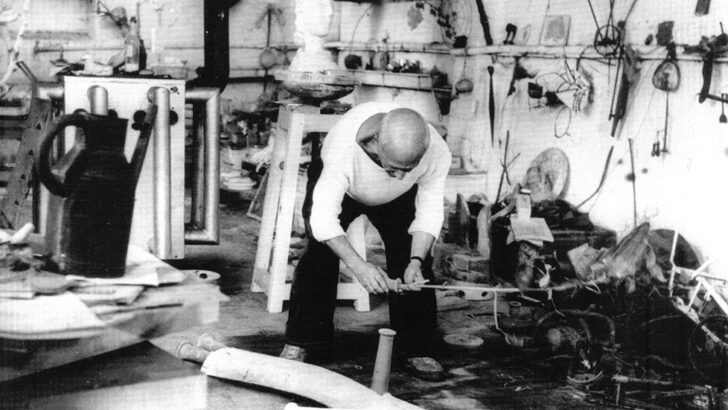 Picasso at work in his studio at Vallauris in 1954. Photo: André Villers / Musée national Picasso-Paris.
 Picasso’s long life of creative achievement
Of all 20th century artists the work of Pablo Picasso (1881-1973) is perhaps the most easily recognised. But for the ordinary gallery goer getting to see his important works of art usually involves a great deal of travelling from Paris and Madrid to Moscow and Tokyo and other far-flung places.

But this autumn and winter Picasso comes to Dublin, thanks to a joint enterprise of the National Gallery of Ireland (who own a few Picassos themselves) with the great Picasso Museum in Paris where the items left to the French state by the artist and his heirs are preserved. It is a rare show and one not to be missed.
Enlarges
It enlarges one’s idea of the Spanish painter is not so much his achievement but his way of working. This exhibition is subtitled ‘from the studio’, but in point of fact that studio was not a place but a state: wherever Picasso was at any one moment was where his studio was, for he was himself the studio. He seems to have worked every day from after lunch until late into the night. It has been estimated he was the creator of some 45,000 works of art in all (but this may not be a true total one suspects, as he would draw anywhere and on anything.
This show at the NGI runs from 1904 through the Great War, the Twenties and Thirties, and on through the succeeding decades, moving between apartments In Paris and large houses in the South of France. His last studio was at Mas de Notre Dame-de-Vie.
He was an obsessive collector of broken bits and pieces of the life around him, from which he would create his own works of art”
From these periods there are shown representative works, not great works in effect, but typical works, which give the visitor an excellent idea of how he lived and created, and what he achieved in several different areas, painting, sculpture, ceramics, drawings and etchings.
Françoise Gilot recalls going for rural walks with Picasso, wheeling their children’s pram, into which the artist would throw anything of interest scavenged along the way. He was an obsessive collector of broken bits and pieces of the life around him, from which he would create his own works of art. A photograph by his friend Andre Villiers taken in 1953 shows him in the studio at Vallauris assembling the bits and pieces that made up Woman with a Key (La Taulière).
Myth
This reminds one of that passage in Claude Lévi-Strauss where he talks about myth making being a matter of making use of bits of older myths, a form he says of bricolage, of creative ‘do- it-yourself’. Here in fact Picasso was connected with the earliest impulses in humanity towards making art.
Picasso’s achievement has been recognised in (among many others) such biographical accounts as John Richardson’s four volume unfinished life (1991-2001) and John Berger’s trenchant little work The Success and Failure of Picasso (1965); between them these books span the range of what can be thought and said about Picasso.
Aside from the art works which are the essential elements in the exhibition, gallery goers should not miss the filmed encounters with Picasso on two small screens. In one he is showing in a potter’s studio taking a newly thrown flower vase, and in a few swift moments transforming it into a dove, his symbol of universal peace, in what is a bravura display of confident artistic skill. This was a rare occasion – he was rarely photographed working. It is a quite magical moment.
Television
In a later interview with a French television journalist, he is asked what he thinks of television, the journalist expecting a disdainful comment. But Picasso admitted the family had bought a television set so they could watch Princess Margaret’s wedding in May 1960 – being among the 300 million viewers worldwide – and they had never given it up; he loved it.
He spoke as if he might have been a reader of Hello magazine, a devotee of celebrity culture. This is a reminder that we should never forget that Picasso, like so many of his creations, was many faceted, an artist who has to be seen in the round as well as the flat.
For those who might like to read a lighter account of the world of Picasso, David Douglas Duncan’s account of how his dachshund Lump refused to leave Picasso after a visit and settled down happily in the Picasso ménage as one of the family. It is recounted with Duncan’s own superb vérité images of the daily round chez Picasso. It is a delightfully amusing little book that would make an inspiring introduction to Picasso for an art-interested teenager.
Exhibition runs to February 22, 2026. (Beit Wing) Rooms 6-10 | Tickets from €5.
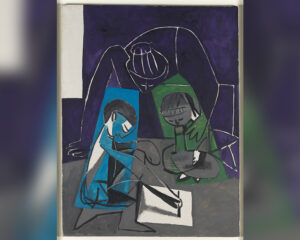
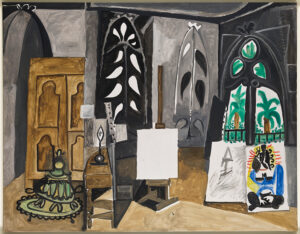
Picasso From the Studio,
by Janet McLean & Joanne Snrech
(National Gallery of Ireland in association with the Musée Picasso Paris, €37.50)
Lump: The Dog who Ate a Picasso,
by David Douglas Duncan
(Thames & Hudson, €20.70)