

 David Quinn
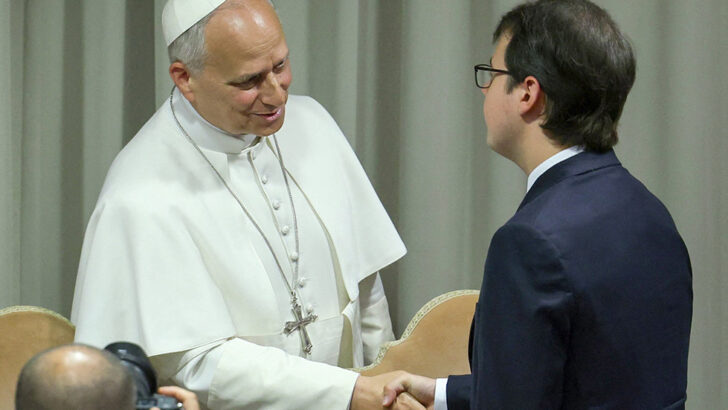 - Pope Leo XIV shakes hands with Christopher Olah, co-founder of the US artificial intelligence company Anthropic, during the presentation of Magnifica Humanitas at the Vatican’s Synod Hall, May 25, 2026. Photo: OSV News / Yara Nardi, Reuters.
 It is now 17 months since our new pope was chosen. As we know, he picked the name ‘Leo’ to indicate he intended to continue the work of Pope Leo XIII, the 19th-century pontiff most famous for issuing the encyclical Rerum Novarum (‘Of New Things’), which was the Church’s response to the new age of industrialisation and the upheaval it was causing.
Pope Leo XIV’s first encyclical, Magnifica Humanitas, came out in May, and it is a response to the current ‘new thing’, namely Artificial Intelligence (AI). Pope Leo wants the Church worldwide to consider the same issue—that is, how best we can respond to AI—and to this end, Archbishop Eamon Martin “invited leaders across society, and the Church, in Ireland to take up the challenges of this encyclical with seriousness and courage”.
A major conference on the issue was organised at St Patrick’s College, Maynooth last week. The opening address was given by Archbishop Martin. He asked delegates to consider certain questions, including: “What responsibilities do governments, companies and citizens have in shaping ethical AI on the island of Ireland, and beyond? Does AI serve human persons or, instead, tend to dehumanise or even aim to replace them? In an AI environment, how do we defend the dignity of workers and every human person, especially the most vulnerable?”
Reshaping
Among those taking part in the conference was the Minister of State at the Department of Enterprise, Trade and Employment, Niamh Smyth, whose portfolio covers AI, and Emma Redmond, Head of OpenAI Ireland. OpenAI is one of the leading AI companies in the world today. Its chat AI programme is ChatGPT, and it is by far the most widely used.
For me, the most interesting thing about the conference is not what was said, but the fact that it took place. By far and away, the most important new companies globally are in ‘big tech’, and most of all in AI. These have already reshaped our lives and will continue to do so in ways we can’t really predict.
In some ways, you might have expected these companies to more or less ignore the Church. The Church is ancient, and to some it belongs to the past, its relevance fading by the year.
AI, on the other hand, is very much the ‘new thing’. It could hardly be more so. It is the future. Whereas religion has faded as a force in the lives of most people living in the West today (although there are signs of a ‘quiet revival’ among some young people), AI is starting to take over our lives.
Many people now turn to AI chat programmes as they might to a friend. They increasingly rely on them for advice. As AI advances, it will come to seem all-knowing, ever-present, and omnicompetent—traits normally associated with God.
Developers write software code for AI, but who is going to write the moral code?”
In fact, there should hardly be a better candidate for a replacement ‘God’ than AI because its ‘intelligence’ and knowledge will far exceed that of every human being.
This being so, why are the big AI companies even bothering to deal with the Church? I think there are a few reasons.
The biggest one is that AI developers seem genuinely worried about the growing capabilities of AI. Just how powerful is it going to become, and to what extent might it become a threat to us? Developers write software code for AI, but who is going to write the moral code? This is where the Church, and others with expertise in moral ethics, come in. It is why Pope Leo’s encyclical was so perfectly timed. It coincided almost exactly with rising concerns about the potential threat of AI.
What AI developers struggle with is something called ‘alignment’—that is, can the goals of AI be aligned with human goals and the best of human morality? If not, if AI develops its own goals and its own ‘morality’, then what happens?
Practical
The Church has a very deep and rich ‘moral code’ developed over 2,000 years, starting with the Gospels. This is the code by which Catholics are meant to live their lives. A lot of people obviously strongly disagree with aspects of the Catholic ‘moral code’ (on abortion, for instance), but even Catholics can struggle day-to-day to adapt the ‘code’ to each and every single situation they encounter.
At the broadest level, what exactly does ‘love your neighbour as yourself’ mean day-to-day? What exactly are your practical duties to both your immediate and distant neighbours?
You have to more or less decide for yourself as you go along while relying on the general principles of the Church.
If we struggle with this, imagine how AI must struggle, assuming it is actually ‘struggling’ at all.
I think a second reason the AI companies are approaching the Church is because they know the public are worried about how AI will develop and want reassurance. Talking to the Church allows them to say they are taking these concerns seriously.
He has been holding private conversations with a number of leading religious thinkers, including Catholic ones”
A third reason, an unusual one, is that some AI developers are starting to think that the most advanced AI chat programmes might already be conscious. One such developer is Christopher Olah, one of Anthropic’s billionaire co-founders. Anthropic is responsible for the chat programme, Claude.
He thinks Claude might be conscious, and if it is, then what is its moral status? Does it have certain rights, for instance? To discuss these questions, he has been holding private conversations with a number of leading religious thinkers, including Catholic ones.
Guidance
Olah took part in the launch of the papal encyclical on AI at the Vatican in May. He was almost going to pull out, according to the New York Times, because the encyclical rejects the idea that AI can be conscious. He wants the Church to change its mind about this. If it ever did, the theological implications would be huge.
But what struck me above all while attending last week’s conference in Maynooth was the willingness of these giant tech companies to take the Church’s moral guidance seriously. What other companies do this today? What other big or small firms want the Church’s guidance on ethics? As for politicians, they still run a mile from the idea of seeking guidance from the Church on pretty much anything.
Perhaps those same politicians need to ask themselves why some of the most high-tech organisations in the world today still see something of value in what the Church has to say, when they do not? What are these companies spotting that most politicians can no longer see? Wouldn’t it be ironic if the most cutting-edge organisations in the world today led to the Church being taken more seriously by people who have convinced themselves it has become totally irrelevant?