

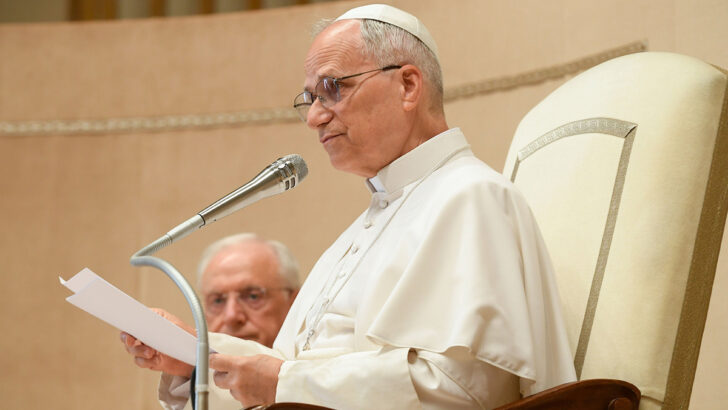
 Pope Leo XIV addresses the Conference of the International Inter-Parliamentary Union during an audience in the Hall of Benediction at the Vatican. He reflected on the ethical challenges posed by artificial intelligence. Photo: CNS/Vatican Media
By Dr Christopher Kwan Hoong Ng
Newly minted Pope Leo XIV has identified artificial intelligence (AI) as one of the most critical matters facing us. After taking the helm of the Catholic Church, the new Pope laid out the vision of his papacy:

“In our own day, the Church offers everyone the treasury of its social teaching in response to another industrial revolution and to developments in the field of artificial intelligence that pose new challenges for the defence of human dignity, justice and labour.”
By placing AI at the heart of his papacy’s mission, the Pope signals that the Church must engage these technologies and be a moral compass for a rapidly disruptive world.
Simultaneously, Pope Leo XIV has also indicated his intention to continue with the moral and prophetic voice of his predecessor, Pope Francis, who consistently called for ethical and responsible governance in the face of unprecedented disruptive technological change.
In his message for the 2024 World Day of Peace, Pope Francis warned of a world where algorithms could outpace our ethical reflection. The late pope cautioned that the unchecked development of AI could reinforce inequality, deepen surveillance, and de-personalise human interaction.
Vision
The papal vision of Pope Leo XIV appears to be one grounded in human dignity, the common good, and ethical responsibility – in effect, continuing the ethical legacy of Pope Francis.
These three principles are essential in navigating the complex terrain of AI. The prevalence of AI poses not just technical and economic questions, but also fundamental moral ones: What does it mean to be human in a world where machines can imitate reasoning, generate images and videos, and even influence decision making?
The pertinent parallel question would be: While artificially-intelligent computers might process multi-layered voluminous data at neural speed, will they be able to grasp the full mystery of the human person?
The Church’s teaching on temporal matters is often a critical discernment shaped by her centuries-old role as mother and teacher”
We should not be lulled into thinking that AI is neutral – algorithms are designed by programmers with specific assumptions, values and goals. While we recognise the need for discernment in spiritual matters, we must also importantly judge critically the adoption of technology, especially AI. When AI is deployed in areas such as health care, criminal justice or warfare, it has profound implications for social well-being and world peace.
The Church’s teaching on temporal matters is often a critical discernment shaped by her centuries-old role as mother and teacher, and helps ensure that technology and innovation remain as tools at the service of humankind.
Ramifications
As Pope Leo puts it, we must “weigh the ramifications of AI in light of the integral development of the human person and society, ”which includes not only material outcomes, but “safeguarding the inviolable dignity of each human person and respecting the cultural and spiritual riches and diversity of the world’s peoples.”
Thanks to the timely and focused effort of Pope Francis, a directional and discerning thesis on AI was issued by the Vatican in January 2025. The document, titled Antiqua et Nova (Note on the Relationship Between Artificial Intelligence and Human Intelligence) provides a comprehensive framework for AI’s ethical development and use.
In Antiqua et Nova, Pope Francis concretely advised that AI applications must respect human dignity, promote the common good, and that AI remains a tool to complement human intelligence.
We are tempted to replace human labour or judgement by AI; instead, we should be in favour of systems that support and enhance human labour, creativity and – importantly – unity”
Further, Pope Francis emphasised the need for growth in human responsibility, values, and conscience proportionate to the growth in the potential that AI technology brings – recognising that with an increase in human power comes a broadening of responsibility on individuals and communities.
The late pope encouraged the use of AI to benefit education, environmental stewardship, and social justice, but always within a framework that prioritises human well-being over efficiency or profit. This balance is delicate but it is essential. We are tempted to replace human labour or judgement by AI; instead, we should be in favour of systems that support and enhance human labour, creativity and – importantly – unity.
For a start, the new pope’s focus on AI is both bold and visionary. It is anticipated that Pope Leo XIV will build upon Pope Francis’ legacy of ethical concern and prophetic insight, reaffirming that the Church has a pivotal role to play in the here-to-stay digital age.
Dialogue
Pope Francis often said that the “future is not built in isolation, but in dialogue.” AI offers an unprecedented opportunity for such dialogue between technologists and theologians, scientists and ethicists, and believers and non-believers.
As AI continues to develop rapidly, the wisdom of Catholic social teaching, rooted in human dignity, the pursuit of justice, and the call to solidarity, remains a beacon of hope for humanity.
On the vital aspect of serving humanity, Pope Francis, in his message for the 2024 World Day of Social Communications, said that the wisdom of the heart could help us “to put systems of artificial intelligence at the service of a fully human communication”.
The Church’s role and thrust, under the stewardship of Pope Leo XIV, might well be a voice of conscience to convene these conversations, and keep them grounded in the deeper questions: What kind of world are we building? Will AI bring about the common good of humanity?