

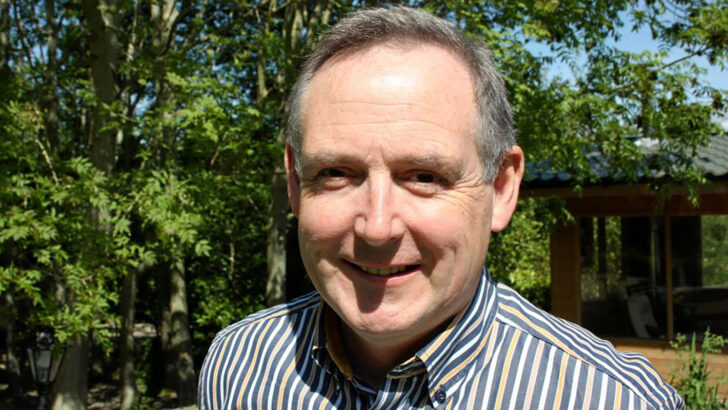
 Prof. Eamonn Conway.
 The final episode of the 2026 season of Education Nation brings listeners a rich and compelling conversation with one of the most authoritative voices in the world of Catholic education: Prof. Eamonn Conway, a priest of the Archdiocese of Tuam was appointed as the inaugural Professor of Integral Human Development at the University of Notre Dame, Australia in 2022.

Inspiration
On this, my first in-person meeting with Prof. Conway, I am struck by how at ease, authentic and grounded he is in conversation, even when discussing the abstract and cerebral. Listening to his story and his childhood memories of growing up on a farm outside Tuam you can see where this came from. His mother was a teacher in the local Presentation Convent, and his father’s sister was a Presentation Sister. He was planted in fertile ground. “That was a very important influence in my life,” he recalls. Though his father joked at his ordination that he would have been “a lousy farmer,” Conway credits those early years with giving him a deep “sense of nature, of the land, and of being part of the outdoors.” Farming’s loss is Catholic education’s gain, I suggest to him.
Eamonn’s schooling followed the path well-trodden by Irish boys of his generation: a primary education with the Presentation Sisters transferring to the Christian Brothers with whom he stayed for secondary. He remembers his education and many of his teachers as “fantastic… inspiring”. As a teenager he had imagined a future in electrical engineering. “No electric device could come into the house that I didn’t take apart,” he laughs. But the draw of priesthood—and the example of those he encountered in religious, especially priests like his cousin Enda Lyons, proved stronger.
The seminary years were marked by both intellectual growth and a moment of profound personal loss. His mother died when he was 21, something that forced him to confront the depth and meaning of his faith. “I remember thinking, ‘I want to be a priest—if God exists’. And that was a serious if.” He was ordained in 1987, one of a class of 45, at a time when Maynooth still held more than 350 seminarians.
He suggests that his progress along the academic path was almost accidental. “I forgot to stop studying,” he jokes. A master’s thesis on how God is at work in the lives of nonpracticing Christians led to doctoral work in Tübingen, where he immersed himself in the theology of Karl Rahner and Hans Urs von Balthasar. Rahner’s much debated idea of the “anonymous Christian” remains, in Conway’s view, deeply relevant today, though he prefers the German nuance of anonymous as “unnamed” rather than the English which suggests something is being withheld or hidden. Many people, he argues, live lives shaped by grace long before they can name it.
He has crafted a role which is centred on influence rather than on power”
After completing his doctorate, Conway was recruited to All Hallows College, where he spent seven formative years. He describes it as “a community of teachers and learners… open, inclusive, dynamic.” Later, he spent more than two decades at Mary Immaculate College, establishing and leading the Department of Theology and Religious Studies. He speaks with pride about the department’s popularity among arts students and its commitment to exploring “the deeper questions of meaning” that so many young adults hunger for.
In 2022, at the age of 60, Conway made a bold decision: to step away from institutional leadership and take up a new role at the University of Notre Dame in Australia. He had previously spent some time there as a visiting professor and was drawn to the strength of the institution’s commitment to ethos. Upon taking up this new role, he had one request of his new employer. “I said I wanted nobody reporting to me,” he laughs. “It was a lifesaver. I’ve had no stress.” Instead, he has crafted a role which is centred on influence rather than on power, his energies are not taken up by managing others but rather on mentoring colleagues, shaping staff formation, and helping the university to live out its mission.
Heart
Integral human development is at the heart of that mission. Notre Dame, he explains, is committed not only to academic excellence but to the intellectual, moral, spiritual, and physical flourishing of its 12,500 students and staff. “We want people to experience the university as a community where you are a continuous learner and a continuous teacher.” This holistic vision, he believes, is precisely what Catholic education can offer a world grappling with rapid technological change.
The conversation turns to Humanitas Magnifica, the newly promulgated papal encyclical on technology and human dignity. Conway had been watching the launch that very morning. “It’s wonderful,” he says, “that the Church is paying such attention to the moral and ethical implications of these changes.” Technology, he insists, is fundamentally a gift. The question is how we use it. “Our key task now is helping people choose wisely, how to engage with technology, how to make ethical decisions.” Catholic education is uniquely positioned to lead this conversation he believes. “We are blessed with this advantage,” he says simply, perhaps we need to stop apologising for that..”
As the conversation draws to a close, Conway’s passion for formation of teachers, leaders, and students comes into sharp focus. The GRACE Project, which he cofounded, has highlighted the urgent need for wellformed educators who can accompany young people in a complex world. Formation, he argues, is not an optional extra but the beating heart of Catholic schooling.
Prof. Eamonn Conway is the keynote speaker at next week’s conference in Marino which will celebrate and reflect on the GRACE Report.