

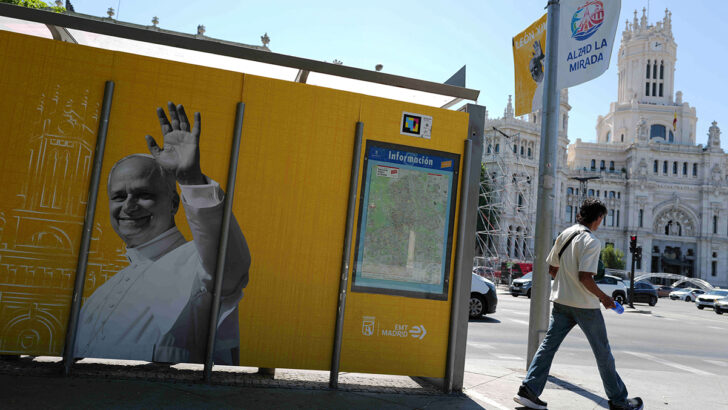
 A man walks past a poster of Pope Leo XIV in Madrid May 28, 2026, ahead of the pontiff’s June 6-12 apostolic visit to Spain. Photo: OSV News/Kacper Pempel, Reuters.
 Gonzalo and three of his friends earn pocket money in a rather unusual way for most university students. He sings in a traditional Spanish band, entering restaurants in a town northwest of Madrid known for its splendid history — San Lorenzo de El Escorial.

It is here where King Philip II of Spain built a spectacular pantheon — a massive complex containing the Basilica of St Lawrence, a royal palace and an Augustinian monastery — and the biggest Renaissance building in the world. The construction was the perfect embodiment of an alliance of the altar with the throne.
Just a few blocks from the grandeur of El Escorial, Gonzalo and his friends went into a local restaurant and, in a spontaneous moment, sang for a group of journalists — including OSV News — gathered over traditional Spanish fare in one of the town’s historic dining establishments. When asked how he felt ahead of the June 6–12 apostolic journey to Spain, Gonzalo responded without hesitation.
Speaking as a Catholic and a man of faith, he said, “I am very excited to be able to be with Leo XIV.”
Embodiment
Gonzalo is the perfect embodiment of the change observed in the Catholic Church in Spain in recent years, said Augustinian Fr Alberto Sánchez Sánchez.
“Something is changing in Spain regarding the relationship between religion and, above all, young people,” said Fr Sánchez. “Why do I say this? Well, because I see, above all, more participation from young people in religious celebrations and also less fear of identifying as a believer and as Catholic.”
He said that what Gonzalo testified to in a restaurant to a group of reporters would have been impossible a few years ago when young people were too ashamed to admit they’re Catholic in Spain.
During his June 6-12 apostolic visit to Spain, Church leaders say Pope Leo XIV will encounter a Catholic community at a pivotal moment. While the number of Spaniards identifying as Catholic has declined in recent decades, many observers point to signs of renewed interest among young people.
The Catholic Church in Spain has seen a sharp decline in numbers between 2011 to 2026, with a study conducted by the website Statista showing a 15.8% drop in those identifying as Catholic.
A comparison of the Spanish bishops’ conferences’ official activity reports from 2007 and 2024, showed that total yearly baptisms fell by roughly half, dropping to 159,693 in 2024, compared to 325,271 in 2007 (which the falling birthrates also contribute to).
The Spanish Church has lived through a few decades of having to situate itself in a new social, economic, and political context”
But while those numbers have decreased, the Catholic Church more than doubled its charitable and social assistance centers to 9,060, compared to 4,459 in 2007, and supports over 3.8 million people in need across Spain.
Archbishop Luis Argüello of Valladolid, president of the Spanish bishops’ conference, told a small group of media representatives via phone conversation that while the Spanish Church — 15 years after the last papal visit — “desires the coming of the pope with a special longing,” it is also a Church “caught at a crossroad.”
“On the one hand, the Spanish Church has lived through a few decades of having to situate itself in a new social, economic, and political context, which has meant that, well, we have shrunk on the one hand,” but on the other, Archbishop Argüello said, “we have observed in the last two years a desire, a search by younger generations to get closer to the Church.”
And in such a sense of the crossroad, he said, “the pope’s visit is going to be a splendid moment to encourage this entire missionary path of the Church in Spain.”
Heritage
“Spain has not ceased to be a country shaped by a Catholic cultural heritage, but it has ceased to be a society in which Catholic socialisation happens automatically,” Narciso Michavila, president and founder of the research and communications consultancy GAD3, said to OSV News.
That, he pointed out, is the great difference between today and the 1980s — when John Paul was bigger than any superstar and 2011 — when Benedict came for World Youth Day.
We are not witnessing a ‘mass return’ to religion, but we are seeing signs of partial desecularisation in some youth circles”
“Spaniards’ relationship with religion is now more elective than inherited. Faith is increasingly chosen rather than received through social inertia,” he said.
Among young people, he pointed out, “we are not witnessing a ‘mass return’ to religion, but we are seeing signs of partial desecularisation in some youth circles: interest in the liturgy, new communities, pilgrimages, music, social media and public expressions of faith.”
For Yago de la Cierva, general coordinator of Pope Leo’s trip to Spain, the Spanish Church today is also in a time of completely different challenges than when Pope Leo’s predecessors were arriving in the country.
“First, the society is different,” de la Cierva told OSV News. And secondly, “the church is in a different situation. We have good elements and sad elements,” he said, referring to dropping Church attendance and sacraments’ statistics.
“But at the same time,” he said, “there are many, many manifestations of a revival of old institutions and also new institutions.”
Revival
He said the signs of revival among young people are especially hopeful.
What brings them to the Church is the “lack of meaning in their own lives,” he said. “The Church, and many parish movements, are offering them … an emotional and welcoming environment,” as well as the sense of beauty which transcends especially through music, in many “new movements like Hakuna,” known for spectacularly beautiful performances, and a movement that will sing for Pope Leo in Madrid.
World Youth Day 2011, for which de la Cierva also was a key organiser, led the entire generation to the Church. Now, he said, Pope Leo can help stoke that fire anew.
Sara de la Torre, spokeswoman of the Archdiocese of Madrid, added, “There are also many figures in the world of culture — actors, singers, artists — who openly acknowledge their Catholic faith. Young people are no longer afraid of that search or of expressing it publicly,” she said.
‘if we compare it with the past of a tradition in which the throne and altar walked together’ – today’s ‘church at the crossroads’ is a ‘smaller community’”
“What is emerging is not so much a revival of tradition itself, but rather a renewed search – an interest in questions that previously did not provoke rejection, but indifference. Young people are asking: ‘I have doubts, concerns — what can faith offer me?’” she told a group of reporters, including OSV News, at Madrid’s archdiocesan headquarters.
Pointing out to the magnificent Catholic heritage of the Spanish state, Archbishop Argüello concluded that “if we compare it with the past of a tradition in which the throne and altar walked together” — today’s “church at the crossroads” is “a smaller community,” but “there is no doubt that it has the real possibility of being more significant.”
“And that is what the pope’s visit we hope will boost,” he said.
And that flame will be in the hands of young musician Gonzalo and his friends to carry on.