

 Nuala O’Loan
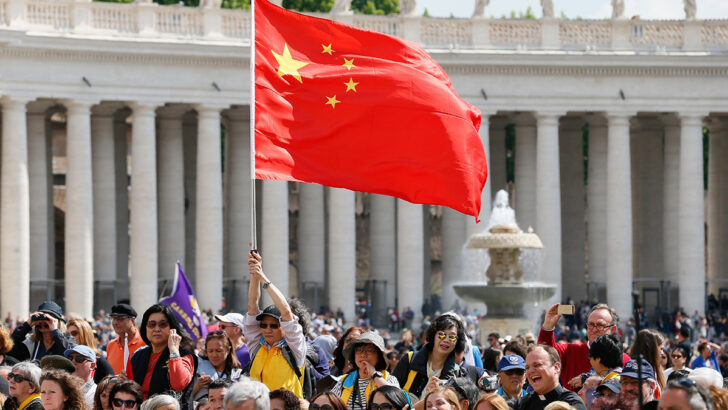 A visitor waves the flag of China in St Peter’s Square at the Vatican in this file photo from May 22, 2019. Photo: CNS/Paul Haring.
 How would you feel if, in order to practice your Catholic faith, you had to comply with a draconian series of laws which dictated whether there could be a church, who could be appointed as a bishop or priest, how priests were to be trained, when and where worship was allowed, who could belong to the Church, and what priests could preach and teach in the course of their ministry?

How would you feel if you went into a Catholic church and the crucifixes and images of God, of His Son – indeed all the images – had been removed or sidelined and replaced by pictures of a Communist President? If all the crosses on top of churches were removed , and Communist Party flags flew over the churches? What would your reaction be if your children could not be taught their faith in some cases even in their own homes?
This is what happens now in Communist China under the Chinese Communist Party (the CCP).
Ideology
Pope Francis entered into the Holy See-China Agreement on the Appointment of Bishops in 2018. The content of this agreement has never been made public, but under it bishops are selected, nominally by the Chinese Catholic Bishops Conference (an organisation regulated by the CCP which is not recognised by the Vatican), but in reality by the CCP, and approved by the Pope, who can veto appointments in theory but has never done so. These bishops are bishops of the Chinese Catholic Patriotic Association. They are regulated by the CCP as are their churches, their priests and their people. Catholics are only allowed to worship in Patriotic Association churches.
The international organisation, Human Rights Watch reported in April this year, presenting a terrifying picture of what it is to be a Catholic in China today, saying “A decade into Xi Jinping’s Sinicisation campaign and nearly eight years since the 2018 Holy See-China agreement, Catholics in China face escalating repression that violates their religious freedoms”.
Between them these regulations govern the operation of dioceses and religious orders”
It reports that the CCP has subjected clergy to intense political or ideological training, as frequently as twice a week in some locations. If they do not pass the training and pledge their primary loyalty to the CCP, they cannot minister. There is state control over religious materials; priests’ homilies and teaching must be approved by the CCP. In some areas Mass times have been changed, to make it difficult for people to attend. Children may not enter churches at all.
Since 2018 the CCP has adopted a series of laws: the Regulations of Religious Affairs (revised in 2018), Measures for the Administration of Religious Groups (2020), Measures for the Administration of Religious Personnel (2021), Measures for the Administration of Internet Religious Information Services (2022), and Measures for the Administration of Religious Activity Sites (2023).
Between them these regulations govern the operation of dioceses and religious orders. Their purpose is clear – to control the Catholic Church in China and, in many situations, to regulate it so that Catholicism will inevitably diminish, and communism will flourish.
Regulations
Article 3 of the Regulations on the Management of Religious Activity Sites states, “Religious venues shall uphold the leadership of the Communist Party of China, support the socialist system, thoroughly implement Xi Jinping Thought on Socialism with Chinese Characteristics for a New Era, abide by the Constitution, laws, regulations, rules and relevant provisions on the management of religious affairs, practice the core socialist values, adhere to the direction of Sinicisation of religion in China…”
In effect churches are to be organs of the state whose purpose is to promote communism.
Article 3 of the Regulations on the Management of Religious Personnel 2021 states that “Religious personnel shall love the motherland, support the leadership of the Communist Party of China, uphold the socialist system, abide by the Constitution, laws, regulations and rules, practice the core socialist values, adhere to the principle of independence and self-management of religions in China, adhere to the direction of Sinicisation of religions in China…”
Religious venues cannot be named after churches, sects, or personal names”
Article 12 of those Regulations states that religious personnel may not be “controlled by foreign forces, accepting appointments of religious positions from foreign religious groups or institutions without authorisation.” No room for the Vatican or its teaching there.
Every aspect of religious life is regulated – household registration books and resident identity cards of people and clergy must be presented to the CCP for approval before anyone can belong to the Church; information on every aspect of Church activity- personnel, finance, assets, accounting, archives, public security matters must be provided to the CCP; religious venues cannot be named after churches, sects, or personal names. Priests cannot leave China without permission from the CCP.
Underground
Those who refuse to pledge allegiance to the Chinese Communist Party and remain faithful to the Church belong to what is called the Underground Church. The CCP have for years pressured underground Catholic communities to join the Patriotic Association by arbitrarily detaining, forcibly disappearing, torturing, and subjecting underground Cardinals, bishops and priests to house arrest, forbidding them to minister at all.
One such underground Church priest was Fr Yu Heping. Ordained in 2004, he studied at the Pontifical University of Salamanca in Spain, gaining master’s degrees in Canon Law and Catholic Social Teaching. He returned to China in 2007 to the Underground Church, focusing on the formation of young Catholics, charitable outreach, and the continuing education of underground priests and religious sisters from across China. He was the webmaster of Tianzhujiao Zaixian, a popular Catholic web portal. It was shut down by the CCP.
Fr Yu must have known the danger he was in, but his courage in the face of such perils was absolute”
Under his leadership, underground Catholic communities from northern and southern China began working together on a scale rarely seen before.
In November 2015, while travelling to a meeting, Fr Yu, in normal health and having engaged with several people during the day, disappeared. His body was found in a river. It was reported that he had taken his own life. His family, and many others in the Underground Church, utterly rejected that suggestion. For 10 years his family sought to get his body back but the CCP refused unless the family signed a statement accepting that he had killed himself. Eventually one member of the family signed the statement and his ashes (not his body) were sent to them.
Fr Yu must have known the danger he was in, but his courage in the face of such perils was absolute. I have no doubt he was killed because of his priestly ministry.
The 2018 Agreement seems to have emboldened the CCP in its attempts to control, limit, even destroy Catholicism. It does not seem to have benefited the Catholic Church in China at all, rather it has empowered the CCP. Many people have spoken of these presumably unforeseen consequences. It is time for a review by the Holy See of what is happening to Catholics in China, and of the extent to which Catholic dogma and doctrine is being replaced by CCP ideology in the Chinese Catholic Patriotic Association.