

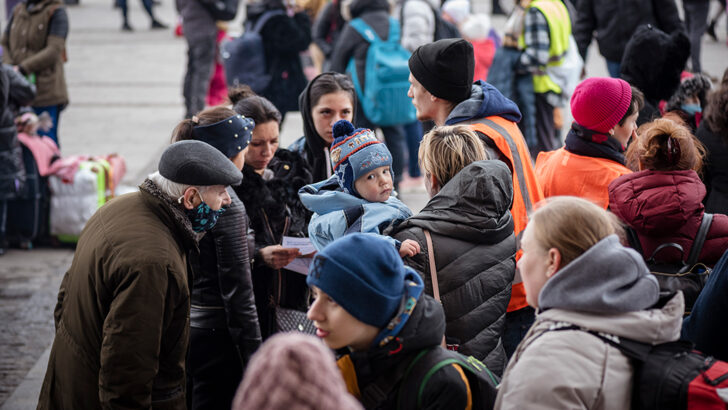
 Lviv, Ukraine - March 3, 2022: A young boy in a crowd of people transiting through Lviv stand outside the Lviv train station. Photo: Joel Carillet/IStock
 In the first week of August, delegates from Dominican Lay Fraternities across Europe gathered at Maynooth College for their four-yearly assembly. Representatives came from 21 countries, stretching from Ireland in the west to Ukraine in the east, and from Norway in the north to Italy in the south. The assembly was formally opened with Mass celebrated by the Archbishop of Dublin, who preached a homily that was both supportive and challenging, encouraging the delegates to reflect on their Dominican vocation and their responsibility to the wider world.
Over the course of the gathering, delegates listened to presentations and engaged in serious discussion on the theme of how lay Dominicans in Europe can be “Witnesses to the Truth and Prophets of Hope in a rapidly changing world”. For me, however, one of the most powerful moments came not during a formal presentation, but in conversation with a delegate from Ukraine.
Leave
I asked him how he had managed to leave the country. He is beyond military service age. He smiled and simply replied: “I walked.” He had taken a bus to a point close to the Polish border and then walked the remaining kilometres. “Walking is the quickest and safest way to cross the border,” he explained. By the time this article is read, he will have walked home again — back into a country still at war.
Members of the Dominican Laity in Ukraine reach out to soldiers returning from the front lines. They meet young men whose lives will never be the same. Some carry visible physical injuries, but all carry emotional and psychological scars. The delegate told me how wonderful it had been to get a full night’s sleep during his time in Ireland — a night not constantly interrupted by the sound of sirens warning of drone attacks.
Why
As we spoke, he would occasionally interrupt his own account with the words: “Why… for what reason?” Often the question seemed unrelated to what he was saying. Yet it became clear that it was the question running beneath his entire experience.
Eventually, I asked him about it. He had not realised that he had been repeatedly asking the question. He explained that he simply could not get his head around what had happened. One day, life had been continuing as normal. The next, there was war. He had never imagined that war would become his reality. Ordinary people had been getting on with their lives, raising families, working and making plans for the future. Then, suddenly, everything changed. “And for what reason?” he asked.
His question stayed with me after our conversation ended. It is a question without an easy answer — and perhaps one that people across Europe should be willing to hear.
For the Dominican delegates gathered in Maynooth, being witnesses to truth and prophets of hope is not an abstract calling. For some, it means returning to a country at war. For others, it means standing alongside those who have lost faith in institutions and feeling isolated. In a changing Europe, their witness reminds us that hope is not simply optimism. It is the courage to keep walking, even when the road leads back into uncertainty, and to continue asking difficult questions while refusing to give up on the truth.
Visa problems
I continue to engage with the difficulties surrounding the visa application for a young foreign Dominican whom we would like to come to Ireland to study. Our rules are so restrictive, because he is not a priest, he cannot apply for a religious visa and because our house of studies is recognised by the Vatican but not by the Irish State, he is also unable to apply for a student visa.
From the time of the ancient monasteries, Ireland has welcomed religious men from other lands to study theology before returning home to serve their own communities. It is part of our long and noble tradition of hospitality, learning and missionary outreach. Yet today, it seems that we are in danger of forgetting — if not actually rejecting — that heritage. A tradition that once saw Ireland as a place where religious and theological learning could flourish now appears increasingly difficult to navigate for those who wish to come from other lands here for precisely that purpose.