 Fr Dominik Domagala
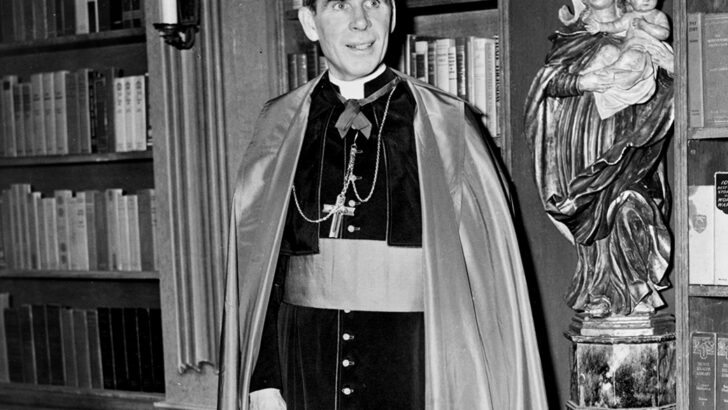 Blessed Fulton J. Sheen. Photo: OSV News /Library of Congress.
There is something remarkable about the timing of Fulton J. Sheen’s beatification. On the eve of the ceremony in St Louis, Pope Leo XIV mentioned Sheen during his General Audience in Rome. He did not speak simply about the American bishop as a figure from the golden age of Catholic television. Instead, he presented him as an example for the Church today: a bishop known for his evangelising work through the media whose “example and intercession” might inspire others “to find new ways of spreading the Gospel message with joyful enthusiasm”.
Those words deserve particular attention in Ireland. The question raised by Sheen’s beatification is not simply: How successful was he? Nor is it: Could we have another Fulton Sheen on television today? The more important question is: What made Fulton Sheen an evangeliser — and what might his example ask of the Church in Ireland?
More than a communicator
At the Solemn Vespers celebrated in St Louis on the eve of the beatification, Bishop Robert Barron described Sheen as “one of the pivotal players in the modern history of the Catholic Church”. He recalled that Sheen “opened the door to the evangelisation of the world through the electronic media”. At the height of his influence, Sheen’s television programme reached an audience of around 30 million people, while he received thousands of letters every day. Yet Bishop Barron deliberately refused to make this the centre of his homily. His purpose, he explained, was not primarily to speak about Sheen’s fame, but about what made him blessed.
It is much more challenging to ask why he communicated in the first place. For Sheen, Christianity was not an abstract philosophy or a collection of moral principles. It was friendship with a living person: Jesus Christ. The Christian life began, therefore, not with a communication strategy but with an encounter with the Lord.
And here the story becomes rather uncomfortable for the modern Church. We can learn how to use microphones, cameras, websites, podcasts and social media. We can study algorithms and discover how to reach larger audiences. Yet none of these things, by themselves, makes us evangelisers.
Holy hour
One of the most striking parts of Bishop Barron’s homily concerned something that, at first sight, has almost nothing to do with television. It was Sheen’s daily Holy Hour before the Blessed Sacrament. For decades, Sheen maintained a daily hour of prayer before the Eucharistic Lord. Yet the Holy Hour was not principally a place for producing ideas or achieving something. It was simply a place to be with Christ.
The missionary who does not know that he himself is in need of mercy eventually begins to proclaim himself rather than Christ”
Sheen compared the transformation produced by Eucharistic adoration to the face of Moses after his encounter with God. The person who remains before Christ is gradually changed by the presence of Christ. And there is a lesson here which Ireland urgently needs. We sometimes speak about evangelisation as though it were primarily a question of strategy. We ask how many people attend Mass, how many young people are involved, how many followers a parish has online or how many views a particular video receives. Who are we becoming before we begin speaking?
Bishop Barron described Sheen’s spiritual journey through three stages: first, the recognition of God’s holiness; secondly, the acknowledgement of one’s own sinfulness; and finally, the sending of the disciple on mission. First comes grace. Then conversion. Then mission. Not the other way around. The missionary who does not know that he himself is in need of mercy eventually begins to proclaim himself rather than Christ.
How close was I to the Cross?
Perhaps the most challenging aspect of Bishop Barron’s homily was his willingness to speak about Sheen’s weaknesses. Sheen’s autobiography was entitled Treasure in Clay. Sheen admitted his attraction to prestige and his enjoyment of being a bishop, a university professor and a popular public figure. He could say of himself: “I was popular. I was sought after.”
Then came the searching question: “But how close was I to the Cross?”
The Gospel does not become more true because millions watch it, nor does it become less true when only ten people are listening”
That question is more important than any television statistic. The modern Church can be tempted to measure evangelisation by visibility. Sheen reminds us that Christian fruitfulness cannot ultimately be measured by popularity. The Cross remains the measure.
This does not mean that the Church should be suspicious of success or afraid of large audiences. What it means is that visibility must always remain subordinate to fidelity. The Gospel does not become more true because millions watch it, nor does it become less true when only ten people are listening.
Duc in altum
Sheen’s academic formation provides another important lesson. When he went to Louvain, he wanted to study St Thomas Aquinas. But, as Bishop Barron recalled, his purpose was not merely contemplative. It was apostolic. He wanted to bring the wisdom of Aquinas into conversation with the great questions and dilemmas of his age. He deliberately studied the art, philosophy, science and literature of the secular world because he wanted to understand the people to whom he would speak.
This is very different from abandoning Catholic intellectual tradition in order to become fashionable. Sheen did precisely the opposite. He knew Catholicism deeply enough to explain it in the language of his contemporaries.
There are young people who can navigate the internet with extraordinary confidence but cannot explain who Jesus Christ is.
The answer cannot simply be to repeat the language of the past louder. Nor can it be to discard that language altogether. Sheen’s example suggests something more demanding: we must know the faith deeply enough to translate it faithfully into the questions of the present. This is what Duc in altum — “put out into the deep” — meant for Sheen. He was prepared to take the intellectual riches of Catholicism beyond the classroom and into the wider culture.
Ireland itself has become a mission field
Sheen’s understanding of mission went far beyond the television studio. As National Director of the Society for the Propagation of the Faith from 1950 to 1966, he travelled extensively in support of the Church’s missionary work. The boy from Illinois eventually became a missionary to the world.
That missionary consciousness is perhaps especially important for Ireland. For generations, Ireland was accustomed to thinking of itself as a missionary country. Irish missionaries taught, preached, built schools, established hospitals and founded communities throughout the world. But the missionary geography has changed. Ireland itself has become a mission territory.
There is another dimension to this pastoral mission. The people who are absent from our churches are not necessarily absent from our communities”
This is not simply a phrase to describe declining Mass attendance. It is a pastoral reality encountered by many Irish priests every Sunday. A priest baptises a child whose parents rarely, if ever, attend Mass. A couple comes to the parish office to arrange a funeral and discovers, perhaps for the first time in many years, that they are being asked to think about death, resurrection and eternal life. Teenagers receive Confirmation and then disappear from parish life.
And then there are the many adults who have not necessarily rejected Christianity. They simply never learned it. This is precisely where Fulton Sheen can speak to Ireland. He did not begin by assuming that his audience already understood Catholicism. Nor did he insult his audience by assuming that serious theology was beyond them. He believed that ordinary people were capable of thinking deeply when the truth was presented clearly, intelligently and beautifully.
There is another dimension to this pastoral mission. The people who are absent from our churches are not necessarily absent from our communities. They are in our workplaces, schools, hospitals, sports clubs and families.
The missionary Church therefore cannot simply wait for everyone to come through the door. Like Sheen, it has to go out. This does not mean turning every priest into a media personality. It means recovering the confidence to speak naturally about Christ wherever people are.
We should not romanticise the Ireland of the past. So our task is much more demanding. We are called to proclaim Christ within the Ireland that actually exists. He did not spend his life complaining that the world was changing. He entered the changing world and preached Christ there.
What would Sheen ask of Ireland?
Perhaps the most important thing about Sheen’s beatification is that it prevents us from turning him into a museum piece. Pope Leo XIV has asked that Sheen’s example inspire Catholics to find “new ways” of spreading the Gospel with “joyful enthusiasm. We have educated lay Catholics, talented priests, universities, Catholic schools, publishers, journalists and an enormous digital communications network.
But Sheen would probably ask a more fundamental question: Do we still believe that people need to hear the Gospel? Because if we do, then we cannot be embarrassed by it.
We cannot hide behind institutional language. We cannot assume that people will simply rediscover the faith because a church building remains open. And we cannot confuse maintaining Catholic structures with proclaiming Jesus Christ. Sheen’s great contribution was not simply that he knew how to speak to millions. It was that he believed that every one of those millions had a soul.
Changes
It changes something for us. It places the life of a holy man before the Church as an example and asks us what we will do with it.
For Ireland, perhaps the answer begins with recovering something Sheen never lost: the conviction that Catholicism is not merely an inheritance. It is an encounter with Jesus Christ.
We cannot spend all our energy asking why people have stopped coming to church. We must also ask whether we are going out to meet them. Fulton Sheen spent his life going “out into the deep” — from the classroom to the radio studio, from the television screen to the mission territories of the world, from the bishop’s office to the tabernacle.
The Church in Ireland now lives in a very different world, but the command remains the same: ”Go out into the deep.” We do not necessarily need another Fulton Sheen. But we do need Irish Catholics who possess something of his missionary imagination: the courage to speak about Christ, the intellectual generosity to explain the faith, the humility to recognise our own need for conversion, and the prayerfulness to remain before the Lord before we attempt to speak for him.
Christ is still waiting to be proclaimed.