

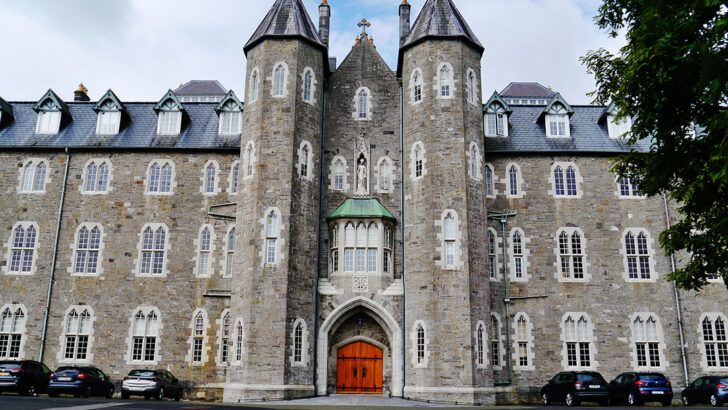
 St Patrick’s College College House. Photo: Wikimedia Commons / Zairon.
 I attended a double book launch in Renehan Hall, Maynooth College, on April 18. The authors were Dr Mette Lebech of the Faculty of Philosophy, Maynooth University, and Dr Robert McNamara of the Faculty of Philosophy, St Patrick’s Pontifical University. When the official proceedings were over, we dispersed to mix and mingle. Having happily paid my respects to the authors and many of the guests, I wandered over to talk to some of the seminarians. You see, my working life in Maynooth College for almost forty years was spent as a teacher in their company.

I introduced myself as someone who had taught their predecessors many years ago, in the days when — and this was just for our Seminarist course — there were between thirty and forty students in first year, diocesan and religious. Thirteen students, I knew, had started their formation this year. “Imagine,” I added, “in the space of one man’s working life, the number of vocations falling from such a high to such a low today. One man’s working life!” “Ah, you’d never know. Numbers might start to pick up again,” said a laudable optimist. “Well, I hope so,” I replied. “There are only three seminarians for Dublin, my diocese.”
Opportunity
Before we parted, I thought I’d seize the opportunity to put myself somewhere on the Maynooth map of today for them. “As you go down the corridor now, look up at the ordination class-piece for 2014. You’ll find me in the bottom row, between two other members of staff who retired that year or, in my case, 2013.” (The reader will kindly allow me to add here: I’ll be forever grateful to those who included me in it.)
“Did you teach Philosophy?” I was asked. “No,” I said. “I was appointed in 1974 to teach the Arts subjects English (obligatory) and French (elective).” I left it at that but will elaborate here. I taught in the Department of Seminarist Studies, set up in 1969. It offered a two-year course in Philosophy and Arts, leading to a diploma recognised by the Pontifical University. This ‘Sem. Course’ ran parallel to the three-year degree course in the National University of Ireland (NUI) part of the house. In 2018, the Sem. course changed to a full Faculty of Philosophy in St Patrick’s Pontifical University, (SPPU), separate from the one in NUIM (Maynooth University, MU). Gone now were the Arts subjects.
Next life
And gone to the next life by this time were the three full-time Philosophy lecturers in the department. Two were priests belonging to the Congregation of the Sacred Hearts of Jesus and Mary (SS.CC.), Frs Flannan Markham (d. 1995) and Patrick Bradley (d. 2010). The third, who succeeded Fr Pat in 1980, was Thomas Kelly (d. 2008). After nineteen years in the Sem. Course, he was appointed lecturer in the NUIM Faculty and rose to the top as Professor in 2007. His lasting mark on the Maynooth map is a grave in the college cemetery. The old order changeth . . . “May all go your way in Philosophy and, after that, in Theology,” I wished today’s seminarians.
I count myself so lucky, blessed even, that, without being a clerical student, I had — thanks to my mother seeing an ad seeking a teacher for St Patrick’s College — a completely unexpected calling to Maynooth which I lived out for nearly forty years to the best of my teaching ability.
Dining rooms are where we gather to share food in a family spirit, whether that family be domestic or communal. Maynooth College’s dining facilities changed as it expanded, especially after lay students were admitted in 1966. I dined first in a small low-ceilinged room capable of holding 30 at most. Years later, a very spacious upstairs hall near the Power House became the lunch-time rendez-vous venue for the lay staff of the college.
And finally came the big move to the splendid, palatial Pugin Hall once reserved for generation after generation of seminarians. Its unique character need not be in any way dimmed as a result. Rather let it be even more resplendent now as it opens wide its doors to welcome, in addition to the annual — let’s be optimistic — 15-20 seminarians, all manner of staff and students inheriting, while renewing, the over-225 years’ tradition of Maynooth’s communal family.