

 Brendan O’Regan
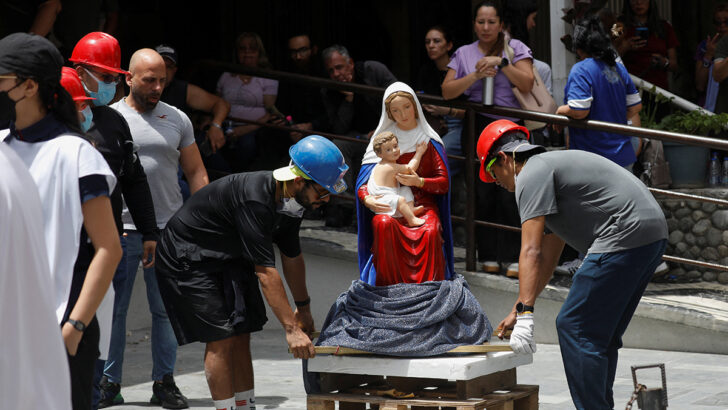 People transport an undamaged statue of Mary and the Christ Child near the site of a damaged building in Caracas, Venezuela, June 25, 2026, following 7.2 and 7.5 magnitude earthquakes that rocked the country June 24. Venezuelans searched for survivors beneath collapsed buildings June 25, and rescue teams raced to northern areas hit hard by the twin quakes that officials say killed nearly 200 people and left hundreds trapped. More were feared dead. Photo: OSV News/Fausto Torrealba, Reuters.
 The earthquakes in Venezuela dominated news and current affairs coverage last week, as the numbers of casualties rose daily.
On Sunday (BBC Radio 4) Edward Stourton, describing Venezuela as a mainly Catholic country, spoke to Bishop Carlos Marquez from Caracas, the capital. He said the Venezuelan people were noted for their solidarity, and that the Church there was providing support to the people and attending to their immediate material needs. They were working through the Caritas organisation and were receiving much help from agencies abroad, including a donation of a hundred thousand euro from Pope Leo. He said many churches had been damaged beyond repair and those that hadn’t been were used to provide shelter and accommodation. Asked if the political situation had been a factor in the response, he said it was more urgent to focus on solutions before determining responsibilities.
The same show picked up on another media-dominating event, the World Cup. Apparently domestic violence reportedly increases during such competitions “irrespective of victory or defeat”. That reminded me of a Reform MP in the UK getting into trouble for urging the England team to keep on winning to reduce incidence of domestic violence. Campaigner Sally Hope saw it as a chance for churches to increase awareness of the issue. She didn’t blame football per se for the problem, but one person choosing to exert power and control over another, combined with alcohol abuse and the masculine culture surrounding football. I was surprised to hear Stourton quoting research that suggested 71% of abusers used Christian teachings to justify or excuse the violence! Sally Hope pointed out that this was in situations where the victim was Christian and where theology was twisted and Bible quotes taken out of context. Interestingly she said that in forty years of church going she never once heard a sermon on domestic violence. Come to think of it, neither have I.
Stourton also covered the 250-year anniversary of the USA, and in particular the First Amendment which came later and declared separation of Church and State. To debate this, we got two Baptists – Dr Guthrie Graves-Fitzsimmons of the Interfaith Alliance and Pastor Mark Burns, a spiritual adviser to President Trump. It didn’t help that it became fractious – a more diverse panel would have helped. As it was, the participants fell into the typical polarised patterns of current American discourse. Pastor Burns described himself as a “spiritual diplomat”, supporting what President Trump had done for Christians and being critical of what he regarded as anti-Christian measures from previous Democratic administrations and corporate institutions. Dr Graves-Fitzsimmons thought religion was diminished if the Government took over religious matters, didn’t like the idea of the ruler giving favours to the religious leaders that toed the line, and was critical of the way the President had attacked the Episcopalian bishop that had presided over his inauguration and more recently attacked Pope Leo. He referenced Charles Carroll, the only Catholic signatory to the Declaration of Independence, who was barred from public office because he was Catholic. At one stage, Stourton intervened with a telling comment – that former President Joe Biden was “a faithful Catholic or at least a regular churchgoer”.
Another signatory of the Declaration of Independence was Thomas Mckean from Ballymoney in Antrim, who was the last man to sign it. His story featured on Sunday Sequence (BBC Radio Ulster) when Audrey Carville spoke to Prof. Richard Bell from the University of Maryland about the role of Ulster Presbyterian emigrants in the American Revolution. Some of these emigrants, not being Church of Ireland Protestants, were fleeing from religious discrimination in Ireland, some supported American independence on religious freedom grounds, some resented the relaxing of anti-Catholic measures in the colonies. Such issues are certainly more complex than any polarised discussions would suggest.
Evan Almighty (RTÉ One, Saturday) wasn’t high on complexities as it took newsreader Evan (Steve Carrell) from Bruce Almighty and has him visited by God, again played with appropriate gravitas by Morgan Freeman. There are some very funny scenes, especially in the early stages. It’s an entertaining and enjoyable reprise, with a soft environmental message mixed with a Noah’s Ark motif, more family-appropriate than the original, but missing the manic and comic energy of Jim Carrey.
On the plus side, a family film with a genial but challenging God character has a lot to recommend it.
==
Pick of the week
HEART OF A SERVANT: THE FATHER FLANAGAN STORY
RTÉ One, Monday, July 6, 9.35pm
The story of Irish priest Fr Flanagan and the impact he had on child welfare in the US by creating Boys Town.
EVERYBODY LOVES RAYMOND
Channel 4, Tuesday, July 9, 8.10am
The Sister: Debra’s hippy sister shows up unexpectedly and announces that she’s decided to become a nun. (S4 Ep6)
FRANCISCAN UNIVERSITY PRESENTS
EWTN, Wednesday, July 8, 8am and Friday, July 10, 10pm
The First American Pope: Dr Matthew Bunson, VP and Editorial Director of EWTN News and author of “Leo XIV: Portrait of the First American Pope,” explains how we came to have a Chicago-born pope.