

 Photo: iStock
 As a mother, I would do anything to spare my children unnecessary pain. Any parent knows the instinct to shield their child and the desire to absorb their suffering whenever possible. In many ways, this is what defines parenthood: the adult’s willingness to ‘suffer for’ a child’s good. Surrogacy, on the other hand, begins with a willingness to make a child suffer to alleviate an adult’s pain. That is why I cannot accept surrogacy in any form – not for heterosexual or same-sex couples, nor for single people. It is wrong in principle.

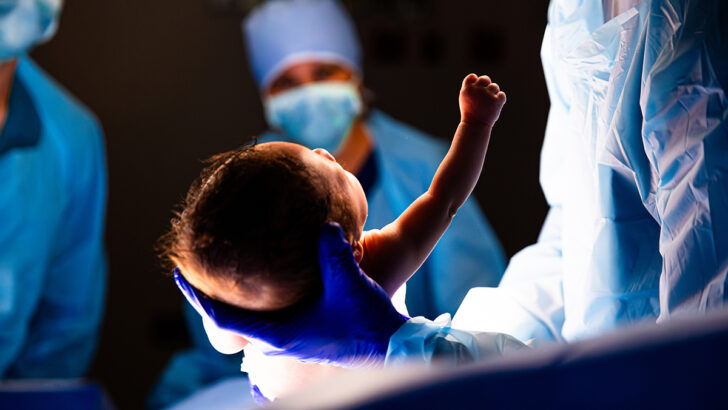
A baby does not ‘have’ a mother the way one has a favourite teddy that can be substituted. The baby and the woman who has carried and birthed that child exist in a profound unity. For nine months, the child’s entire world has been one particular body, one heartbeat, one voice. At birth, that bond does not evaporate; every fibre of their being longs for nothing more than to deepen it. From the moment of birth, and in the days and weeks that follow, a baby’s sense of self is bound up with the mother’s. To remove a newborn from the only mother they have known, sometimes within minutes or hours of birth, is not just a parting of two separate individuals. They are, in a real sense, one. Ripping them apart has a deep impact on the formation of that baby’s very sense of self and safety.
Scars
Early separation of a baby from their mother can leave lasting scars on the child’s emotional development. Surrogacy chooses to inflict this wound intentionally, leaving a void that is never fully filled. Many spend their lives circling this absence, longing for a connection that they were never allowed to keep. Even a loving bond with commissioning parents cannot fill that exact space, because it was not forged through the same biological, hormonal and neurological processes that would take place in the arms of the woman who nurtured their life within her.
We would rightly recoil at the idea of tearing a toddler from his mother’s arms. But we justify doing the same to a newborn as an act of love, so long as the adults involved have longed hard enough for that child. Of course, men and women who cannot have children deserve real compassion. But we should never seek to heal adult wounds by asking our children to bear our pain for us.
The willingness of would-be parents to commit such an intentional inversion should disqualify, not qualify, them for parenthood”
By planning the severing of a child’s first and most important relationship, surrogacy normalises making a child suffer to soothe an adult’s pain. This is an inversion of the parent-child relationship. The willingness of would-be parents to commit such an intentional inversion should disqualify, not qualify, them for parenthood. If I am willing to put my desire for a child above that child’s most basic need, have I really grasped what it means to be a parent at all?
We speak the language of children’s rights in almost every other area of society. We insist that their voices be heard in family law, that their welfare take precedence in education, healthcare and safeguarding. But for some reason, when it comes to surrogacy, the pressure to look the other way is always present. Ireland’s continued prohibition of commercial surrogacy is a testament to our instinct to protect the child. We should take care not to succumb to the pressure to close our eyes and hearts to the children at the centre of this issue in the name of equality and inclusivity.
This month, an overseas surrogacy and egg-donation agency was due to host a “path to parenthood” seminar for gay men in a Dublin hotel, including a “step-by-step” talk on international surrogacy. Our own laws recognise the harm of this practice, so why then is it being promoted in our nation’s capital at all? By hosting events such as this on Irish soil, mere exposure does the work of training us to see surrogacy as ordinary; as just an alternative way to begin a family, regardless of current law.
Acceptable
Psychologists have long observed that the more often people see something, the more familiar and acceptable it begins to feel. A practice that once ran contrary to our moral instincts can, over time, begin to seem unremarkable simply because it keeps appearing in front of us. Each time such surrogacy events are allowed to take place unchallenged, each friendly leaflet in circulation, each human-interest story promoted in Irish media, nudges the practice a little further into the category of ‘normal.’
This is how cultural drift happens. Something we once rejected as harmful is recast in our minds as ordinary, inclusive, even compassionate. Eventually, we will be told that anything but pro-surrogacy beliefs are out of date, that ‘modern Ireland’ has moved on, and that the law must be changed. The seminar in Dublin did not go unchallenged and was rightly cancelled by the organisers, but it will not be the last attempt.
If we really care about children’s rights, there is nothing left to consider”
Amid talk of laws, seminars and adult desires, it is easy to forget that, before anything else, surrogacy begins with a plan to sever a child’s first and deepest bond. Admitting the harm and pain this causes should bring an end to the debate. If we really care about children’s rights, there is nothing left to consider. The conversation should stop there, with a simple and necessary ‘no’ in defence of the child.
Kelly Henriques is a mother of four based in Sligo, with a BSc (Hons) and an MSc in Psychology.