

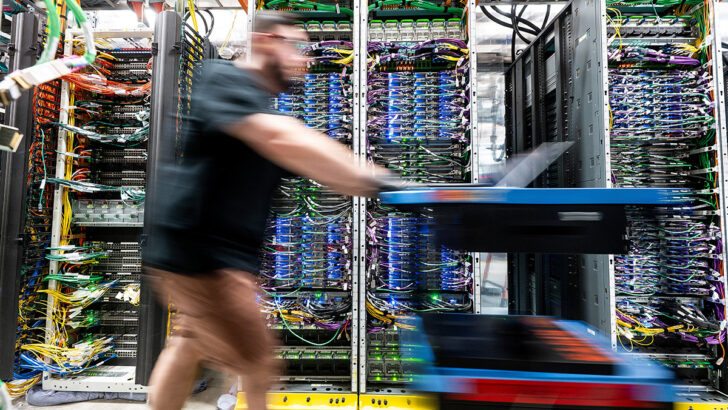
 A technician works at an Amazon Web Services data centre in Hermiston, Oregon, May 9, 2025. The explosion of massive data centres to handle the increasing generative demands of artificial intelligence has placed high demands on both power and the water used in cooling systems -- millions of gallons per day -- and low-income communities have typically endured the brunt of the air pollution they create. Photo: OSV News / Noah Berger for AWS via Reuters.
 Artificial Intelligence – the technology has revolutionised our modern day. A system that has impacted every generation yet left different people of different ages with different perspectives. For three of us Generation Z Intern Reporters at The Irish Catholic, AI has granted us feelings of disarray, contempt and an overarching sense of unease.

As we are in dire times with the cost of living, pressure to secure jobs and uncertainty about the state of the world, a technology like AI is adding more fuel to the fire of dysfunctionality.
One of the largest issues we are facing with AI technology is the damage it is causing to the environment. The adverse environmental effects of Artificial Intelligence are somewhat unknown to the general population, but are of grave concern to those aware.
With the development of AI data centres, we are seeing rapid changes to our planet. An AI data centre is a facility that holds IT infrastructure needed to train and deliver AI services. The Irish Catholic’s Alexa McAuliffe discussed how the damage these centres are causing to the environment is becoming irreconcilable.
Demands
“Electricity demands of data centres is a major cause of the environmental impacts of generative AI. They produce approximately 1% of the global energy greenhouse gas emissions,” she explained.
“The energy consumption used by data centres is expected to reach 945 TWh by 2030 according to the Global Sustainability School, which would exceed Japan’s current total energy consumption,” she stated.
Not only is the energy consumption distressing the planet, but the water consumption figures are unsettling. A UN report warns that by 2030, AI data centres could consume more water than every person on Earth each year.
“The energy servers are also desperate for cooling energy, leading to millions of gallons of freshwater being used for the purpose of generative AI. Data centres are using water to absorb the heat generated by the hardware, diverting its usage away from drinking purposes,” Ms McAuliffe explained.
While many laud AI for bringing great technological advances, another issue we find with Artificial Intelligence is the permissibility of a lack of academic integrity”
As a Melbournian resident myself, the issue of data centres is rather topical. Many people are protesting against the implementation of a new data centre hub in the city’s west that is set to span over 350 hectares. It’s going to need 2.4 gigawatts of energy supply – which is bigger than the largest coal-fired power plant in the whole of Victoria. Along with energy concerns come light and noise pollution, emissions and water usage issues.
While many laud AI for bringing great technological advances, another issue we find with Artificial Intelligence is the permissibility of a lack of academic integrity.
Literacy
The Irish Catholic’s Avery Gleason said that the decline in literacy rates among young children and teens is alarming.
“School systems have become, arguably, overly dependent on technology in the classrooms. Transitioning to an almost entirely online classroom experience has given students access to generative AI at a very young age, resulting in something called ‘cognitive offloading’. This is a term that means, in short, instead of the students doing the hard work, they outsource these tasks to AI platforms such as ChatGPT, Claude, etc.”
Ms Gleason said that this has resulted in the loss of the ability to analyse, a decline of reading comprehension, and children struggling with critical thinking.
Having a platform like ChatGPT at your fingertips is essentially like putting sweets in front of a child: too tempting”
“This poses a real threat to their futures in both education and the job market. If students become too reliant on this technology, higher education is going to be incredibly difficult for them and securing a stable job will be even harder.”
Further, Ms McAuliffe raised concerns over the prompt accessibility young people have to these platforms and how this is impacting them.
“Having a platform like ChatGPT at your fingertips is essentially like putting sweets in front of a child: too tempting,” she said.
“Fewer and fewer students are learning to think for themselves. The work they are submitting isn’t their own and they aren’t actively using the skills learnt in class nor practising critical thinking.”
Positive
However, on a positive note, some academic institutions in the United States are prohibiting the use of AI.
“As a result, schools and universities are putting in place stricter technological regulations. The Common Application (Common App), the platform used by most American universities for applications, has warned applicants against using any type of AI. They have recently implemented an AI scanner on submission of student work, and if AI is detected, the platform will terminate your account, notify all colleges on your list of the misdemeanour and potentially bar you from applying to school for the round of applications,” Ms McAuliffe explained.
Another absurdity that is a byproduct of generative AI is the concept of deepfakes. Ms Gleason discussed how the synthetic media are harmful to the wider community.
Voice cloning can be used in fraud scams and can be used to bypass security systems. Deepfakes can pose a threat in political realms by creating fabricated videos of politicians”
“AI deepfakes are a type of synthetic media that create hyper-realistic videos, audio, and images that can use other people’s images and voice without their knowledge or consent,” she said.
Ms Gleason acknowledged there are many different ways that deepfakes can be used that pose a threat to people.
“Voice cloning can be used in fraud scams and can be used to bypass security systems. Deepfakes can pose a threat in political realms by creating fabricated videos of politicians which can result in a shift in voter opinion,” she said.
Ms Gleason explained further the disturbing use of deepfakes. “That being said, arguably, the most disturbing use of deepfakes is that of non-consensual exploitation. This is when an individual’s face (and even sometimes body) is used to generate sexual content, which has been used to target both ordinary, everyday people and public figures. This can lead to blackmail, extortion, reputational damage, mental health problems, bullying, etc.,” she explained.
The creation of generative AI is undeniably a technological feat. However, as it becomes infused more and more in everyday life, it seems to be doing more harm than good. Still early in its creation, the potential threat of what AI may become creates great anxiety for the future. From the perspective of Gen Z, who has grown up with technology, it is essential to take time to research why AI may be a detriment to society and the environment rather than just simply a benefit of convenience to oneself.