

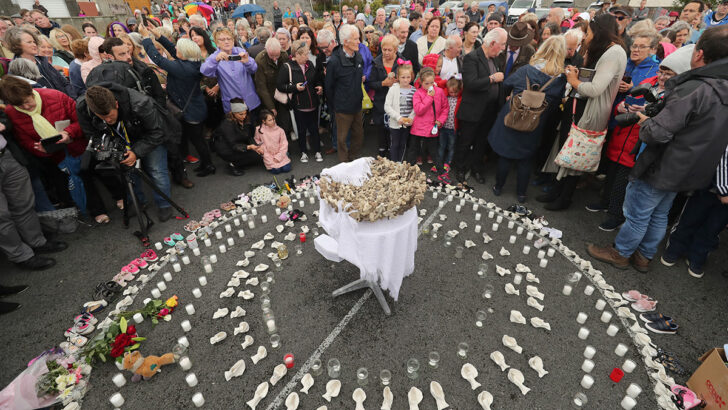
 People gather to protest at the site of the former state-funded, Catholic-run home for unmarried mothers in Tuam in this 2018 photo. Photo: CNS / Niall Carson, Reuters.
Just released in Irish cinemas, The Lost Children of Tuam tells the story of the local historian Catherine Corless and her investigation into the Bon Secours Mother and Baby Home in Tuam.

Few need an introduction to the story, more than a decade on from the initial burst of international media coverage about Tuam.
Even with the involvement of Liam Neeson as a producer, The Lost Children of Tuam lacks the Hollywood star power of Cillian Murphy’s 2024 film, Small Things like These.
However, it will still have an impact in reinforcing beliefs, even in cases where they conflict so sharply with established facts. This film is a moderately skilful case study in calumny.
Story
The film starts slowly and proceeds in like manner. The protagonist (played by the English actress Monica Dolan) embarks on a local history project relating to the Tuam Home.
A dark story unfolds as Corless digs into a distant past, and the story is interspersed with flickering imagery of women clothed in black.
There is no such excuse for omitting basic facts, but incorporating any of them would have contradicted this film’s overarching narrative”
While no actual abuse is shown, neither the direction nor the script is subtle.
Questions are asked by the protagonist and others, and statements are made. “What they did is evil.” “And they covered it up.” “Those children are in that septic tank.” “Where are the coffins?”
Had the film been made a decade ago, the speculative dialogue may have been justified.
Given that the State’s own 2,800-page report was published in 2021, there is no such excuse for omitting basic facts, but incorporating any of them would have contradicted this film’s overarching narrative.
As the State report makes clear, mother and baby homes “were not a peculiarly Irish phenomenon,” and there “is no evidence that women were forced to enter” them. There is also “no evidence of the sort of gross abuse that occurred in industrial schools.”
Report
In fact, these institutions, the report states, “provided a refuge – a harsh refuge in some cases – when the families provided no refuge at all.”
Zooming in further, a 63-page chapter is dedicated to the Tuam facility, and its contents do even more to raise red flags about this film.
In one scene, Corless asks nuns directly why the mortality figures were so high in Tuam.
Sr Hortense lobbied the local authority to install electric lighting. In 1947, she pressured them to increase the capitation grant”
This question does not need to be posed by Catherine Corless in the here and now, for it was answered not only in the report but in the Department of Health’s own inspection report from the early 1950s, which is quoted therein: “[A] number of causes were given for the high death rate, the ‘chief one being lack of pre-natal care, a cause which the authorities of the home cannot remedy.’”
That inability of the nuns to fix the problems is an important point. The Tuam Home was the property of the Galway County Council, and the official report makes clear how the nuns – and in particular Sr Hortense McNamara – fought to convince the state authorities to increase funding to improve the facility.
In 1927, Sr Hortense lobbied the local authority to install electric lighting. In 1947, she pressured them to increase the capitation grant to pay for provisions and clothing. In 1953, the Sisters were recorded as having tried and failed to get hot water installed.
Truth
Again and again, the nuns pushed for more funding, and found the agents of the State reluctant to provide it. A (female) departmental inspector in the 1940s identified numerous flaws – like the lack of an isolation unit – which were responsible for the high mortality rate, while specifically noting the good care provided by the “careful and attentive” nuns: “It is not here that we must look for the cause of the death rate.”
Modern-day Bon Secours Sisters are shown though, and demonstrate complete indifference to the plight of the dead children”
Neither this material nor the fond memories of Sr Hortense provided by witnesses (one former child resident described her as having “a heart of gold”) can co-exist with the story told in The Lost Children of Tuam.
What is accomplished in this film is not the distortion of truth but its inversion.
The long-deceased religious sisters are not portrayed, except in those sinister glimpses. Modern-day Bon Secours Sisters are shown though, and demonstrate complete indifference to the plight of the dead children, merely beseeching the heroine Corless to cease her investigation.
Right
In real life, of course, the Sisters of Bon Secours issued a statement in the aftermath of the state report’s release, which arguably went further than was appropriate in apologising for their own order’s members’ behaviour, while preempting the excavation by stating that children “were buried in a disrespectful and unacceptable way.”
Worldwide coverage about deaths of indigenous children in Church-run residential schools in Canada led to public fury and attacks”
The excavation at the Tuam Home began in July 2025 and is expected to last two years. Thus far, the remains of more than 100 children have been exhumed, and found to have been buried in coffins.
Time will tell what else is found, but there is little prospect of the historical record ever being righted regardless. Worldwide coverage about deaths of indigenous children in Church-run residential schools in Canada led to public fury and attacks on churches in 2021, but subsequent investigative findings at the Kamloops Indian Residential School have not proven the lurid headlines right.
Reaction
Truth is not a casualty but an afterthought here. This film has not been judged by its artistic merits any more than its factual basis.
The review which appeared in The Irish Times on September 25 appeared underneath an article where Emer McLysaght described her “seething rage” watching it, while adding that she and others left the cinema “ashamed of our country.”
Children died, and the nuns must have been responsible. Bodies are unaccounted for, and are surely in a mass grave”
Previous films have had a similar effect, and have done much to create the collective self-loathing of Ireland’s past which infects many in our society.
The Magdalene Sisters (2002) depicted nuns humiliating female residents by examining their naked bodies, holding a contest to see who had the most pubic hair and largest body parts. Small Things like These (2024) showed a pregnant girl locked in a coal shed. Of course, none of this ever happened.
It is no longer necessary to depict abuse, merely to conjure up images of it, and that is what The Lost Children of Tuam does throughout. Children died, and the nuns must have been responsible. Bodies are unaccounted for, and are surely in a mass grave.
Children
There is one final point which must be made. Towards the film’s conclusion, television footage of the vigil which Catherine Corless organised during the visit of Pope Francis in 2018 is shown. Among the marchers is a woman wearing a ‘Repeal’ jumper.
There have always been unplanned pregnancies and there have always been inconvenient children.
In the past, many unwanted children were disposed of by being sent to institutions. In today’s Ireland, many unwanted children are disposed of as medical waste.
At the very least, we should wake up to what is happening”
Adoption used to be unhealthily common while abortion was extremely rare. Now, domestic adoptions are practically unheard of, while the number of abortions rises steadily.
Those who are most vocal about the alleged wrongdoings of yesteryear are often the most vocally supportive of today’s crimes. Damning the past has become a means of justifying the present.
Catholics should not expect fairness from films like this. At the very least, we should wake up to what is happening, and not contribute to digging the Church’s reputational grave.