

 Photo: OSV News /Stephane Mahe, Reuters.
 The world is in turmoil. Europe is in chaos. Metaphorically speaking, a hurricane is raging all around us. How are we to respond? Certainly, there are those whose response is to enter into the fray. That can possibly be a legitimate reaction but it perhaps at times contributes to the chaos and confusion of our world.
The world around us is in a certain sense a reflection of the inner world of the individuals that make it up. When attachment to material wealth or power or fame or honour or pleasure abounds, so too does conflict. God is not in the conflict. Neither is He in the disordered desires that give rise to conflict.
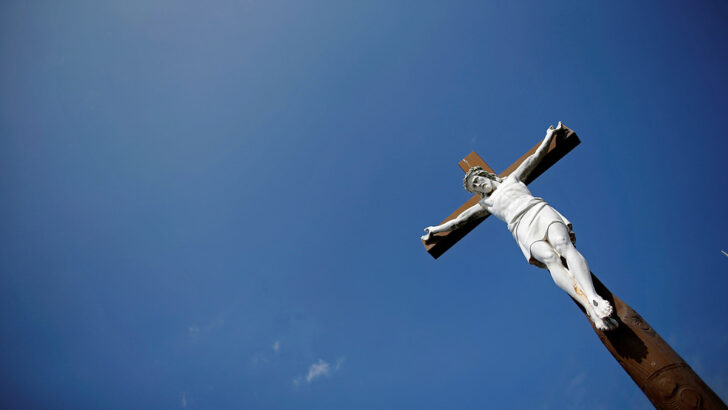
The Cross of Jesus is the source of all peace. Only by taking up our cross and following Jesus can we achieve inner peace and, by extension, peace with those around us. Taking up one’s cross means crucifying one’s disordered desires. St Paul, in his Letter to the Galatians, writes that “those who belong to Christ (Jesus) have crucified their flesh with its passions and desires” (5:24).
St Paul does not offer us a psychology of growth in holiness – what is referred to as the mystical ascent. Accounts of this ascent come later in the Christian tradition and they make it clear that growth in holiness is possible only by the power of sharing in the Cross of Christ. As the inner self is re-ordered and pacified, one hears the voice of the Lord in the silence that ensues. One encounters God in silence. The voice of the Lord resounds in the inner silence of one’s being.
Word
St John of the Cross famously expresses this experience in his ‘Spiritual Canticle’:
My Beloved is the mountains,
the solitary wooded valleys,
the strange islands,
the sonorous rivers,
the whisper of the winds of love;
the tranquil night
at the approach of dawn,
the silent music,
the sounding solitude,
the supper that refreshes and awakens love.
The Word, uttered in silence from all eternity by the Father, takes root in time in the silence of the hearts of the believer, a silence cultivated by detachment from worldly concerns, his “house being now at rest,” to adapt the poetic words of St John of the Cross.
There is a hierarchy among the Gifts: the most sublime is wisdom, which is caused by charity and has its essence in the intellect”
Indeed, not only is the Divine Word engendered in the soul of the believer, the inner life of knowing and loving of the Holy Trinity unfolds within it. The Holy Spirit, Who proceeds from the Father and the Son from all eternity, continues that process in time in the soul of one who is in a state of grace. What an ineffable mystery! We are caught up in a mutual indwelling: the Trinity of Persons dwells in the soul of the believer while the believer is plunged in the infinite depths of the Trinitarian dynamics of knowing and loving!
With grace, whereby the Holy Trinity dwells in the soul, the Gifts of the Holy Spirit are infused in the soul. There is a hierarchy among the Gifts: the most sublime is wisdom, which is caused by charity and has its essence in the intellect. Charity unites the soul with God. It plunges the soul into the depths of the Divine life. The intellect, elevated by faith, follows the will and enters into an ineffable knowledge of God and of His will that transcends ordinary knowledge. It is the dark knowledge of unknowing, as it were.
Soul
The soul animated by grace is attuned to Divine Wisdom. St Thomas talks in terms of connaturality: it belongs to wisdom as a gift of the Holy Spirit to judge aright about Divine things “on account of connaturality with them.” This connaturality entails a certain passivity or receptivity: one “suffers” divine things. The soul does not dictate the faith to God.
And it is the wisdom of the Cross that is the source of all true peace”
St Thomas associates each Gift with a Beatitude. The seventh Beatitude, “Blessed are the peacemakers,” is ascribed to wisdom. A peacemaker is one who makes peace either in himself, or in others. In either case, Thomas continues, this peace is a result of “setting in due order those things in which peace is established, for peace is the tranquillity of order,” an idea he draws from St Augustine. Since it pertains to wisdom to set things in order, whatever relates to peace is fittingly ascribed to wisdom.
The most sublime expression of Divine Wisdom is in Christ crucified, as St Paul teaches in 1 Corinthians. And it is the wisdom of the Cross that is the source of all true peace: “For in him all the fullness of God was pleased to dwell, and through him to reconcile to himself all things, whether on earth or in heaven, making peace by the blood of his cross” (Col. 1:19-20).
Fr. Kevin Eamonn O’Reilly, O.P.