

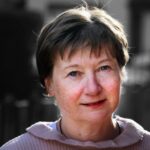
 Martina Purdy
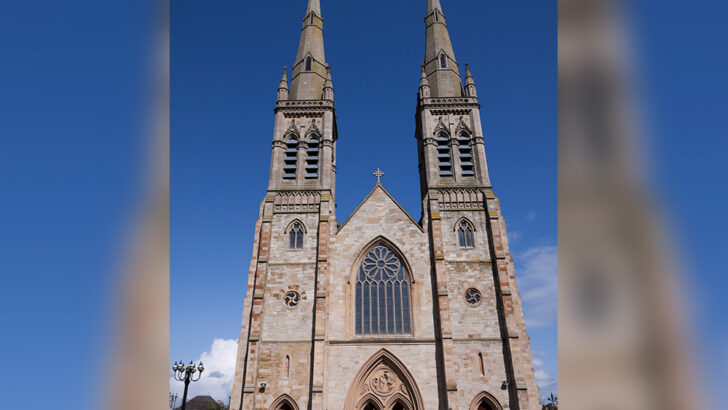 St Peter’s Cathedral, Belfast. Photo: iStock.
Ihe most popular version of the Irish republican song, The Foggy Dew, was penned by a priest at St Peter’s Cathedral, Belfast, which is about to mark its 160th birthday.
It was one of the many fascinating facts I learned on a recent tour, led by local historian Steven Corr.
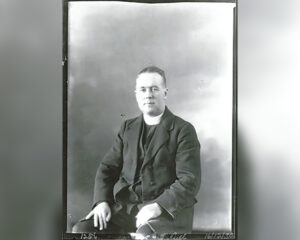
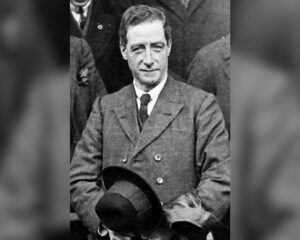
St Peter’s was forty years old when the Easter Rising took place and its curate, Fr Charles O’Neill, was among the priests who attended the first session of Dáil Éireann in January 1919, listening intently to the speech by leader Cathal Brugha TD.
Did that speech inspire the priest to write The Foggy Dew, commemorating the events of 1916? Our tour guide thought so. “When you see Cathal Brugha’s speech,” said Mr Corr, “you can actually see the words of The Foggy Dew starting to jump out at you.”
Fr O’Neill subsequently wrote the words for the modern version of The Foggy Dew while living at the parochial house at St Peter’s: “But to and fro in my dreams I go and I kneel and pray for you. For slavery fled, O glorious dead, when you fell in the foggy dew.”
The priest had help from the church organist, composer Carl Hardebeck, who reworked the traditional Irish melody. “It was a real meeting of minds,” said Mr Corr.
Creed
Hardebeck once said his creed was this: “I believe in God, Beethoven and Patrick Pearse.”
Hardebeck was born in London, of Welsh-German parents, and was blind from a young age. He had a great gift for music and had become the resident organist at St Peter’s in 1904.
Indeed, a retired Belfast schoolteacher, Eugene Dunphy, is preparing to publish a book shortly on Hardebeck who was known as ‘The Blind Bard of Belfast’.
On the Sunday after the Easter Rebellion, Hardebeck apparently delighted the congregation as they left Mass that Sunday.
“Hardebeck was up in the gallery,” said Mr Corr, “and at the end of mass instead of playing a recessional hymn, he played The Soldier’s Song.”
My great-grandparents, the Buntings, were likely among the congregation that day. They lived next door to the Cathedral, in Alexander Street West, a space that is now occupied by the parish youth club and hall – which contains the portrait of the wealthy Belfast philanthropist who provided the land for St Peter’s in the nineteenth century.
His name was Bernard (Barney) Hughes and his bakery sold the famous ‘bap’ to the poor families of Belfast, a black-crusted round loaf which was cheap and nutritious.
There was a collective intake of breath when we were told that the cost of building the Cathedral today would be £49 million”
Hughes – the first Catholic alderman in the city – bought the land from John Alexander, a wealthy Protestant who owned the biggest flour mill in Ireland and was originally from Milford, Carlow.
Hughes gifted the property to the Diocese of Down and Connor in 1858, as Catholics flocked into Belfast in search of work.
St Peter’s opened on October 14, 1866 – and was built of sandstone at a cost of £17,155 pounds. The guided tour heard that the Cathedral was recently revalued for insurance purposes. There was a collective intake of breath when we were told that the cost of building the Cathedral today would be £49 million.
The birth of St Peter’s coincided with rapid development in Belfast, once the fastest growing town in these islands. Belfast was in fact known as ‘Linenapolis’ for its flourishing linen industry.
Churches sprang up to meet the needs of the burgeoning Catholic population and religious congregations came to meet the needs of the poor, in education and healthcare.
Packed
Mr Corr said Belfast’s first Church – St Mary’s in Chapel Lane – was continually packed despite an exceptional number of Sunday Masses. Catholics began to move beyond the city limits.
St Peter’s was built in the Pound Loney, a district between the Falls and Shankill Roads. Loney comes from the Irish word for Lane (Lana). There was a nearby pound where animals for market were kept, hence the name.
This weekend – to mark European Heritage Day – the Cathedral will host two tours on September 12 and 13, this time led by Fr Brian Watters, who has served at the Cathedral for around a decade.
When the tour was first conceived for the Summer Feile, there was an expectation of five or six visitors a day – but at least ten times that number turned up and numbers grew across the week.
Many Catholics came with their own stories of St Peter’s Cathedral, around which the Troubles erupted in 1969.
In the previous thirty years, the Catholic population had increased five-hold”
One of the more famous funerals was that of Gerry Conlon whose Requiem Mass was held in June 2014.
Conlon was one of the Guildford Four, who were falsely imprisoned for the IRA bombings in England in the 1970s. Conlon’s story was told in the film, In the Name of the Father, starring Daniel Day Lewis, who won the Best Actor Oscar for his portrayal of the Belfast man.
St Peter’s Cathedral was itself conceived at a time of political unrest and sectarian strife in Belfast. Indeed, there was a degree of nervousness at the dedication in 1866. In the previous thirty years, the Catholic population had increased five-hold and thousands had gathered outside the Cathedral where the great and the good had gathered, by invitation only.
“The Belfast Morning News,” said Mr Corr, “described the opening of St Peter’s as the most spectacular event yet in the history of Roman Catholics in Belfast. It was a massive affair.”
By 1886, the famous twin spires – which survived Hitler’s bombs – were added to St Peter’s stretching its height to 50 metres”
St Peter’s predated the city hall by twenty years and was lit by more than 300 gas lamps. The arrival of Cardinal Cullen from Dublin, in a horse-drawn coach, was greeted with such a roar that those inside the Church feared it was under attack.
St Peter’s was officially dedicated by Bishop Patrick Dorrian (whose Coat of Arms is on the parish hall, along with many others, the oldest of which dates to 1673).
St Peter’s was then a pro-Cathedral (it was not conferred Cathedral status until 1986).
By 1886, the famous twin spires – which survived Hitler’s bombs – were added to St Peter’s stretching its height to 50 metres (165 feet).
One of the quirks of St Peter’s stained-glass window depicting the risen Christ in the garden with Mary Magdalene – designed by the late Róisín Dowd Murphy – is that the Lord has two left feet.
The bells of St Peter’s rang out at the end of our tour – and I felt a great nostalgia for this traditional call to prayer, a beautiful sound that sadly, is no longer commonplace in the city.
===
On a wall inside St Peter’s, to the right of the altar, there is an ambry, a small cabinet with holy oils, dedicated to the memory of two priests shot dead by the British Army during the Troubles.
Our guided tour heard that an icon has been commissioned by the Diocese of Down and Connor depicting Fr Hugh Mullan and Fr Noel Fitzpatrick with the Good Shepherd. Written by Fr Anthony Alexander, the icon is expected to be formally installed in the Cathedral in the near future. There were also hints of a process involving Rome in the next few years, though it is at an early stage.
Fr Mullan (38) was a curate at Corpus Christi Church in Ballymurphy when he was shot on August 9, 1971 by the British Army’s Paratroop Regiment. The tragedy is known as the Ballymurphy Massacre as it involved ten victims. Fr Mullan was giving the last rites to parishioner Bobby Clarke and was said to have been waving a white flag to indicate his intentions when he was killed.
He was the first Catholic priest to be shot dead in the Troubles and a 2021 inquest ruled that all ten victims that day were entirely innocent.
On July 9 1972, Fr Noel Fitzpatrick (42), also serving at Corpus Christi, was shot dead, along with four parishioners, three of them teenagers. Fr Fitzpatrick was killed as he went to give the last rites to Margaret Gargan, aged 13.
In April of this year, an official inquest ruled all the victims were innocent. It also concluded that the soldiers had “lost control,” using force that was in violation of military rules.