

 Mary Kenny
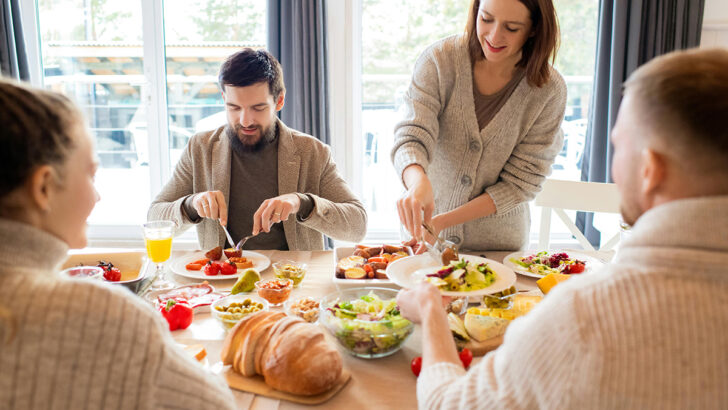 Photo: Pexels / Alexy Almond
 I had a rather dull chicken dish last Sunday for my main meal, and, according to an Irish master butcher, Seán Kelly in Co. Mayo, this is increasingly typical. People are, he says, ditching lamb and roast beef in favour of chicken, because it’s cheaper (if more tasteless).

Disappointingly, Mr Kelly suggests that the tradition of the Sunday family roast is disappearing. Once, the leg of lamb would be routine on a Sunday, as would the joint of beef. But now “the leg of lamb is hardly ever sold now,” he told Charlie Weston of the Irish Independent.
Not only are family budgets strained, but families don’t sit down to eat together as much as they used to, he claims. People are more inclined to eat “on the go” – sometimes called “grazing”.
Studies
Yet there have been numerous studies which have found that family meals together – especially the ritual of the “Sunday roast” – enhance family bonds, and also teach discipline. These were occasions when parents set out certain rules of table manners, such as ‘no elbows’ on the table, and being considerate about helping others. (Nowadays, parents might struggle to impose a ‘no phones’ rule – or even adhere to it themselves.)
Youngster
As a youngster, I learned a lot listening to my older siblings discourse around the family meal-table, when the conversation was often lively.
When my kids were young, many is the Sunday roast I served up, and we nearly always had guests and extended family members too. These were bonding occasions; and I discovered that all you had to do to produce a satisfying meal was to purchase high-quality beef or lamb, and time the cooking properly.
Lamb has risen by 52% since 2021. I’ve seen supermarket security tags on meat because it’s so pricey”
True, the family mealtime can be occasions of argument too, especially if alcohol is involved. The famous “Parnell” scene in Joyce’s Portrait of the Artist is a classic description of how verbal conflict can fiercely unravel.
You can’t blame people for reluctance to eat beef and lamb, considering the rise in price – lamb has risen by 52% since 2021. I’ve seen supermarket security tags on meat because it’s so pricey.
Eating patterns are changing, but hopefully the tradition of the family meal will endure. The symbolism of ‘breaking bread together’ goes back a long way.
**
The singer Tommy Fleming has announced that he is a gay man, and that his 20-year marriage to his wife, Tina, is over. He said that he had been “living a lie” during his marriage.
Some men in the past took a different course, admittedly when homosexuality was taboo. The great lyricist Cole Porter was gay, but he loved his wife and they stayed together, happily.
John Maynard Keynes, the famous economist, was described by his biographer as having been “a promiscuous homosexual” in his youth, yet he married the ballerina Lydia Lopokova, and they had a happy marriage (although their baby sadly died in infancy). Bosie, Oscar Wilde’s boyfriend also subsequently married a woman (and became a Catholic) – he too lost a newborn infant.
My husband’s great-grandfather, the Victorian literary figure, John Addington Symonds, was homosexual in orientation, but married and had four daughters, who loved him, and nursed him in illness. He probably was unhappy about the hidden side of his nature, yet he was cherished in his family life, which was some consolation.
We live in different, more candid, times, and Mr Fleming must follow his conscience as he sees fit; many people applaud him for doing so. But emotional – and family – attachments can be more complex than sexual orientation alone.
**
A new dark age
Glad to see that Prof. Nigel Biggar, an ordained Anglican, got to speak at UCD (as reported by The Irish Catholic) on the perils of a new “dark age”, when debate around gender and race may be disallowed. His book of the same title contains much interesting information, and some shocking examples of misinformation.
In May 2021, it was reported that the remains of 215 children from the First Nation indigenous people had been found at Kamloops in British Colombia, Canada. These were claimed to be undocumented deaths, possibly murders, occurring at a residential school run by a Catholic religious order.
Prof. Biggar writes that the mainstream media “sexed up” the story into a “mass graves atrocity”, and the “tip of the iceberg” in maltreatment of indigenous children. Justin Trudeau ordered flags to be flown at half-mast in response, and Al Jazeera amplified the story globally.
In consequence, a hundred Christian churches were burned or vandalised as revenge attacks.
Four years later, after forensic investigation, it emerged that there was no evidence that any atrocity had occurred or that any children had been killed and left in unmarked graves. The Kamloops story was a “myth” – yet quickly believed because it suited an agenda of “colonialism”, and anti-Christian bias, as Prof. Biggar points out.