

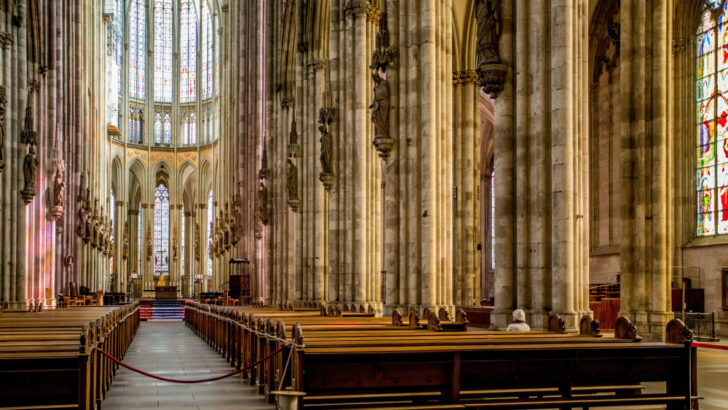
 A woman prays in a pew at a nearly empty cathedral in Cologne, Germany, March 16, 2020, during the COVID-19 pandemic. (CNS photo/Theodor Barth, KNA)
 When Covid-19 reached Ireland six years ago, this country responded with a solidarity that surprised even ourselves. We closed our doors, cancelled our funerals, queued in the rain and checked on neighbours we had never spoken to, all in the name of protecting the vulnerable and saving lives. We can debate the necessity of some of the restrictions at this remove, but it was, as the Irish bishops recall in their statement ‘Offering Hope in Crisis’ ahead of the Day for Life, a horrible time — but also a time of extraordinary collective effort.

The bishops then place a second set of figures beside the first, and the comparison is uncomfortable. Covid claimed almost 10,000 lives in Ireland. Since 2019, well over 50,000 unborn lives have been ended through abortion — the equivalent, as they put it, of nearly 2,000 classrooms of children. One crisis mobilised the entire apparatus of State, media and community. The other has provoked no crisis response at all. The bishops ask why. It is a question that deserves a better answer than silence.
Silence
Indeed, the silence is itself the story. Ireland is a country that researches everything. We commission studies on commuting patterns, gambling habits, screen time and hedgerow density. The ESRI and the universities map every corner of Irish life in exhaustive statistical detail. Yet, as the bishops observe, in a society otherwise collapsing under the weight of research, there has been no serious attempt by the State or the mainstream media to find out why more than 90% of abortions here take place in the first twelve weeks, what leads women to that decision, or what happens to them afterwards. Eight years on from repeal, we count the procedures but ask nothing about the people. That is not neutrality. It is a studied lack of curiosity, and a modern, sophisticated society should be ashamed of it.
Because the question matters. The most natural instinct in the world is for a mother to protect her child. When tens of thousands of Irish women act against that instinct, the honest response is not to file it under “choice” and look away, but to ask what pressures are bearing down on them. The bishops gesture towards the answers — loneliness, economic difficulty, domestic violence, addiction — and behind those private struggles stands a public failure. Successive governments have presided over a society in which raising a family has become punishingly expensive: housing among the dearest in Europe, childcare costs that amount to a second mortgage, and an economic model that quietly assumes two full-time incomes and treats a child as an awkward interruption. It is not so long ago that the Government’s contribution to this debate was to ask the people to delete the reference to mothers from the Constitution altogether — an invitation the electorate, to its credit, firmly declined. A State that cannot find room for mothers in its founding document should not be surprised when women conclude there is no room for motherhood in its economy.
The left in Ireland – and now Sinn Fein this week – want to widen the scope of our abortion law so that the three day wait is removed. You wait a week to have your bins taken out but aborting a human life should be an on-demand service with no waiting period according to the left which seem to prey on the unborn because they have no viable policies for improving the lot of their constituencies who struggle with all the issues that the bishops point out contribute to a woman taking the decision to abort.
Nor is the unborn child the only life being quietly re-categorised. In other jurisdictions we now see where the logic leads: in Canada, elderly and ill people — some with treatable conditions, some citing poverty or lack of housing — have been offered assisted death (M.A.I.D) as though it were one option on a care pathway. When a society stops asking why the vulnerable despair, it ends by offering them efficient ways out of existence. This is the Irish left’s agenda, a culture of death.
This is precisely what Pope Leo XIV named when he addressed members of the Spanish Parliament recently. “The defence of human life is neither a partisan issue nor a confessional interest: it is a goal of civilisation,” he told them, adding that when the certainty that every life must be safeguarded from conception to natural end is obscured, “the most vulnerable are the first victims, and the law loses its deepest meaning: to serve and protect every person.” It was a bracing message for a secular parliament, and by all accounts not a universally palatable one. The truth rarely is. But people of goodwill recognise it when they hear it.
Caricatured
The Church is routinely caricatured as backward on questions of life and birth, a relic lecturing a world that has moved on. Yet on this question it is the Church — almost alone — asking what everyone else refuses to ask, and quietly doing what the State will not: supporting women in crisis pregnancy and accompanying those seeking healing afterwards, through agencies the bishops rightly commend to our generosity. That is not backwardness. It is prophecy: the stubborn insistence that a better world is possible, one in which every child is wanted and allowed the life they have been gifted, and in which ending that life is recognised not as a routine medical procedure but as the denial to society of its own future.
This Sunday, the Day for Life, the bishops invite Ireland once again to choose life. They are right to ask their question. The scandal is that nobody else is asking it or wants to ask it.