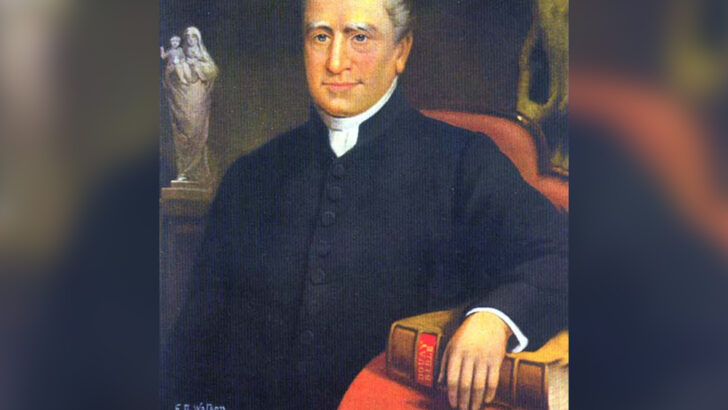
 Portrait of Edmund Rice by S.R Watson.
 From Memory to Understanding: A Study of the Christian Brothers in Ireland 1922-1970,
by Tom O’Donoghue
(Gracewing, UK, 2026)
This is an important book on the long history of the Christian Brothers. It attempts to tell the whole story about their creation, spread and effects here in Ireland and indeed abroad, from their foundation at a critical moment in Irish affairs just after the Act of Union.
With the support of Thomas Hussey, Bishop of Waterford and Lismore, Edward Rice established the religious order of the Irish Christian Brothers at Waterford in 1802. One of the important aims of the Irish Christian Brothers was to provide education for poor boys. Their first school was opened in Callan, Co. Kilkenny, in 1882 and was later transferred to Mount Sion in Waterford City.
On August 15, 1808, seven men, including Edmund Rice, took religious vows before Bishop John Power and are regarded as the co-founders of the Irish Christian Brothers. Houses and schools were soon opened in Carrick-on-Suir, Dungarvan and Cork.
Communitites
By 1907 there were ten communities and schools in Dublin catering for more than 6000 pupils. These schools included primary, secondary and technical schools, orphanages and a school for the deaf.
Earlier, in 1820, the Holy See had formally recognised the Irish Christian Brothers as a religious congregation. Thereafter, the mission-minded brothers established schools in Liverpool and other places in England. They then went further afield to Gibraltar, Australia, New Zealand, Canada, the US, India and South Africa. In the meantime, further schools were also established in many of the towns across Ireland.
By 1965 the Irish Christian Brothers was the largest religious order in Ireland and Australia and had 3709 members worldwide. However, by 2005 the number of Brothers in Ireland had been reduced by more than half and in 2008 fewer than 10 Brothers were teaching in schools across Ireland. The decline of the Irish Christian Brothers reflected the decline in commitment to religion, in general, and to Catholicism, in particular, in Ireland by that time.
He was a cherished member of the staff in the Kabaleo Teachers Training College on the island of New Britain in Papua New Guinea”
In this book Prof. Tom O’Donoghue, who has been in education his entire life, recalls his experience of the Irish Christian Brothers, both as a pupil and teaching colleague. He has nothing but happy memories of the eleven years he spent at the primary and secondary schools at Mount Sion.
Many years later he was a cherished member of the staff in the Kabaleo Teachers Training College on the island of New Britain in Papua New Guinea, which had been established by the Brothers in the early 1950s.
Indebted
Tom O’Donoghue also recalls two occasions on which he was particularly indebted to the Irish Christian Brothers. He secured his first teaching appointment at St Joseph’s Irish Christian Brothers College on Clonkeen Road in South Dublin, and later they facilitated his return to teach near his home in their college in Lismore, Co. Waterford.
Their contribution to the development and popularity of these games is far from adequately acknowledged in the official history of the GAA”
Next the author provides a detailed analysis of the Irish Christian Brothers under the following headings: Recruitment, Training how to become a Christian Brother, Who Attended Christian Brothers’ Schools?, The Teaching of Religion, Curriculum and Pedagogy, and the Promotion of a Gaelic Ireland. This last refers to their promotion of the Irish language and the Gaelic games: hurling and Gaelic football. Regrettably, their contribution to the development and popularity of these games is far from adequately acknowledged in the official history of the GAA.
Educated
The author lists some of those educated by the Irish Christian Brothers. It includes seven of the fourteen leaders who were executed after the 1916 Rising. More recently, it includes President Eamon de Valera who stated: “Ireland owes more than it will ever realise to the Christian Brothers. I am an individual who owes practically everything to them”.
The film stars Liam Neeson and Gabriel Byrne were past pupils, as were the supermarket bosses Terry Leahy of Tesco and Kevin McCarten of Sainsburys”
All the leaders of the Fianna Fáil party were educated by the Irish Christian Brothers, as were most of the leaders of the Cumann na nGaedheal and Fine Gael. Some of the Irish Christian Brothers pupils became captains of industry on both sides of the Irish Sea. The film stars Liam Neeson and Gabriel Byrne were past pupils, as were the supermarket bosses Terry Leahy of Tesco and Kevin McCarten of Sainsburys.
By the late twentieth and early twenty-first century many cases of emotional, physical and sexual abuse of children in the care of the Irish Christian Brothers and other Religious Orders, both male and female, had been reported in Ireland, Canada, the US, Australia and the UK. As in the case of the other Religious Orders, because of the criminal misconduct of some of its members the Irish Christian Brothers were subjected to much abuse and a great stain was left hanging over the Irish Christian Brothers as a consequence.
Tom O’Donoghue’s history is an important study which hopefully will prompt a more enlightened, positive and appreciative public attitude to the Irish Christian Brothers for the immeasurable service they provided in their schools to Irish people at home and abroad over the last two centuries.