

 Fr Barry White
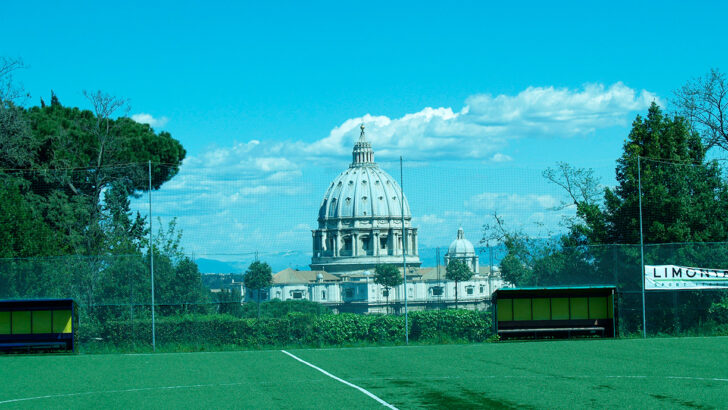 St Peter’s Basilica is seen from St Peter’s Oratory football field in this 2008 file photo. Photo: OSV News /courtesy Knights of Columbus Multimedia Archives.
 Sport is not simply an escape from reality. It is also preparation for reality writes, writes Fr Barry White

As the FIFA World Cup kicks off today, June 11, 2026, across North America, many of us will spend the weeks ahead captivated by the drama that only a World Cup can provide: stunning goals, heroic saves and the tension of penalty shoot-outs. But why does a football match matter so much to millions? Why can ninety minutes of sport stir such powerful emotions? The Catholic tradition offers an unexpected answer: sport reveals something profound about our human nature.
The FIFA World Cup owes its existence to Jules Rimet, a French Catholic who believed football could serve a higher purpose than mere competition. Influenced by Pope Leo XIII’s social teaching and Rerum Novarum (1891), he saw sport as a means of fostering peace, friendship and unity within the human family. In the years between the World Wars, he championed the creation of the World Cup, first played in 1930. The original trophy was renamed the Jules Rimet Trophy in 1946, a title it retained until 1970.
Fascination
Reflecting on my fascination with the World Cup, I found in it echoes of faith and the spirituality of sport. While sport and faith may seem worlds apart, both Pope Benedict XVI and Pope Leo XIV have reflected on how sport reveals the human person’s longing for communion.
When the 1978 FIFA World Cup began in Argentina, Cardinal Joseph Ratzinger—later Pope Benedict XVI—reflected on the significance of sport in our divided world. While some dismiss sport as escapism, Ratzinger believed it revealed something essential about the human person. Beneath the desire for entertainment lies a yearning for happiness, freedom and fulfilment. He suggested that play represents an attempt to recover something of humanity’s original harmony before the Fall. In the biblical vision of creation, humanity lived in communion with God, one another and creation. There was unity amid diversity: human beings, animals and plants; male and female; different yet ordered towards a common good.
Ratzinger described play as “a sort of effort to return to paradise”. Unlike work driven by necessity, play is freely chosen and engages the whole person, offering freedom from life’s pressures. The rules that govern sport are part of this vision. They reflect Eden’s order and harmony, where freedom flourished within a life-giving order.
Insight
Pope Leo XIV develops this insight in his letter Life in Abundance: On the Value of Sport, arguing that “true sport fosters a peaceful relationship with limits and rules”. Far from restricting us, limits give meaning to effort, while rules provide the “shared grammar” that makes genuine competition and encounter possible. In a culture that often resists limits, sport teaches their value. Athletes learn discipline, perseverance and self-control through training and sacrifice. Success comes through commitment rather than shortcuts. Sport, therefore, is not simply an escape from reality. It is also preparation for reality. It is, as Ratzinger described it, a “school of life”.
Reflecting on the meaning of competition, Pope Leo noted that the word derives from the Latin cum (“together”) and petere (“to strive” or “to seek”). Competition, therefore, is not primarily about defeating an opponent but about striving together towards excellence. In our time marked by conflict, sport offers a unique form of encounter: people compete fiercely yet shake hands afterwards. Rules foster harmony, competition builds character, and opponents share a common pursuit of excellence. Sport teaches us to strive without hostility, excel without arrogance, and use our gifts in service of something greater than ourselves.
He reminded the world that football’s greatest moments are not always found in victory, but in empathy, dignity and respect for a fellow human being”
A striking example of this spirit was visible after the recent Champions League Final between Arsenal and Paris Saint-Germain. When Arsenal defender Gabriel missed the decisive penalty, PSG captain Marquinhos did not immediately join his teammates in celebration. Instead, he crossed the pitch to console his fellow Brazilian. Having missed a crucial penalty himself at the 2022 World Cup, Marquinhos chose compassion over triumph. In that simple embrace, he reminded the world that football’s greatest moments are not always found in victory, but in empathy, dignity and respect for a fellow human being.
Value
During the Jubilee of Sport in 2025, Pope Leo highlighted the value of sport. Team sports remind us that fulfilment is found not in the isolated “me” but in the communal “we”, forging friendships on side-lines, in dressing rooms and in shared victories and disappointments. In an age of digital connection yet widespread loneliness, sport reconnects us with our bodies, communities and the real world. It also teaches us how to lose, showing that failure can become a path to growth and renewal. Although sport can be distorted by violence, racism or corruption, at its best it reveals that we are made for relationship, perseverance and solidarity. As the World Cup begins, Pope Leo’s June prayer intention offers an appropriate hope for the weeks ahead: that sport may be “an instrument of peace, encounter and dialogue among cultures and nations” and promote “respect, solidarity and personal growth”. If football can help us glimpse even something of that vision, then perhaps it truly deserves its title as the “Beautiful Game”.