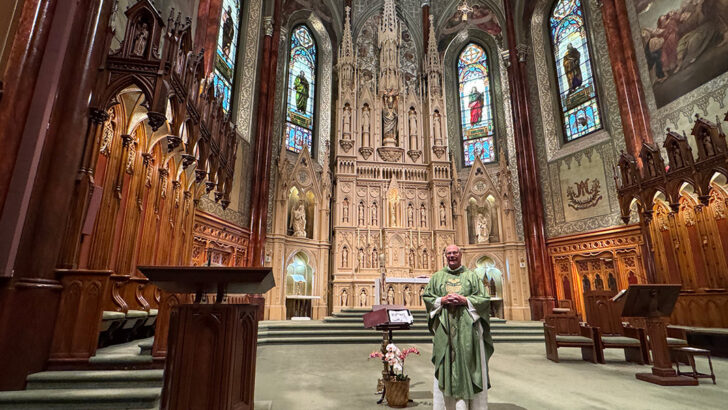
 Msgr Coyle in the Basilica. Photos Éanna Mackey.
As the world turns green for St Patrick’s Day, the great outposts of the Irish diaspora will compete, as they always do, to outshine one another. In Chicago, the river will glow an impossible emerald. Beneath the spires of St Patrick’s Cathedral, Fifth Avenue will pulse with marching bands and tricolours. In Boston, Southie will erupt into a carnival of memory and migration.
Yet a little further north, in the French-speaking heart of Montreal, something quieter and much older endures.
As the last crust of winter loosens its grip and the St Lawrence begins to flow once again, Canada’s second-largest city prepares to host North America’s second-largest St Patrick’s Day parade, surpassed only by New York City’s. Up to a quarter of a million people will line Sainte-Catherine Street as Quebec’s metropolis pays homage to the Irish who did not simply pass through but built the place, blasting canals from rock, laying the first rail lines across a vast continent, and shaping the civic and spiritual foundations of a vast young country.
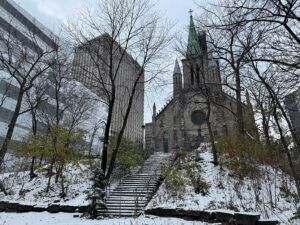
But away from the parade route and plastic shamrocks, in the shadow of the financial district’s steel and glass towers, stands the real core of Irish Montreal: St Patrick’s Basilica.
Constructed in 1843 and consecrated amid the horror of 1847, the blackest year of the Great Famine, the church became a refuge for thousands who staggered ashore along the banks of the St Lawrence. For migrants drifting down the river valley after weeks at sea, Montreal would have appeared like a glimmering promise on the horizon. For many, it was their last sight of hope.
Roots
Many never made it beyond Griffintown, Point St Charles, or Goose Village. Disease and exhaustion cut lives short almost as soon as they began again. From its hilltop perch overlooking the parish below, St Patrick’s stood as both sanctuary and sentinel.
Typhus and exhaustion tore through the newly arrived. The tragedy is still marked today by the Black Rock, the Montreal Famine Rock, which stands near the river on the site of a mass grave, a stark memorial to those who perished in 1847.
In 1989, during his Canadian visit, Pope John Paul II designated it a minor basilica, cementing its place not only in Irish-Canadian history but also in the spiritual story of the country itself. Nearly 180 years after its first stones were laid, the old Irish neighbourhoods have thinned, and the community no longer carries the political or demographic weight it once did.
And yet, at the centre of it all, the pulse remains.
Msgr Francis J. Coyle, a fourth-generation Irish-Canadian with roots in Donegal, has served at St Patrick’s for 24 years. Originally from New Brunswick, he has witnessed both decline and renewal and, in recent years, something unexpected.
He oversees the Rite of Christian Initiation of Adults (RCIA), a programme aimed at preparing adults for baptism and entry into the Church. What was once steady has, he says, become something close to a surge: young professionals, immigrants, students, and people from every background seeking meaning in one of the city’s oldest sanctuaries.
It’s traditional. They seem to be reaching for that tradition. It brings a sense of security, and it warms my heart to see the big crowds here”
“The Irish have moved to the suburbs,” he reflects, acknowledging how the old enclaves have dispersed. “But we cater to a multicultural world now. There have been a lot of young people returning to the Church. There are almost no faith schools left in Quebec; that seems to be why kids are not getting baptised or confirmed.”
“I think Covid ruined everything for a lot of young people, but in my view this is the Holy Spirit at work. They are searching for something more than themselves, and they are wonderful young people. If you ask them, they might not know what’s drawing them here, but it’s the Holy Spirit working. It’s not being forced, and that’s what’s so beautiful about it.”
“In my generation you were forced; you go to church or you’ll get paddled. Not anymore. I think they like this place because it’s traditional. They seem to be reaching for that tradition. It brings a sense of security, and it warms my heart to see the big crowds here.”
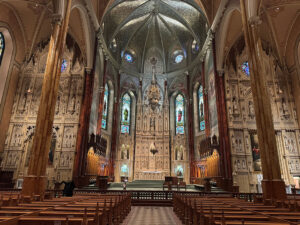
St Patrick’s Basilica is among the oldest churches on the island of Montreal, and that sense of age carries a palpable weight. Tucked discreetly into the downtown core, it is easy to pass without noticing, a sanctuary hidden in plain sight. Yet step inside, and the noise of the city falls away. In winter, it offers refuge from Quebec’s brutal cold; in summer, shade from the heavy, blistering heat. There is an immediate stillness, a feeling that this is a place that has endured.
Restoration
Inside, the Basilica is a statement of Irish resilience expressed through art and architecture. The interior is richly ornamented with motifs that intertwine the French fleur-de-lys and the Irish shamrock, a visual marriage of Quebec and Ireland.
Most striking are the soaring 25-metre columns, each carved from the same white oak and painstakingly painted to resemble marble. The basilica contains three altars, four rosette stained-glass windows, and some 150 oil paintings depicting saints, giving the space both grandeur and intimacy.
Music has long been central to its life. The church houses a pipe organ built in 1895 and is also known for “St Patrick’s Chimes”, a set of ten bells. The oldest of them was cast in 1774 and originally rang out from the earlier church of Notre-Dame, its chime linking the present basilica to an even deeper chapter of Montreal’s Catholic past.
As he looks ahead to another St Patrick’s Day, Msgr Francis Coyle has one eye on the celebration and the other on the future. Restoration works are already underway at St Patrick’s Basilica; a new entrance is planned, and repairs to the church’s steps and exterior walls, long battered by Montreal’s punishing winters, have begun. The hope is simple: to ensure the basilica endures for another century and more.
“St Patrick’s Day is a huge day for us”, he says. “The church is full of Irish people. They come from near and far. We have a special Mass here; the archbishop comes, and it’s packed with the Irish.”
“This place is filled with prayer; it’s been here since 1847. You walk in and you sense it. We don’t have plays or concerts or anything like that. It’s just a place of prayer and worship. The Holy Spirit is at work here, and you can feel it. Even with me, I’m 77 years old, and I’m not ready to give up yet, even though I probably should.”
“Everybody was Irish before me. I don’t know what will happen when I retire; there’s no Irishman waiting to take over from me. But it’s beautiful. Being a Coyle, it makes me very proud.”