

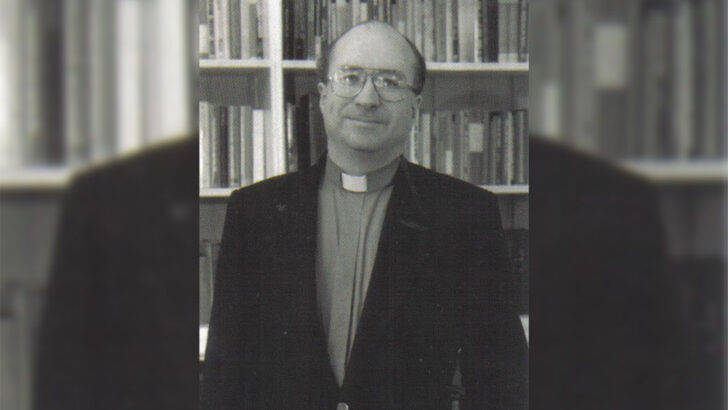
 Author Joseph McCann
 Church, Parish & Education: Interaction
Joseph McCann CM
(Kingdom Books, €30.00)
Joseph McCann was born at Hollis, Queens, New York in 1940. He attended the local Pascal Baylon elementary school taught by the Sisters of St Joseph of Brentwood.
After the family re-settled in Dublin he was a student at the secondary school of St Paul, Raheny, which was conducted by the Vincentian Fathers. He joined the Vincentian Congregation in 1958 and was ordained eight years later. Thereafter he spent his life teaching and in education.
Initially he was principal of St Paul’s Primary School in Raheny. Then he was a secondary school teacher for fourteen years, first at St Paul’s Raheny, and later at St Patrick’s College, Armagh City. Finally, he was a member of the staff of St Patrick’s Teacher-Training College at Drumcondra, Dublin, for thirty-five years.
This study of the interaction of Church, parish and people is a collection of articles which he published in various professional journals when he was a professor in the Teacher-Training College and a member of its Research Department.
In content they range far and wide, but essentially they concern religion, religious organisations and the teaching of the Catholic religion. From his life-time spent in education McCann provides valuable insights and suggestions as he conducts a sociological analysis of religion teaching.
Concepts
His emphasis is on ideas and concepts as he accesses educational developments, structures and theories. He also has some incisive and helpful comments to make with regard to the organisation of worship, church gathering, public service and Christian formation. And throughout there is an authentic ecumenical tone.
One of the most interesting articles in the collection is a short history of the Irish Vincentians, which provides an inkling of what the Vincentians have bequeathed to the Irish people at home and abroad, not least Castleknock College, All Hallows College, and St Patrick’s Teacher-Training College, Drumcondra.
In 1833 as they were establishing the Vincentian Congregation in Ireland the founders set up a college at Usher’s Quay in Dublin. Within a year the Archbishop of Dublin requested that they take on a seminary for the archdiocese.
He conceived the idea of setting up a missionary college which would provide priests to minister to the large number of Irish people who were emigrating”
In 1834 they transferred their Ushers Quay College to a new location west of Dublin, added a programme for priestly formation and named it St Vincents’ College, the name to be changed afterwards to Castleknock College. From 1835 to 1867 the college was run as a joint secondary school and minor seminary.
Then from 1867 to 2006 it was one of the leading Catholic colleges for boys in the country. It ceased taking in borders in 2006 and became an all-day school. Thereafter the student numbers increased year by year. By 2025 those had risen to almost 700 ; its sister college at St Paul’s in Raheny has an even greater student attendance.
Those colleges continue to successfully equip and prepare their students to make a responsible and valuable contribution to contemporary society.
Fr John Hand, CM, is rightfully given much of the credit for the establishment of All Hallows College. He conceived the idea of setting up a missionary college which would provide priests to minister to the large number of Irish people who were emigrating to English-speaking parts of the world.
College
With the assistance of the Archbishop of Dublin and Daniel O’Connell he acquired Drumcondra House and its grounds. The college opened on November 1, 1842. It was named All Hallows after a twelfth-century Augustinian Priory on whose lands it stood. By 1892 it had dispatched 1500 priests to the USA, Canada, Great Britain, the Caribbean, South Africa, Australia and New Zealand.
In 1892 following a serious dispute the college was formally entrusted to the Vincentians and another 2500 priests were ordained for the foreign missions. With the catastrophic decline in vocations the Vincentians had to close the college in 2016. They sold the property to Dublin City University and it is now part of the campus of DCU.
St Patrick’s Teacher – Training College at Drumcondra is another institution bequeathed by the Vincentians to the nation. After staffing it and overseeing its development the Vincentians handed it over to the DCU in 2014, where it is now a central part of the University’s department of education.
There are, of course, many other reasons why Irish people can be grateful to the Irish Vincentians. For instance, who can measure the contribution they made to the common good and quality of life of the Irish nation through the missions and retreats they conducted across Ireland over many years?