

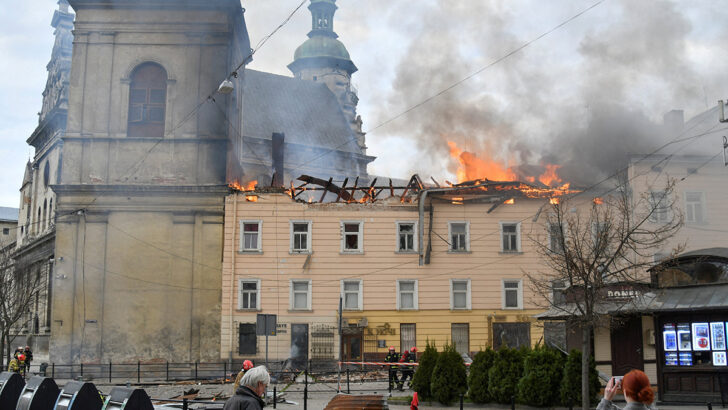
 Firefighters work at the site of a residential building in Lviv, Ukraine, hit by a Russian drone strike on March 24, 2026, amid Russia’s massive nationwide attack on Ukraine that day. The building is adjacent to the Bernardine monastery complex and part of a UNESCO World Heritage Site. Photo: OSV News / Reuters.
 Gana, a refugee from Kharkiv—one of the Ukrainian cities hardest hit by Russian attacks—found safety in Ireland not only from the war, but also from her abusive husband.

Now she fears she and her five-year-old daughter, who has autism, could be left without a home. Gana is deeply concerned by the Irish Government’s plans to scale back and eventually phase out the Accommodation Recognition Payment (ARP) scheme, under which hosts receive a tax-free monthly payment of €600 for providing accommodation to people granted temporary protection under the EU Temporary Protection Directive. As the sole caregiver for her daughter, whose additional needs require constant support.
The woman says she is currently unable to work. “When I arrived in Ireland at the beginning of 2023, I was in an extremely bad psychological state,” she says. “I had PTSD, I couldn’t gain weight, I was emotionally broken and had no idea how I was going to continue living. It was here, in this wonderful country surrounded by kind people, that I finally felt safe and able to breathe again.” Gana and her daughter were initially placed in hotel accommodation, where their basic needs were met.
Eventually, she found accommodation in another town through the ARP scheme. “It was the only option I found after searching for an entire year,” she says. “Wherever I asked, people either didn’t want to accommodate someone with a child, or the only available options involved sharing the house with other people. For my daughter, who is neurodivergent, that would create even more stress and sensory overload.”
Meltdowns
According to Gana, her daughter often experiences meltdowns (intense emotional outbursts) after spending time around other people. By the time the little girl returns home from preschool, the emotional strain of the day has built up, and she releases it with the person she trusts most—her mother. She doesn’t want mum talking to anyone on the phone. The daughter needs her complete attention and wants to be in control of everything. She needs quiet, a predictable environment and her own safe space.
At present, they live alone in a two-bedroom apartment. “But if the ARP scheme ends and I have to rent privately, I don’t know whether I’ll be able to afford it. Because of the housing shortage, rents just keep increasing”, she says. Finding employment is not a realistic option at the moment.
My ex-husband, who is from North Macedonia, enjoyed seeing me afraid. I ran away from him three times, and twice he forced me to come back”
Although Gana has a university degree in medicine from Ukraine and speaks English fluently, she still needs to have her qualifications recognised in Ireland. Caring for her daughter makes that process extremely difficult. Gana says she may apply for social housing or try to find work that can be combined with caring for her daughter.
What she cannot imagine is returning to her abusive former husband. “In Ireland, women are much better protected from domestic violence than they are in Ukraine,” she says. “My ex-husband, who is from North Macedonia, enjoyed seeing me afraid. I ran away from him three times, and twice he forced me to come back.” She says he stalked her, controlled every aspect of her life and repeatedly tried to take their daughter away.
During the winter, he would lock her outside the house, humiliate her and verbally abuse her. “It reached the point where he threatened to stab me. He held a knife and described exactly how he would kill me and watch me die. Our daughter was standing nearby. I truly believe he was capable of killing me. That’s when I realised the only way to survive was to escape”, — the woman recalls.
Returning
Returning to Kharkiv is not an option either. Her mother’s apartment is located in the city’s historic centre, where many buildings have been damaged or destroyed by Russian strikes. Her hometown continues to come under attack almost daily. “The worst moments are when the missiles are so fast that the air raid siren comes too late. Sometimes the warning sounds only after the explosion.”
Gana recalls one particular incident. “I was out walking with my daughter when I suddenly heard an explosion. Thank God it wasn’t very close. She was still very little and didn’t understand what had happened. We ran into a semi-basement for shelter.” “Most nights, Russia launches Shahed drones. They were frightening at the beginning of the war, but now they’re even worse—louder and carrying larger explosives. They sound like mopeds. Sometimes my daughter would already be asleep, and I’d pick her up and run to the basement. The anxiety became so overwhelming that I had to take medication.”
Even now, the ARP scheme doesn’t really guarantee our security”
Moving to Ireland, Gana says, was above all about protecting her daughter from the war. In Ukraine, particularly in frontline cities, children continue to be killed and injured every day. “Even now, the ARP scheme doesn’t really guarantee our security,” the Ukrainian says. “The landlord could tell us to leave tomorrow because he agreed voluntarily to provide temporary accommodation. We would have nowhere to go. That’s what frightens me the most. I hope God has a plan for us and will show us the way forward.”