

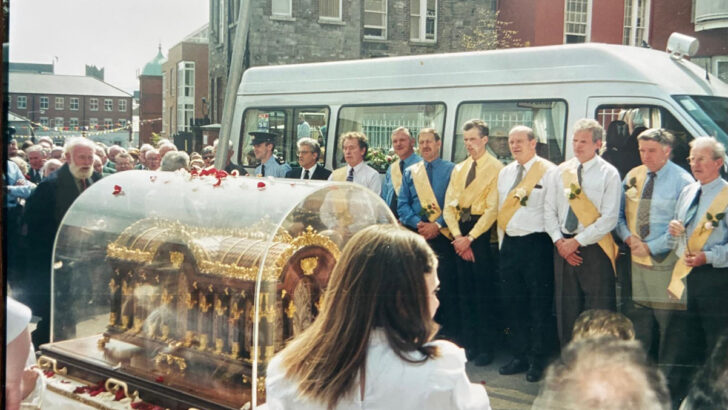
 Relics of St Thérèse of Lisieux arriving at the Morning Star Hostel in 2001.
 On Friday October 2 and Saturday October 3, a special event will be taking place at De Montfort House and the Morning Star Hostel in Dublin’s north inner city.
The relics of the St Thérèse of Lisieux and her canonised parents St Louis and St Zélie Martin will be visiting the facilities to mark the 25th anniversary of the visit of the ‘Little Flower’ in 2001.
Organised by the Legion of Mary, ‘A Call to Grace’ will include a procession and reception of the relics led by the Archbishop of Dublin Dermot Farrell, followed by an all-day veneration.
Much has changed in the last quarter of a century. In 2015, St Thérèse’s parents St Louis and St Zélie Martin became the first married couple in the history of the Church to be canonised together. A cause for the beatification of their older daughter Léonie (Sister Françoise-Thérèse) is underway also.
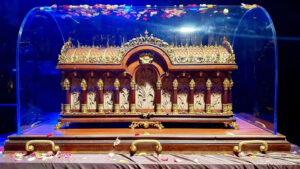
Ireland has also changed dramatically. Footage from RTÉ’s ‘Reeling in the Years’ episode for 2001 gives a sense of the occasion. Uniformed soldiers of the Irish Army carried the reliquary containing the relics of St Thérèse ashore at Rosslare after its arrival from France, as little girls scattered flowers before them.
What followed was a remarkable 80-day visit in which the relics attracted vast crowds, to the extent that permission was granted to extend the visit by an extra four days.
Response
The public response to the visit – during which an estimated three million people visited the relics, took many by surprise.
Almost a decade had passed since the revelations regarding the Bishop of Galway Eamonn Casey, and the subsequent and unremitting deluge of abuse scandals had left the Irish Church battered.
By 2001, less than half of the population was attending church weekly, the vocations crisis was obvious, and few were expecting that the arrival of relics of a French Carmelite nun who died in 1897 would attract such public interest.
Yet the sheer numbers who travelled to see the reliquary and touch the glass surrounding it attracted considerable attention internationally.
The Guardian, Britain’s voice of secular and centre-left opinion, reported in April of that year that the tour had “provoked remarkable religious fervour in a predominantly Catholic, but increasingly secular, country.”
In July, the same paper reported that 70% of the island’s Catholics had visited the relics, and quoted the co-ordinator of the trip Fr Linus Ryan, O. Carm., who said: “We knew it was going to be big but it exceeded our most optimistic expectations.”
St Thérèse’s relics were brought to churches and religious communities nationwide, as well visiting more remarkable locations such as Mountjoy Prison, where 90% of inmates were said to have attended the veneration.
When a gate prevented the ‘Thérèsemobile’ vehicle from entering Limerick Prison, it was physically removed by one of the inmates, who exclaimed: “This was meant to keep us in, not to keep her out!”
One of the most extraordinary aspects of the overall visit was the huge number of people who were drawn to Confession”
In a book about the visit titled A Gift of Roses written by the well-known media figure Don Mullan, Fr Ryan noted the large numbers of ill or disabled people who flocked to see the relics.
Many others sought spiritual healing. During an all-night visit of the relics to the Carmelite Monastery in Firhouse, Fr Michael McGoldrick OCD spent the whole night hearing confessions: an experience which was far from unusual during the visit.
“One of the most extraordinary aspects of the overall visit was the huge number of people who were drawn to Confession. We still don’t fully understand why this happened,” Fr McGoldrick said.
Fr Ryan has since died, as has his fellow organiser Pat Sweeney, the retired Army Sergeant Major who served as the co-ordinator and chairperson of the St Thérèse Office.
Sweeney’s deep devotion to St Thérèse later resulted in him being given a first class relic of hers, to which was later added relics of her now canonised parents.
Since Pat’s death in 2022, his daughter Marcie and the wider Sweeney family have carried on his work by bringing the relics around the country, and they have assembled a large exhibition of material relating to St Thérèse, her family and the 2001 visit.
Immense
“My first memory of the 2001 visit is the immense organisation behind it – it took more than two years to prepare,” Marcie recalled. “Then came the extraordinary outpouring of love and devotion across Ireland. I remember Dad ringing home with stories of crowds lining the streets and roads, and of the emotion everywhere. He drove the ‘Thérèsemobile,’ the vehicle that carried the relics, and it was one of the proudest roles of his life.”
Included within the exhibition which attendees at ‘A Call to Grace’ can see on October 2-3 is video footage of the previous visit to the Morning Star and Regina Coeli in 2001.
The 25th anniversary of the visit has already been marked in various places, including in Whitefriar Street Church, where a special commemoration took place in June featuring both relics and an exhibition.
‘A Call to Grace’ continues in the same vein. The Little Flower has long been of great importance to the Legion of Mary, being quoted in their official handbook, and more than 10,000 people visited the relics there in 2001.
St Thérèse graces us with renewed vigour for evangelisation and winning souls to Christ”
These visitors came from all walks of life. President Mary McAleese also visited for an occasion which was of particular importance to the homeless residents of both the Morning Star Hostel and the nearby Regina Coeli Hostel, where female residents and their children were among the very large crowd that welcomed St Thérèse.
The late Liam Heydon was one of the key organisers of this event, and played the piano throughout the night, as his daughter Ciara Kavanagh recalls.
“I remember the beautiful all-night vigil in the grace-filled surroundings of the Morning Star oratory, and the ordinary brothers of the Morning Star and the loud singing in unison with their beloved residents,” she said, while adding that she hopes “St Thérèse graces us with renewed vigour for evangelisation and winning souls to Christ.”
Practical
One practical example of the fruits of this visit was highlighted by the Legion of Mary’s Declan Lawlor, who noted that the popular annual Legion of Mary Young Adult Conference took place for the first time later in 2001, and has since become one of Ireland’s most popular events for young Catholics. This year’s conference took place in De Montfort House in August, and attracted 140 attendees.
The Ireland of 2026 is indeed different to that which existed in 2001. Mass attendance rates have declined dramatically; not only are many of the organisers of the 2001 event deceased, so too are many of the ordinary participants.
The devotion of many Irish Catholics to St Thérèse and her family endures”
It is unlikely that the spontaneous display of national piety which occurred in 2001 – when more people came to visit St Thérèse than came to see Pope John Paul II during his visit in 1979 – could ever take place again.
Nonetheless, the devotion of many Irish Catholics to St Thérèse and her family endures.
In a world so blighted by the disintegration of the family, the Martin family of Alençon – the devoted parents, the five surviving daughters, each of whom became a nun – stand out as an example of how faith can endure all earthly trials.