

 Fr Dominik Domagala
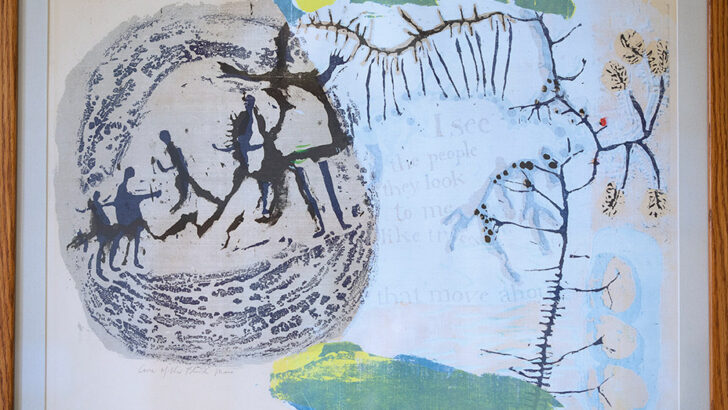 Sr Corita Kent’s 1957 work ‘Cure of the Blind Man’, seen at the Theological College in Washington. Photo: OSV News/ Tyler Osburn.
 There are moments in life when we look, and yet we do not really see. Our eyes function perfectly, but something inside us is still blind. Only when something shifts within the heart do we begin to notice what was there all along. The readings of this Sunday speak precisely about such a miracle: the recovery of sight. Not only physical sight, but something deeper — the opening of the eyes of the soul. The Church deliberately places these readings in the middle of Lent. In that sense, every Lent is a kind of spiritual eye examination. The question is simple, yet unsettling: Do I actually see?

God sees differently (Samuel)
After the Exodus from Egypt, Israel wandered for forty years in the desert. For many years they had no king, believing that God Himself was their ruler. Instead, charismatic leaders called Judges would arise in times of crisis — figures such as Gideon or Samson. It was the prophet Samuel who eventually anointed Saul as Israel’s first king.
But Saul failed. His disobedience and pride distanced him from God. And so Samuel is sent again — this time to the house of Jesse in Bethlehem — to anoint a new king. The scene is almost cinematic. One by one, Jesse’s sons pass before Samuel. The eldest looks impressive. Tall, strong, exactly what one expects from a king. Samuel is ready to choose him immediately. But God intervenes with words that echo through the entire Bible: “Do not look on his appearance or on the height of his stature… for the Lord sees not as man sees: man looks on the outward appearance, but the Lord looks on the heart.” This is the turning point of the story.
Human beings instinctively judge by appearances. God looks elsewhere. God looks at the heart. David, the youngest, the forgotten shepherd boy, becomes the chosen one. The anointing itself happens quietly, almost secretly.
Seen in its wider context, the story is a reminder of God’s quiet fidelity. But the deeper message for us is this: God’s way of seeing reality is different from ours. And learning to see as God sees is one of the central tasks of faith. From Genesis through the Law, God gradually teaches His people how to recognise His presence in events that often appear ordinary. Yet the fullest revelation of God’s vision comes in Christ. In Him we see what God truly looks like. And as the Gospel shows us Christ, it also trains the eyes of our hearts.
From darkness to light (Ephesians)
The second reading speaks about this transformation in strikingly simple language: “Once you were darkness, but now you are light in the Lord.” Notice the radical expression. St Paul does not say merely that we lived in darkness. He says we were darkness. And now we are light.
Through union with Christ in the Holy Spirit, the Christian receives a new way of perceiving reality. It is a new vision. Because of that new vision, certain things suddenly become obvious. St Paul calls them “the works of darkness.”
Furthermore, darkness hides the ugliness of sin. But once the light of the Gospel shines upon it, the illusion disappears. That is why the Apostle insists: the fruit of the light is “goodness, righteousness and truth.” Where those fruits are absent — where there is injustice, manipulation, dishonesty, cruelty — something is wrong with the light. Faith is not merely a set of beliefs; it is a change in the way we see the world.
The man born blind (John)
All of this prepares us for one of the most beautiful and dramatic scenes in the Gospel of John: the healing of the man born blind. Jesus is in Jerusalem during the Feast of Tabernacles — a festival that commemorated Israel’s years in the desert. The appearance of Jesus forces people to choose.
Just before this episode Jesus declares: “I am the light of the world. Whoever follows me will not walk in darkness but will have the light of life.” Immediately afterwards comes the healing. The miracle itself is simple. Jesus makes mud with His saliva, places it on the man’s eyes, and tells him to wash in the pool of Siloam. The man obeys — and returns able to see. But the real drama begins afterwards.
The story unfolds almost like a play in several scenes.
First the neighbours are puzzled: Is this really the same man?
Then the Pharisees interrogate him.
Then they question his parents.
Then they question him again.
Finally he meets Jesus once more.
The man born blind moves from darkness to faith, while those who believe they see move deeper into blindness”
What is fascinating is the inner journey of the healed man. At first he simply describes what happened. Asked who Jesus is, he says only: “The man called Jesus.” Later, under pressure from the Pharisees, he calls Him “a prophet.” Still later he speaks of Jesus as “a man from God.” And finally, when Jesus reveals Himself as the Son of Man, the man declares: “Lord, I believe.” And he worships Him. His sight grows gradually — not only physically but spiritually. At the same time another process is happening in the Pharisees. At first they are merely suspicious. They ask questions. They discuss the matter among themselves. But slowly their position hardens. They become certain that Jesus cannot be from God. Eventually they expel the healed man from the community.
In other words: the man born blind moves from darkness to faith, while those who believe they see move deeper into blindness. And this is precisely the judgement Jesus speaks about at the end of the story: “I came into this world for judgement, so that those who do not see may see, and those who see may become blind.” Jesus does not force anyone. He simply brings light. What people do with that light reveals their hearts.
Meaning
So what does this mean for us? A Christian is someone who sees. Not necessarily someone more intelligent or more informed, but someone who sees reality from the perspective of eternity. That perspective changes everything. It changes how we look at success and failure. It changes how we look at suffering. It changes how we judge what truly matters.
Of course, seeing with God’s eyes is not easy. But the Gospel invites us to learn gradually — by listening to Christ, by confronting our opinions with His teaching. Sometimes the process resembles the journey of the man born blind. Yet slowly the light grows clearer. The danger lies elsewhere. The danger is the attitude of the Pharisees — the certainty that we already see perfectly. That we already possess every answer.
Faith may be personal, but it is never merely private. It shapes how we live, how we speak, how we stand for what is true and just”
A Christian can become like that. He can know every doctrine, every rule, every argument. And yet his heart may slowly slide into darkness. There is also another temptation — the attitude of the healed man’s parents. They avoid taking a position because they are afraid. They prefer safety. They prefer to remain neutral.
Faith may be personal, but it is never merely private. It shapes how we live, how we speak, how we stand for what is true and just. Otherwise Christianity becomes something like an illness without symptoms — invisible even to ourselves.
Lent places before us the same question that Jesus asks the healed man: “Do you believe in the Son of Man?” Sooner or later each of us must answer. Not with perfect understanding, perhaps. Not with complete clarity. But with the humility of someone who has glimpsed the light and trusts the One who brings it. The healed man’s final gesture says everything. He simply says, “Lord, I believe.” And he bows before Jesus. That is the moment when true sight begins. The moment when we can finally say, with gratitude and astonishment: “Now I can see.”
Fr Dominik Domagala is the author of ‘The Social Sermon’ blog on Facebook, Instagram and YouTube. Check out more at the new website: thesocialsermon.com