

 Greg Daly
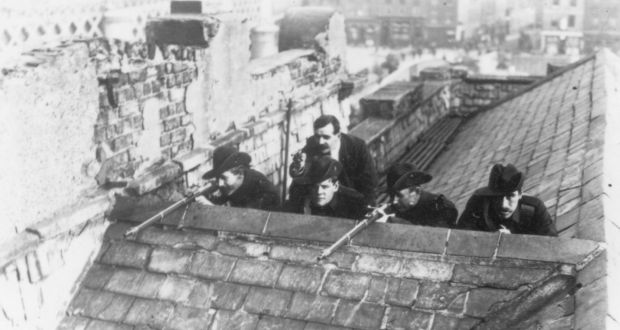 Citizen Army men on the roof of Liberty Hall during Easter Week. Photo Credit: Robert Hunt/ Windmill Books/ UIG via Getty Images.
 The Easter rebels realised the need for recognising spiritual realities as well as material ones, Bishop Denis Brennan of Ferns has said.

“The 1916 Proclamation is explicit in its recognition of the transcendent,” Dr Brennan said at an Easter Monday centenary commemoration Mass in Enniscorthy, noting how, “it begins ‘In the name of God’ and it finishes by saying ‘We place the cause of the Irish Republic under the protection of the most High God’.
“I believe that the rest of the 20th Century provides enough evidence to show that when societies are not underpinned by a sense of the transcendent, however beguiling materially, life can become soul-destroying, repressive and dehumanising,” he continued.
Recognising that “the men and women of 1916 dreamed of a social order which recognised and promoted the material needs of people but they also understood that in the words of Scripture ‘man does not live on bread alone’,” he called those studying the 1916 leaders and their motivation to remember “the influential role faith played in their lives”.
Contrast
His comments were in stark contrast to those of President Michael D. Higgins just hours later in Dublin’s Mansion House.
Addressing the ‘Remembering 1916’ symposium, the President made no reference to the religious faith that inspired the vast majority of the men and women of 1916. Christianity was a startling omission when he listed “the influences of the Enlightenment, romanticism, mysticism, suffragism, socialism, pacifism” on the Easter rebels.
Mr Higgins mentioned religion as a phenomenon in the address only to identify it as a tool of “imperial triumphalism” used to encourage British army recruitment in 1916, and in terms of “a restrictive religiosity” that became, he said, one of “the defining social and cultural ideals of the newly independent Ireland”.
Such comments are all the more striking given the President’s warnings in the speech against avoiding “false or comforting amnesia” and the “uncritical transfer of contemporary emotions onto the past”.
Acknowledging how different Rising commemorations have different focuses, he said such commemorations “tell us at least as much about the zeitgeist of every commemorative period, and perhaps about those who controlled the process of commemoration, as they do about the events of 1916 themselves”.
Photo: Robert Hunt/ Windmill Books/ UIG via Getty Images