

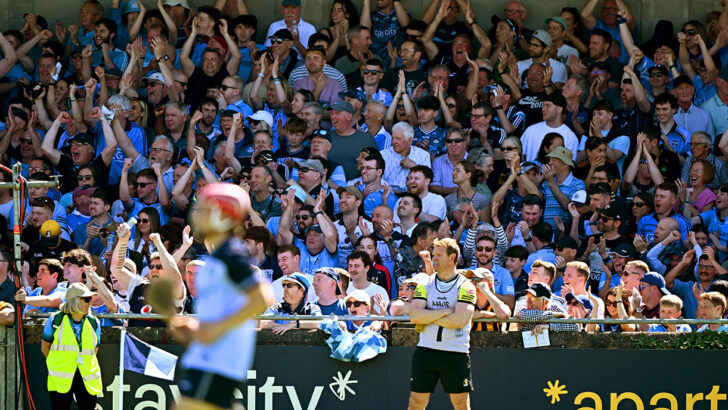
 Dublin supporters during the Leinster GAA Senior Hurling Championship Round 5 match between Dublin and Kilkenny at Parnell Park in Dublin, May 24, 2026. Photo: Seb Daly / Sportsfile.
 It is remarkable to think that after the first weekend of June, just five intercounty hurling games will remain in 2026. Such is the restrictive nature of the split calendar that once the winners of the Mick Mackey and Bob O’Keeffe Cups are crowned, only a handful of fixtures will remain before Croke Park is freed up for concerts and whatever other events the GAA sees fit to host over the summer.

In truth, this year’s provincial championships have not quite lived up to their usual hype. Munster’s much-vaunted shark tank has failed to ignite in the manner it has in recent seasons, with Cork and Limerick operating at a level above the rest. Both counties recorded emphatic victories over third-placed Clare while also dispatching Tipperary with relative comfort.
Indeed, it was Waterford, a county still waiting to qualify from the round-robin series since its introduction in 2018, that provided much of the drama in an otherwise subdued Munster campaign. Kevin Mahony’s last-gasp goal against Tipperary with the final puck of the game rescued a draw and produced one of the championship’s few truly chaotic moments.
Déise
The Déise also pushed Cork all the way before giving Limerick a genuine scare on their own patch. Were it not for a devastating sixty-second burst from the Treaty men to wrestle back control of the contest, Waterford looked set for a famous victory as they led entering the final quarter.
There is an increasing sense that Munster hurling currently consists of Limerick, Cork and the chasing pack, with Clare, Tipperary and Waterford all sitting behind the province’s standard bearers, despite the fact that Clare and Tipp are the two most recent All-Ireland champions. It is a bizarre hierarchy and one that underlines the quality within Munster.
Tipperary’s decline this year has perhaps been the most disappointing aspect of the championship. Last season, Liam Cahill’s side combined the vibrancy of youth with the experience of an established core to bring a relentless energy to the campaign, eventually powering their way to Liam McCarthy glory on Jones’ Road with a direct, high-tempo brand of hurling.
Despite a provincial campaign that has largely failed to catch fire, the prospect of another heavyweight clash between Cork and Limerick still carries enormous intrigue”
However, the image of Ronan Maher lifting the Liam McCarthy high into the Dublin sky now feels increasingly distant after Tipperary’s showing this year. A limp and sobering home defeat to Clare in a do-or-die clash ended their hopes of progression, followed by Limerick’s demolition job in a sun-soaked Páirc na nGael, exposed just how dramatically the Premier County’s standards have dropped in the space of twelve months.
While Cahill has undoubtedly built up significant credit in the bank by guiding a side few expected to become All-Ireland champions to the summit, there is now a growing feeling that this season may mark the end for several of Tipperary’s seasoned campaigners.
Yet despite a provincial campaign that has largely failed to catch fire, the prospect of another heavyweight clash between Cork and Limerick still carries enormous intrigue. In a repeat of last year’s decider, the modern giants of the game now have the opportunity to inject some life into a championship that has struggled to truly ignite.
Limerick and Cork have already served up one blockbuster encounter this summer in the second round of the championship at Páirc Uí Chaoimh. A red card for Cian Lynch and an Alan Connolly goal shortly after half-time ultimately proved decisive as the Rebels secured a valuable two-point victory over their great rivals in the sixth Cork-Limerick clash to attract a sell-out crowd in the past 24 months.
However, five weeks on, that result counts for very little as the sides prepare to meet for the fifth time in 2026. Ben O’Connor’s men now have the opportunity to defend the Munster title they won so dramatically on Shannonside last season under Pat Ryan, ending Limerick’s six-year stranglehold on the Mick Mackey Cup.
It took extra time and penalties to separate the counties twelve months ago after Limerick had obliterated Cork by sixteen points at the same venue just weeks earlier. In many ways, this year’s meeting feels like the inverse of that sequence. The seventy-fourth championship clash between the sides promises another spectacular occasion on the banks of the Lee and may yet rescue what has otherwise been a relatively underwhelming Munster campaign.
Differences
There will, however, be some notable differences from last season. John Kiely is unlikely to find himself involved in another heated half-time exchange with the Cork management team, while the Rebels must also cope without the legendary Patrick Horgan, whose reliability from placed balls remains difficult to replace. Alan Connolly and Tim O’Mahony have shared the free-taking duties this year, though neither has quite replicated Horgan’s consistency.
The Patrickswell sharpshooter could prove decisive, particularly with Cork deprived of their first-choice full-back line to contain Limerick’s attacking threat”
Cork have also been dealt a cruel hand with injuries. Captain Robert Downey is expected to recover after being forced off with an ankle issue against Limerick earlier in the campaign after having lined out against Clare last time out, but Darragh Fitzgibbon will certainly watch from the sidelines following appendix surgery. Star full-back Ciarán Joyce is also absent after suffering a season-ending cruciate injury in the opening minutes of the round-two meeting between the sides.
By contrast, John Kiely appears to have close to a full hand available. Aaron Gillane, who missed the opening rounds through injury, is beginning to rediscover the sharpness that made him so devastating during the league campaign. The Patrickswell sharpshooter could prove decisive, particularly with Cork deprived of their first-choice full-back line to contain Limerick’s attacking threat.
Emergence
The Treaty County have also benefited from the emergence of Aidan O’Connor as one of the breakout stars of the season. Despite scoring 1-1 from play in last year’s Munster final, the Ballybrown forward has elevated his game to another level in 2026. Having already finished as top scorer in the Allianz League, O’Connor now leads the Munster scoring charts and has become one of the championship’s defining figures.
While the provincial finals have produced an almost identical pairing to last season, there is one major difference: for the first time since 2017, Kilkenny will not partake in the Leinster final, as their pursuit of a six-in-a-row provincial title has come to an abrupt end before the All-Ireland series. In truth, the warning signs had been evident throughout the year. A concerning league campaign was followed by a flat and underwhelming Leinster round-robin series from Derek Lyng’s side.
In their place come Dublin, who have shown they belong back among the game’s elite following last year’s remarkable All-Ireland quarter-final victory over Limerick, a result widely regarded as one of the greatest shocks in modern GAA history.
A first championship victory over Kilkenny since 1942 secured the Dubs’ passage into the provincial decider, where they now face Galway, a side they have already defeated this season. Dublin also travelled to Salthill and produced an impressive victory over the Tribesmen, who had entered the campaign tipped for a major year after opening their championship with a resounding fifteen-point win over Kilkenny.
The signs are worrying for Kilkenny. Despite winning a Leinster Under-20 title last season and claiming All-Ireland honours at the grade in 2022, the county has not exactly flourished at underage level in the way it once routinely did. It feels almost unthinkable that both Kilkenny and Tipperary’s summers have been brought to a close before the end of May, but such is the unforgiving nature of the modern split season.
It is difficult to know exactly where Kilkenny goes from here, but if nothing else, this summer offers an opportunity for reassessment. To their credit, the Cats have been without key figures including Adrian Mullen, Jordan Molloy and All-Star full-back Huw Lawlor. Replacing players of that calibre is never straightforward, particularly when the conveyor belt of talent no longer appears quite as relentless as it once was.
Kilkenny’s style of play has also come under increasing scrutiny. The great sides of the noughties thrived on a direct, man-to-man approach built around some of the finest hurlers the game has seen. Perhaps the modern possession-based system simply does not suit the county’s traditional strengths, but one thing is certain: it has not functioned effectively this year.
Kilkenny now face a period of serious reflection. A long summer and an even longer winter may force difficult conversations within the county”
Slow lateral passing, misplaced handpasses and cheap turnovers often disrupted Kilkenny’s rhythm, while too much of their attacking play seemed to rely on direct deliveries towards TJ Reid in the hope that the Ballyhale talisman could produce moments of inspiration.
Two-time All-Star Andy Comerford has also voiced concerns about the current state of hurling within the county, questioning the effectiveness of Kilkenny’s development structures and the lack of players emerging into the senior setup following their Leinster exit. Whether it requires a tactical rethink or a broader change in mentality, Kilkenny now face a period of serious reflection. A long summer and an even longer winter may force difficult conversations within the county. For now, however, it is back to the drawing board for hurling’s most decorated county.
In Kilkenny’s absence, both Dublin and Galway will view this year’s Leinster final as a major opportunity to reclaim the Bob O’Keeffe Cup. Micheál Donoghue’s men are aiming to climb the Hogan Stand steps for the first time since 2018, when they secured back-to-back provincial titles following their first All-Ireland triumph since 1988 the previous season.
Dublin, meanwhile, are chasing a first Leinster title since 2013. That success ended a forty-nine-year wait for provincial glory, and Niall Ó Ceallacháin will leave no stone unturned in his bid to guide the capital back into an All-Ireland semi-final.
Resurgent
Elsewhere, a resurgent Offaly side now head into the All-Ireland quarter-finals full of momentum, where Johnny Kelly’s men will face either Cork or Limerick in what represents the ultimate test of their progress. After years of rebuilding, and following their Under-20 All-Ireland success two years ago, the Faithful County finally appear to be coming of age once again.
For hurling people across Ireland, the resurgence of Offaly has been one of the most encouraging stories of the championship. The Faithful County’s return to the top table has not come about through luck or circumstance; it is the product of years of serious work finally beginning to bear fruit. From underage development to senior progression, Offaly’s rise has been carefully built, and they now look capable of causing problems for any side left in the championship.
The key now will be ensuring that this season becomes a stepping stone rather than a brief appearance at the top table”
Their revival should also serve as encouragement for every county striving to bridge the gap to the elite level. Offaly have gone from Christy Ring champions in 2021 to an All-Ireland quarter-final in the space of five seasons, while Kildare mirrored that upward trajectory by securing back-to-back promotions to reach the Leinster Championship for the first time since 2004.
Although the Lilywhites will return to the Joe McDonagh Cup next season following relegation, their exposure to top-tier hurling should prove invaluable for a talented and ambitious group emerging in the Curragh County. Wexford, Galway and Dublin all survived significant scares against Brian Dowling’s side this summer, underlining just how competitive Kildare have already become. The key now will be ensuring that this season becomes a stepping stone rather than a brief appearance at the top table.
That, perhaps, is where questions around the structure become unavoidable. For counties such as Kildare, who are investing enormous energy into raising standards and closing the gap, exposure to elite opposition is essential. The same applies to the strongest Joe McDonagh teams, many of whom are caught in a cycle where meaningful progress is difficult without sustained opportunities against the game’s leading counties.
Debate
As the championship progresses, the debate around structures and scheduling will only intensify. The split season and increasingly compressed intercounty calendar remain a constant source of frustration, and there is a growing feeling that hurling, particularly outside the traditional strongholds, is being squeezed into an ever-smaller space.
This weekend brings the provincial championships to their conclusion, yet already five of hurling’s eleven top-tier counties have seen their seasons end before June has even begun. In the lower tiers, campaigns concluded last weekend, leaving only a small number of intercounty fixtures remaining for the rest of the summer.
And that is perhaps the contradiction at the heart of the modern championship. Just as momentum begins to build, the season is already racing towards its conclusion.
For those fortunate enough to secure a ticket this weekend, there is every reason to savour it. If Munster can reproduce even a fraction of the drama that defined last year’s decider, and if Leinster continues the unpredictability that has shaped this campaign, supporters could yet witness two memorable occasions before another intercounty season disappears almost as quickly as it arrived.