

 Cathal Barry
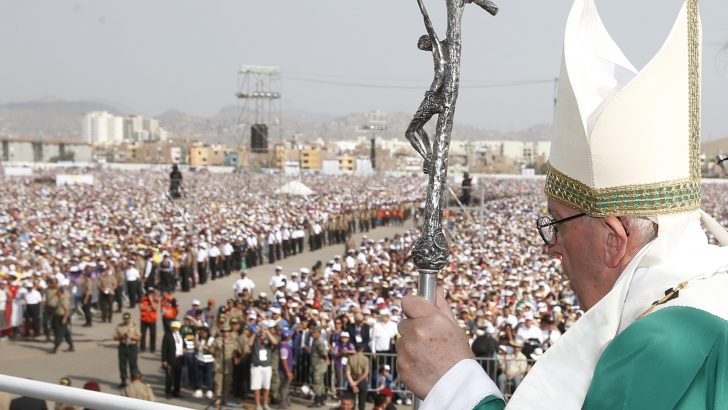 Pope Francis in procession to celebrate Mass at Las Palmas Air Baser in Lima. Photo: CNS
 Cathal Barry examines whether a priest’s character should influence the Mass
The Irish are well known for their larger than life personalities and priests from these parts are no exception.
The personality of the celebrant is a prominent element in the celebration of the liturgy, especially the Mass, particularly since the Second Vatican Council.
To what extent the celebrant’s personality should dominate the Mass, however, is a topic that some suggest needs to be addressed.
The issue was broached by Fr Aidan Ryan of the Ardagh and Clonmacnois diocese in this month’s edition of The Furrow.
“The ideal,” as suggested by the Co. Westmeath-based Parish Priest, “is that the priest would preside without being intrusive and would be prayerful without being overly pious”.
Noting that this is a “skill to be acquired”, Fr Ryan warned that training for this has been “scant”.
“It is possible to preside without dominating and to lead worship with dignity and with minimum intrusion of our own personalities. There are many celebrants who do preside in this way, with a simple quality of presence,” he said, adding “there is anecdotal evidence, however, to suggest that some celebrants still have some learning to do in this regard”.
Speaking to The Irish Catholic, Fr Ryan said he was confident that the “great majority of priests celebrate Mass with dignity, attention and devotion”.
Temptations
He warned, however, that there were “certain subtle temptations” that priests need to be aware of when celebrating Mass.
One such temptation, Fr Ryan suggested, was talking too much, “rather than letting the liturgy speak for itself”.
“I don’t think very many priests do that but it is a subtle temptation if you have a talkative personality,” he said.
Priests attempting to create a relaxed and friendly atmosphere may also be “tempted to think of themselves as an entertainer or as an MC at a chat show”, Fr Ryan suggested.
“The priest is just one participant in the liturgy, obviously he has a very important role, but so do the readers, the servers, the Eucharistic ministers, the choir and importantly, the congregation.
“I think it’s important that the priest doesn’t allow himself to be put into the position where he seems to have to do everything.
“The liturgy doesn’t stand or fall on the priest. It is his job to lead the whole congregation,” he insisted.
Fr Turlough Baxter, Secretary of the Liturgy Commission in Ardagh and Clonmacnois and Chair of the Irish Church Music Association, agreed that it is the presider’s role to “help the congregation to be a worshipping people and trying to draw people into that”.
However, he warned against priests becoming “robots”. “We all have our own way of doing things. We can’t be robots either,” he said.
Fr Baxter noted that when the priest’s position changed to face the congregation “the dynamic changed as well”.
“Sometimes people see the sanctuary as a stage and if we become too much of the character of the stage we are disempowering people in the community from being part of the worship,” he said.
This is a point developed by Fr Ryan in his aforementioned article in The Furrow.
Fr Ryan suggested that the sanctuary area in most churches around the country “can have the appearance of a theatre stage”.
He argued that this may “subconsciously influence some celebrants to ‘act a part’ or even to be theatrical in their manner of presiding”.
“The assembly is then subtly reduced to the role of audience, and the most that can be hoped for is ‘audience participation’,” he said.
Fr Ryan told this newspaper that he believes “the average person thinks of themselves as being there to attend Mass and watch the priest saying Mass, rather than something they are actively involved in themselves”.
He said the Irish experience of Mass pales compared to Africa, the US and Britain, where liturgies are often “far livelier and far more participative”.
Fr Baxter agreed that “one of the aspects that we haven’t achieved in Ireland is enabling the assembly to be the assembly in liturgy”.
“We are very good at creating ministries but the essence of enabling the baptised faithful to be a community that feels that they are worshiping God together, we haven’t really been able to achieve that.
“The liturgy isn’t just something that we watch, it’s something we partake in and we all have a part to play,” he said.
Fr Baxter warned, however, against “imitating the practises” of the Church in other parts of the world.
“Liturgy comes from within us in a certain sense so it needs to grow out of the culture. In Ireland we have probably felt more at home in devotionalism rather than liturgy.
“Quite often, people feel much more at home in private personal devotions rather than within liturgy as a community,” he said, adding that “part of the difficulty is that liturgy can become so bogged down in little things, in rubricism, and sometimes that can take over from what the essence of the liturgy is”.
Participation
Noting that the Second Vatican Council spoke about “full, conscious and active participation”, Fr Ryan said it was his impression that, in Ireland, “that hasn’t happened to the extent that might have been hoped”.
He suggested that there is something “deeply ingrained” in the Irish people that they shouldn’t “appear to be in anyway prominent in worship”.
Questioning how to rid the national psyche of such a notion, Fr Ryan admitted he didn’t have the answer.
It’s the million dollar question and one the Church now must face going forward.