

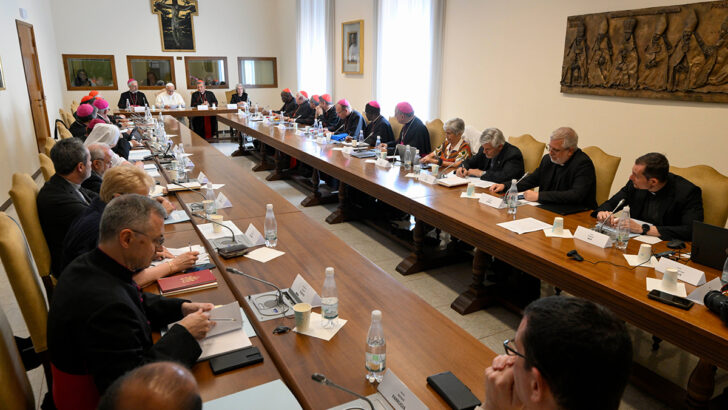
 Pope Leo XIV addresses the Ordinary Council of the General Secretariat of the Synod during a meeting at the Vatican June 26. Photo: CNS/Vatican Media.
 It has often been said that synodality was Pope Francis’ flagship project for reform and renewal in the Church. The 2023 and 2024 sessions of the XVI Synodal Assembly entitled “For a Synodal Church: Communion, Participation and Mission”, along with the publication of its Final Document in October 2024 are seen as the culmination of his papacy. There is no doubt the theme of synodality emerged increasingly as a central theme throughout his papacy.
So what is Pope Leo’s take on synodality? He’s only a few months into his papacy but he has already indicated a positive attitude to it. On the night of his election, for instance, as he spoke from the balcony of St Peter’s Basilica, he said “we want to be a synodal Church”.
In his talk to cardinals on May 10, 2025, just two days after his election, Pope Leo described how Pope Francis had “masterfully and concretely set forth” the pathway outlined at the Second Vatican Council not least in terms of highlighting growth in collegiality and synodality as a fundamental point. Then in his address on May 19, to representatives of other churches, ecclesial communities and other religions, he indicated clearly it was his “intention to continue Pope Francis’ commitment to promoting the synodal nature of the Catholic Church.”
Legacy
In a meeting with the members of the Ordinary Council of the General Secretariat of the Synod on June 26, Pope Leo summarised Pope Francis’ legacy as follows: “that synodality is a style, an attitude that helps us to be Church, promoting authentic experiences of participation and communion.”
In his homily at the Pentecost Vigil on June 7, the new Pope offered his own personal insights into what synodality is and its purpose. He affirmed, for instance, that synodality is “how the Spirit shapes the Church”. Noting how the word ‘synod’ begins with the Greek word syn – meaning ‘with’, he underlined how synodality is rooted in the secret of God’s life: “God is not solitary. God, as Father, Son, and Holy Spirit, is a ‘with’ in himself, and God with us.”
For where there is the Spirit, there is movement, a journey to be made. We are a people on the move”
Synodality is all about relationships because it is rooted in the source of all relating – the life of the Trinity. In emphasising this theme of relationship Pope Leo was echoing a theme developed in a whole chapter of the Final Document of the 2024 Synodal Assembly that he attended as Cardinal.
Synodality, for Pope Leo, is dynamic. The word ‘synodality’, he went on to explain on June 7, points us to a road ahead (hodós): “for where there is the Spirit, there is movement, a journey to be made. We are a people on the move…. In a divided and troubled world, the Holy Spirit teaches us to walk together in unity.” He drew a parallel between creation itself and our call to synodality. He said: “God created the world so that we might all live as one. ‘Synodality’ is the ecclesial name for this.”
Demanding
Pope Leo is clear that synodality is demanding in that it pushes us to open out beyond ourselves and our own talents and viewpoints. It requires “that we each recognise our own poverty and our riches, that we feel part of a greater whole, apart from which everything withers, even the most original and unique of charisms.”
Pope Leo drew an analogy between the interconnectedness we find in nature and the calling to synodality in the Church: “Think about it. All creation exists solely in the form of coexistence, sometimes dangerous, yet always interconnected… And what we call ‘history’ only takes place as coexistence, living together, however contentiously, but always together.”
The eye cannot say to the hand, I do not need you, nor again the head to the feet, I do not need you”
Speaking on June 17 to the Italian Bishops’ Conference that has, like Ireland, embarked on a national synodal pathway, Pope Leo encouraged them saying: “go forward in unity, thinking especially of the synodal path”. He commented on how synodality has to become a mindset. It is a way of seeing the Church as united in the diversity of gifts and ministries. He quoted St Augustine who said: “the Lord, in order to keep his body well-composed and in peace, exhorts the Church, through the Apostle Paul: The eye cannot say to the hand, I do not need you, nor again the head to the feet, I do not need you. If the whole body were an eye, where would the hearing be? If the whole body were hearing, where would the sense of smell be?”
His clear recommendation to the Italian bishops was to stay united and not defend themselves against the provocations of the Spirit: “Synodality becomes a mindset, in the heart, in decision-making processes and in ways of acting.”
Meditation
In his address to Bishops on June 25, in the context of the Jubilee of Bishops which I had the good fortune to attend, Pope Leo offered a meditation to the 400 bishops gathered in St Peter’s on their identity and mission. He advocated the exercise of dialogue as a bishop’s pastoral style and method, both in his relationships with others and in his presiding over participatory bodies, “in other words, in his overseeing of synodality in his particular Church”. He again credited Pope Francis with having taught us much in this regard, “insisting with pedagogical wisdom on synodality as a dimension of the life of the Church”.
The day after, he spoke to participants at an international meeting organised by the Dicastery for Clergy entitled, Happy Priests: “I have called you friends” (Jn 15:15). In his talk he said priestly formation must help to build solid bonds in the presbyterate as an expression of a synodal Church in which we grow together sharing the toils and joys of ministry. His words were an invitation to priests and future priests to let themselves be formed in a synodal mindset by engaging in the synodal processes.
All-in-all, we can say that in the few weeks since he was elected Pope, we can see good evidence the Pope Leo intends to pursue the synodal agenda. He recognises we cannot just pursue the same old pastoral plans. The synodal mindset, rooted in communion, facilitates the interior and structural renewal needed to respond to new challenges.
* Bishop Brendan Leahy of Limerick is chair of the Bishops’ Commission for Catholic Education and Formation, and a member of the Vatican’s Dicastery for Interreligious Dialogue.