

 Renata Steffens
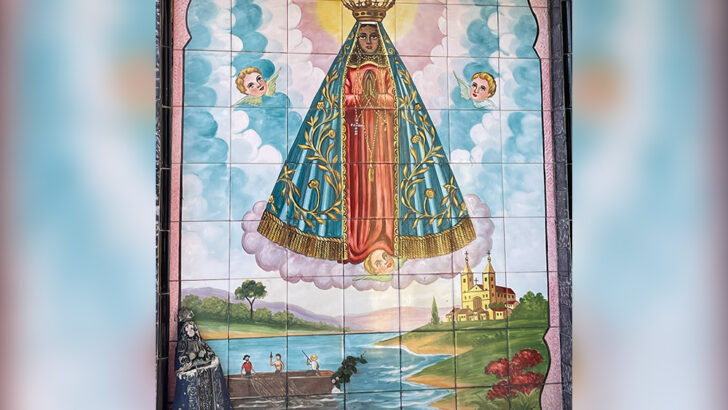 ‘Aparecida’ tiles in Vila Mariana, São Paulo, Brazil. Photo: Wikimedia Commons / Brooks Patty.
 Catholics worldwide are getting ready to celebrate Mission Month this month. But October has an extra special meaning for Brazilian Catholics: it is the month to celebrate their National Patroness, Our Lady of Aparecida, on October 12.
Over 300 years ago, early in the morning of October 12, 1717, three men, Domingos Garcia, Filipe Pedroso, and João Alves, set off with their boat in the Paraíba River in the village of Guaratinguetá, São Paulo, intending to get fish for a big celebration the village would host on the occasion of the visit of Don Pedro de Almeida, Governor of the Province of São Paulo and Minas Gerais.
The fishermen had been fishing for hours with no luck. They were tired and thinking about giving up and going back home when Alves decided to try one more time. He cast his net into the river, and when pulling back he felt something in the net. When pulling up from the water, he saw it was not fish. Instead, he found what looked like a piece of wood. Pulling the wood from the net, the fishermen noticed it was a statue of the Virgin Mary missing her head.
The men decided to throw the net again, and when retrieving it, they found another wood piece, smaller this time. It was the statue’s head. Deciding to throw the net one more time almost by instinct, they had a pleasant surprise: it was so full of fish they could barely pull it into the boat. Alves’ companions threw their own nets, and the three men saw themselves overwhelmed with the amount of fish they were catching.
Having the fish sorted for the festivities, the men went back home and before delivering the commissioned fish, they handed Garcia’s wife the two statue pieces. She fixed the statue with wax and placed it on their home altar, thanking Our Lady for the fish miracle.
The miracle news spread in the village, and every day more and more people came to Garcia’s house to see the statue and pray. They named her Nossa Senhora da Conceição Aparecida, which is ‘The Appeared Our Lady of Conception’. Soon they were gathering every Saturday to pray the rosary and sing hymns.
Devotion to Our Lady of Aparecida grew and from 1717 to 1732 her image went on pilgrimage through the Ribeirão do Sá, Ponte Alta and Itaguaçu areas. By 1732, Our Lady Aparecida’s popularity was such that the humble Garcia’s home became small for the crowd. The first oratory was built for people to pray for Our Lady ‘Appeared from the Waters’ that year.
A small chapel was built in 1740 by Vicar of Guaratinguetá, Fr José Alves Vilela and some lay volunteers. In this chapel, they prayed the rosary, but the Eucharist was not celebrated.
By the year 1743, Fr Vilela contacted the Bishop of Rio de Janeiro, listing the Virgin’s miracles and the people’s devotion, asking the bishop to approve and authorise the Eucharist and the construction of the first church in honour of the image then known as the Mãe Aparecida, the Appeared Mother. On May 5, 1743 they received approval. The church was built on Morro dos Coqueiros, a hill that today is the centre of Aparecida City.
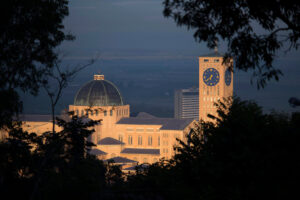
The National Shrine of Our Lady of Aparecida’s website lists six of her miracles:
- The miraculous fishing: when Our Lady appeared in the fisherman’s net.
- The candles: when people were praying in front of the statue and two candles went off, a woman got up to light them again when the candles lit themselves up.
- The blind girl: In 1874, Gertrudes Vaz and her blind daughter travelled for three months to visit Our Lady. The moment they arrived, mam and daughter stood on the road and the girl, looking at the horizon exclaimed, “Look, mammy! It’s the saint’s chapel!” The girl was cured.
- The slave Zacarias: When the slave Zacarias was being brought back to the ranch from where he escaped, passing by the chapel, he asked to pray to the Virgin. When he was kneeling and praying the chains holding him were released.
- The horse rider: A man who did not believe in Our Lady of Aparecida and laughed at the devotees decided to enter the church with his horse. When he tried to get up the stairs to enter the church, the animal’s foot was stuck on the first step.
- The drowning saving: In 1862 a 3-year-old boy was playing with his family in a boat when he fell and the mother and sister knelt and prayed to Our Lady Aparecida to intercede so he would not drown. Instantly, the boy started floating and was rescued.
In 1768 the church known today as the ‘Historic Basilica’ was repaired and expanded, and in 1893, the Aparecida Parish was created.
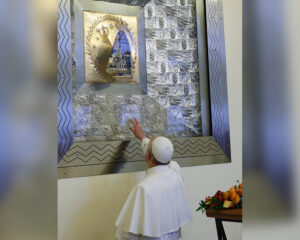
The first Brazilian Cardinal, Archbishop of Rio de Janeiro Joaquim Arcoverde suggested crowning Our Lady of Aparecida in 1901, Pope Pio X accepted the request and the solemn ceremony took place on September 8, 1904.
For the first time, the shrine gathered 15,000 people, 12 bishops and hundreds of priests for the Virgin’s crowning. The title of ‘Minor Basilica’ was given to the church by Pope Pio X in 1908. Pope Pio XI declared Our Lady of Aparecida the Patroness of Brazil in 1930.
She has been an important source of faith and hope to Brazilians worldwide since her appearance in the river in 1717. Fr Severino Pinheiro da Silva Neto OFM Cap, Chaplain for the Brazilian Community in Dublin believes Our Lady of Aparecida is an anchor to Brazilians living abroad.
“An anchor guarantees the boat is stable in the instability of the sea, that is why the anchor is also a symbol of hope.” The priest said Our Lady, the anchor, gives people hope during the turmoil of moving to a new place, the instability, uncertainty, “but you have a place, something to hold on to.”
“Devotion to the Virgin Mary gives the Catholic faithful stability during the instability of living in another world. Another culture, another tongue, another weather, without much hope, without stable grounds to walk on, but you have faith, and that faith carries you forward.”
“This faith gives you the certainty you are not alone: God is with you. And His mother, our mother, walks with us. With her blessing, intercession, and above all, her example. Because she was also a migrant, she went to Egypt and lived the distress of the one who leaves their place, the one who goes towards the unknown but is certain God does not abandon us.”
(i) Novena to Our Lady of Aparecida will happen from October 9-18 in St Mary of the Angels, Church Street. Procession through Dublin on October 18 at 4pm. Mass in English on October 10 at 6pm.