

 Brendan O’Regan
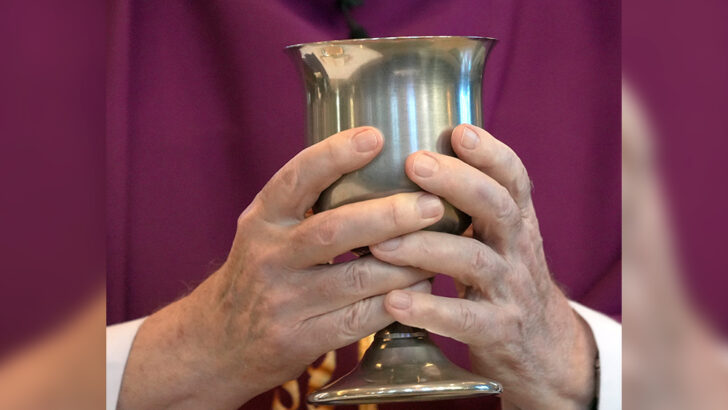 File photo of a priest holding a chalice as he celebrates Mass. Photo: OSV News / Gregory A. Shemitz.
 I was at a funeral last week, and once again I was reminded of the wonderful support priests provide to their parishioners in times of difficulty.
This brought to mind an item I had heard earlier in the week. Today with David McCullagh (RTÉ Radio 1, Wednesday) featured three priests in active duty – Fr Willie Purcell, Parish priest of St Canice’s Catholic Parish Kilkenny & National Vocations Coordinator for Diocesan Priesthood, Fr Paddy Byrne, Parish Priest of three parishes in the Diocese of Kildare and Leighlin and Fr Bryan Shortall, Capuchin monk and Parish Priest in St Michan’s Church in Dublin. They came across as dedicated, hard-working priests, serving their various communities, embracing their vocations while still conscious of the problems of Church and society. There was much talk of the priest being ‘present’ in their communities, showing kindness and compassion, offering consolation, bringing people to the Eucharist, to Jesus Christ.
Fr Purcell said that essentially the ministry hadn’t changed over the years. Yet during Covid he thought people’s attitude to the priest had changed, as they saw them being first responders, being there when needed. He said priests were “ordinary men who … live extraordinary lives”. Fr Byrne was inspired by the lives of so many of the good people around him. He found that in a world with so much hate, Christianity offers “balance and consolation” and speaks of hope. Fr Shortall said he goes out to people to invite them into church – it was a cool place of rest in the heatwave!
On some tougher questions, like the lack of priests, Fr Purcell was hopeful, with around a 50% increase in vocation enquiries. On the question of the humanity and vulnerability of priests, Fr Byrne said that Christ, to whom he is in a life of service, “embraces all our wounded hearts”. He favoured women priests and an end to compulsory celibacy (two very different issues, unhelpfully conflated here) – he thought it was unfair to young men to be called to live a lone, celibate life. Fr Purcell said these issues were above his pay grade and rested with a higher authority. He said, “we’re not miserable retired bachelors … our friends and our families are the ones who support us”. It was an engaging discussion that ended all too soon.
Also ending all too soon was the life of UK politician Ann Widdecombe, murdered last week. Ms Widdecombe was a Catholic convert and former MP and minister. At the time of writing, it seems not to have been a political murder, but that may change. The tributes have been pouring in from allies and opponents alike. Her dedication to her faith was much commented upon, even as some made sure to distance themselves from some of her more ‘unpopular’ views – e.g. against abortion and euthanasia.
Mind you, some have drawn attention to her past support for capital punishment – not good for the ‘consistent life ethic’. On Times Radio Breakfast (Saturday) there was an interview with another former MP, Harry Proctor who, along with other prominent figures, had been wrongly accused of child abuse. Of Widdecombe he said “she stood by me at the darkest time”. She was praised for her “unwavering commitment to justice”. Others commented on her ability to not take herself too seriously – e.g. taking part in Strictly Come Dancing. On the Nine O’Clock News (RTÉ One, Saturday) we heard that neighbours described her as “a lovely woman with a great sense of humour”. Rt Rev. Nicholas Hudson, Bishop of Plymouth, said his immediate thought was to come to the famous Buckfast Abbey where Ms Widdecombe frequently attended Mass – to offer Mass for the repose of her soul. On The Wrap (Sky News, Saturday) presenter Gillian Joseph described what had happened as a “disgusting and despicable act”.
On Sunday with Laura Kuensberg (BBC One, Sunday) her fellow Reform party member Nadhim Zahawi described her as “incredibly kind”. On Sunday Morning (Times Radio) presenter Adam Boulton started the show with an apology about his “insensitive comments” after her death – “I got the tone and timing wrong in my word portrait of this remarkable woman”.
Reaction to her death has exposed many of the divisions in UK politics, particularly obvious on X/Twitter, where polarisation thrives on anonymity, though some commentators who are models of restraint on mainstream media become rather unpleasant, even when sporting their own names.