

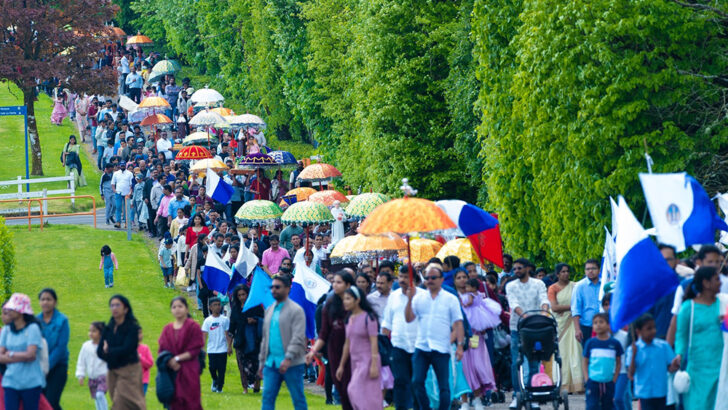
 Syro-Malabar Catholics are pictured during
their pilgrimage to Knock Shrine, Co. Mayo,
earlier this year.
Syro-Malabar Catholics are pictured during
their pilgrimage to Knock Shrine, Co. Mayo,
earlier this year. Ireland’s Catholic landscape is changing. On any given Sunday, you might see a family from Kerala sitting beside an Irish grandmother who has prayed in the same pew for fifty years, a Filipino nurse lighting a candle after her night shift, or a Polish choir leading hymns. You might even notice the mixture of languages at the church door afterwards – English with a hint of Malayalam here, a touch of Tagalog or Polish there – spoken with the soft familiarity of people who now share the same parish life.

This is not a challenge to the Church in Ireland; it is one of its greatest blessings. At a time when Mass attendance is fragile, the arrival of new Catholic communities, especially from the ancient eastern traditions, is nothing less than a gift of the Holy Spirit.
How do we honour the richness of our many traditions while strengthening the one Church in Ireland? It is a question of unity, mission, and the kind of Ireland we wish to build together. And it is not a question for theologians alone; it touches everyday parish life, from school gates to choir rehearsals and even the ‘cuppa’ shared after Mass.
A model worth noticing
Irish parishes are not simply receiving migrants; they are receiving partners in the Gospel. I have the privilege of serving in Clonmel, where the Indian Catholic community has lived out a beautiful model of unity.
For over twenty years, families from Syro-Malabar, Latin, Syro-Malankara, and other Apostolic traditions have gathered once a month for a Mass in Malayalam. It is a simple gathering – no big banners, no fuss – just people wanting to pray in the language that shaped their childhood and their first experience of the faith.
This is not a parallel parish, nor is it a replacement for Sunday worship. Instead, it is a moment of cultural expression within an already vibrant participation in local Irish parishes.
On any given weekend, you can see Indian altar servers standing beside Irish ones, whispering nervously about who is lighting the candles and who is carrying the water. It is small, ordinary moments like these that show how naturally people integrate when the parish keeps its doors open.
It is a model of ‘unity without uniformity,’ allowing people to preserve their spiritual heritage without becoming a separate community. This balance feels so natural in Clonmel that you would hardly notice it unless you stepped back and looked. Yet this is precisely the kind of integration many families hope for.
The risk of parallel structures
Across Ireland, most eastern Catholic families happily worship in their local parishes. Their greatest desire is not to separate themselves but to belong. They want their children to grow up confident in Irish society and confident in the Catholic faith.
However, in some areas, a pattern has emerged of Sunday Masses offered exclusively for one ethnic group, drawing entire communities away from their local parishes. While well-intentioned, this can inadvertently create closed circles and weaken the wider Church’s unity.
Walking together
The Catholic Church is not one Rite but many. It is the Church of Rome, Antioch, and the East; the Church of St Patrick and St Thomas the Apostle. When eastern and western Catholics collaborate, parish choirs become richer, youth ministry becomes more active, and communities begin to look more like the universal Church than any one group’s expression of it. You can see traces of this when new families volunteer for ministries without waiting to be asked, or when parish events suddenly have a wider spread of dishes, music, and stories.
We stand at a crossroads. One path leads to isolated communities worshipping separately. The other path, lived out every week in Clonmel, leads to a Church where differences deepen communion. It is a Church where India’s children and Ireland’s children grow up not as strangers in the same building, but as family around the same altar. A Church where people learn, almost without realising it, that faith can hold many languages and still speak to the same heart.
Rev. Dr Lazarus Gidolf is a Permanent Deacon in the Diocese of Waterford and Lismore.