

 Peter Costello
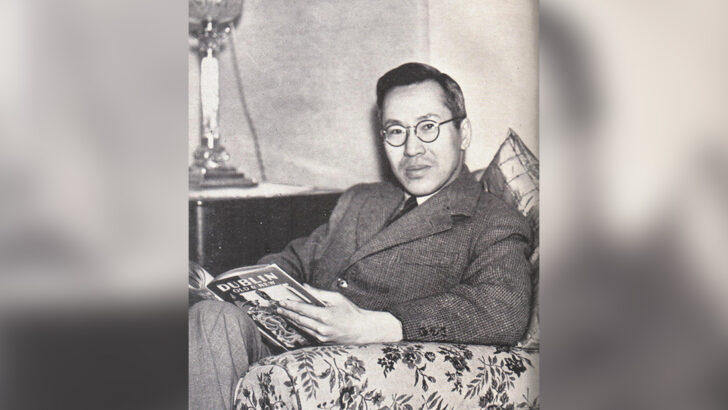 The Japanese Consul-General in Wartime Dublin Mr Setsuya Beppu - he is reading a book
on Dublin by Stephen Gwynn the Observer’s correspondent in Ireland.
The Japanese Consul-General in Wartime Dublin Mr Setsuya Beppu - he is reading a book
on Dublin by Stephen Gwynn the Observer’s correspondent in Ireland. Diplomats in Dublin
by Kees van Hoek
(The Talbot Press, December 1943)
Recently a relative in New York sent me a slightly battered copy of this book, which is not only of great immediate interest as evidence of just how much Ireland has changed since the “Emergency”, but suggests as well a topic for a PhD which might inspire an ambitious young historian and so serve to advance the investigation of Irish history into the century since the revolution ended.
The book consists of a series of sixteen “prose portraits” of foreign diplomats then accredited to the Irish state (not yet a republic), dedicated by the Dutch-born author to Éamonn de Valera, former President of the League of Nations, the best known Irish diplomat abroad as Minister of External Affairs, who he says was guiding Ireland through “the severest conflagration in world history as her greatest statesman and diplomat.”
Kees van Hoek had settled in Ireland just before the war, finally becoming an Irish citizen, and writing a book about his new allegiance in Country of my Choice”
The blurb on the cover describes Kees van Hoek as “probably Dublin’s most cosmopolitan journalist.” He was an active Catholic publicist. Aside from articles and reports in many publications and on Irish radio, he contributed a regular column signed “Spectator” for four years to the Irish Independent.
In those days that was Ireland’s leading paper and circulated more effectively all over Ireland than did the Irish Times (largely read in Dublin) and the Irish Press (read largely by Fianna Fáil families), which made the paper, then edited by Frank Geary, a real shaper of Irish opinion.
Kees van Hoek had settled in Ireland just before the war, finally becoming an Irish citizen, and writing a book about his new allegiance in Country of my Choice (1945).
In the under notice here he admits he was not born Irish, but quotes with feeling the words of Thomas D’Arcy McGee: “Our first duty is to the land where we live and have fixed our home and where while we live we must find the true sphere of our duties. Whilst always ready therefore to say the right word and do the right act for the land of my forefathers, I am bound above all to the land where I reside.”
Keas van Hoek, a Catholic, was the author of an admiring biography of Pius XII, Priest and Statesman (new edition, Kissinger, 2008, €34.99). But it was his accounts of his excursions around the country, also gathered into book form, that make the most interesting reading today: in one article he even mentions the burial with proper rights, in a West Ireland cemetery, of a Muslim sailor washed up as a victim of war.
Toorop
His first book, in Dutch, published in 1929, was an introduction to the life and work of the eclectic Dutch painter Jan Toorop, who had recently died. Toorop, a much admired figure, interested van Hoek in the Dutch context for his late adhesion to Catholicism. His interest in art transferred to Ireland, where he wrote a book about the now neglected Gaetano de Gennaro, published in 1945.
Van Hoek began as a parliamentary journalist in Holland, going in 1924 to London, then Geneva and New York, where he began to write only in English. He published several books in Dutch on history and politics, always with a Catholic angle. All of this suggests that van Hoek brought to his work in Ireland an unusual background, which was indeed truly cosmopolitan.
van Hoek was allowed by the very strict wartime political censorship to write nothing that was deemed to impinge on Irish neutrality”
This account of the diplomatic corps in Dublin began as a series of articles in the Irish Independent in 1940. These were eventually collected, updated and issued as a book in December 1943. The dates are significant. In 1940 it looked as if the German and Japanese advance were unstoppable, but by the time the book appeared the scene had changed. The Allies were on the way to victory.
However, in his book van Hoek was allowed by the very strict wartime political censorship to write nothing that was deemed to impinge on Irish neutrality. All the sixteen members of the Diplomatic Corps were treated equally, whatever the state of the nations they represented. He began with the Doyen of the Corps, the Papal Nuncio, Dr. Paschal Robinson, who was of Irish birth, though reared in America.
The other representatives followed in order. For historians up to now the interest has concentrated on the German Minister, the American Minister and the Representative of the United Kingdom. These have seemed central to Ireland’s situation, so that is natural enough. But aside from the ministers of the Allies and Axis nations, here we also have the Spanish Minister, the Swiss Chargé d’Affaires, the Swedes, Czechs and the Brazilian Minister.
He concludes with the Japanese Consul-General. Mr Setsuya Beppu was said to have kept a low profile in Dublin, though he organised a party to celebrate the capture of Singapore for Axis friends in Dublin. He was a dapper little man, with a toothy smile, who was familiar enough on the Dublin streets and golf courses.
Tried
After the war he was tried in Japan by the Allied Occupation Authorities for destroying his consular records. Later, however, he resumed his career and served as Ambassador to Laos – a sensitive post one would have thought after WWII. Later he was the Japanese Ambassador to the Holy See – clearly in the eyes of the government in Tokyo he had benefited from his years in Dublin.
A rich area for all kinds of research by those enterprising students of history who wish to move on from the well churned fields of revolution to a new pasture, fresh for cultivation”
To sum up, it appears from all this that the years from 1930 to 1965 could truly be called the ‘Era of Catholic Ireland’, a period when a new “properly Irish state” attempted to create the kind of country that seemed to be wanted. That was the purpose of the 1937 Constitution.
The end point 1965 saw for the first time since the Famine, reverse migration, when the country’s population began to grow again. But ‘Catholic Ireland’ might also be seen as ‘De Valera’s Ireland’, one where rather than a settled society there was in fact constant social change as outside influences began to impinge forcibly on a country, which by 1965 was absorbing and interiorising the outcome of Vatican II.
All in all a rich area for all kinds of research by those enterprising students of history who wish to move on from the well churned fields of revolution to a new pasture, fresh for cultivation.
As for Kees van Hoek, the war years were kind to him. The new Europe was less so. Though he maintained a Dublin home, he died unexpectedly in Germany at the age of 52, in December 1954. He was soon forgotten.