

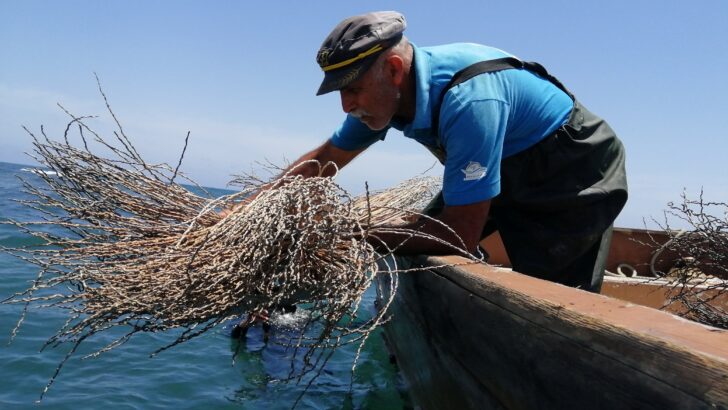
 An environmental activist stands on a boat as he drops artificial reefs into the sea to improve the marine ecosystems, in Monastir, Tunisia, June 4, 2021. In a Nov. 17 message, Pope Francis encouraged Catholics to work with members of other religions and people of good will for justice and peace and the protection of the environment. (CNS photo/Jihed Abidellaoui, Reuters)
 The Archbishopric of Carthage was “nullius”, Tunisia’s socialists declared in Latin in 1964: it ruled “over nothing”. A slap in the face for the claims that Rome had formulated in the 1880s under the protection of France.

Tunis/Algiers (KNA) Ancient Christianity in North Africa, with its front men Cyprian of Carthage and Augustine of Hippo, had perished with the Islamic conquest of the 7th century. It was only in the powerful colonial waters of France in the middle of the 19th century that an opportunity arose to turn back the clock on church history. A key figure in this attempt was Cardinal Charles-Martial Allemand Lavigerie, who was born 200 years ago, on 31 October 1825, near Bayonne in the Basque Country.
Initially Bishop of Nancy, the accomplished church historian and jurist Lavigerie was appointed Archbishop of Algiers by Pius IX at the beginning of 1867. The previous year, cholera had been rampant in the North African harbour city. More than 50,000 people died; many children were orphaned. In this situation, the new archbishop looked for a community of sisters to tackle the need. He sent a priest to Brittany to recruit young women who were willing to serve the people of Africa. He could promise “neither wealth nor human greatness”, but only “poverty, misery, self-denial and a possible martyr’s death”.
Lavigerie’s long-term goal was to revitalise ancient Christianity in North Africa and even spread it throughout Africa. He saw missionary societies as a means to this end, which were to work for education, the poor, the sick and orphans. In October 1868, Lavigerie founded the Society of African Missionaries (White Fathers); the female branch, the White Sisters, followed in 1869.
Sisters in the storm
Lavigerie was aware of how difficult the task would be: “Among Muslims, no one can approach a woman without being a woman themselves,” he wrote in his missionary appeal. “So a mission awaits you women here that has hardly ever been entrusted to you in the church.” Eight young women decided in favour of Algiers; most of them had never left Brittany before. They arrived on 9 September 1869. The day before, they had been caught in a storm – which effectively began the story of the “Missionary Sisters of Our Lady of Africa”.
The common name of the “White Fathers” and “White Sisters” refers to the white habit of the order. However, the name was all too often associated with skin colour – which is why the term “Missionaries of Africa” was later preferred. Their spirituality is characterised by the Jesuits, who trained the order’s seminarians in the early days. The members were supposed to respect the culture of the indigenous population and build a down-to-earth church.
Mission stations were founded in East Africa in 1878 and in 1894 in French Sudan, now Mali, Burkina Faso and Guinea. Branches were established in France in 1874, Belgium in 1884, Germany in 1894 and Canada in 1901. However, not all attempts were crowned with success. In 1876, three Tuareg missionaries were killed while trying to reach present-day Mali through the Sahara.
Campaign against slavery
Lavigerie was particularly committed to the fight against slavery. He visited European capitals and governments, preaching an end to human trafficking. In 1878, Leo XIII (1878-1903) appointed him Apostolic Delegate for Central Africa and thus Commissioner for the Mission. For his services, he made Lavigerie a cardinal in 1882.
Two years later – always under the French “protectorate” – the Apostolic Vicariate of Tunisia, founded in 1843, was elevated to the archbishopric of Carthage and Lavigerie was entrusted with its leadership. With recourse to Christian antiquity, he also received the old title “Primate of Africa” with the seat of Carthage.
Lavigerie also took the initiative to build the cathedral in Carthage. It was built within a few years on the highest point of Bursa Hill, where the acropolis of the ancient superpower Carthage once stood. The mighty Cathedral of St Louis was dedicated to the French King Louis IX, the saint who died here as a crusader in 1270. His tent is said to have stood here at the time.
“A flourishing church”
The church mixes Byzantine-Romanesque and Moorish elements. A circumferential mosaic band formulates the landlord’s claim to leadership for “all of Africa” in thick Latin letters. It also takes up a saying by the Alsatian Pope Leo IX (1049-1054) from the time before the Crusades of the Middle Ages: The Bishop of Carthage was the first in Africa – and a flourishing church would arise there again.
For the time being, however, the Church in North Africa in the 19th and 20th centuries consisted almost exclusively of Europeans, often French officials and leaders. Education, upbringing and charity were provided by the White Fathers and a few other religious orders.
Toast of Algiers
Lavigerie’s so-called Toast of Algiers became famous. In November 1890, the pragmatist and realist issued a “toast” there, inviting French Catholics to reconcile with the Republic. This led to fierce protests from the royalist wing and much uncertainty among ordinary Catholics; Leo XIII felt compelled to assist the cardinal personally – especially as he had previously asked him himself to flank his new France policy in this sense.
Lavigerie died in Algiers in November 1892. His body was buried in his cathedral – and transferred to Rome after the expropriation of the church by the Tunisian state in 1964, which declared the archbishopric of Carthage null and void. Just three years after Lavigerie’s death, in 1895, an old dream came true: a caravan of missionaries succeeded in penetrating the interior of West Africa and establishing branches in what is now Mali.