

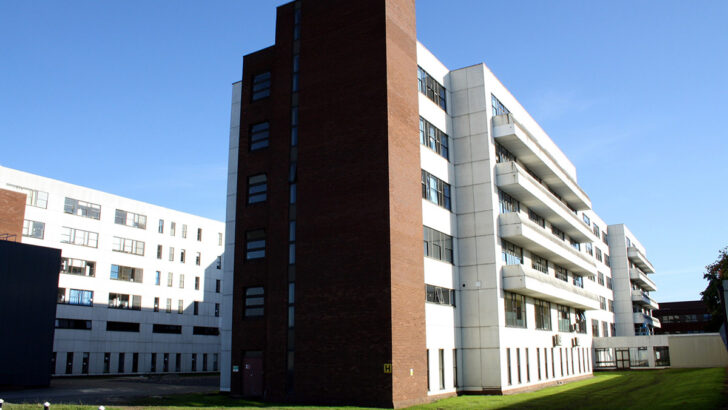
 Beaumont Hospital, Dublin. Photo: Public Domain.
 As Mayo’s footballers were heading Westwards with the Sam Maguire cup, I was making my way to the Accident & Emergency unit of Beaumont Hospital to get my acute stroke treated. If you have never been there, recall the railroad scene in Gone With the Wind, where dead and dying Confederate soldiers litter the ground as far as the eye can see.
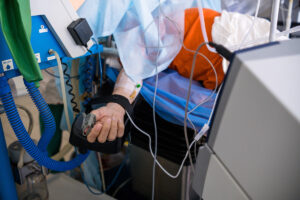
Once I was passed through the overcrowded waiting room, I was guided past columns of patients in beds and onwards to an empty chair in a sea of occupied chairs where I spent the next two days, being periodically visited by the overworked nurses, doctors, consultants and the rest of the Beaumont crews, who work mini-miracles with the insufficient resources the Government allocates to them.
In that respect, they are no different from the Sisters of Mercy, who treated the stroke of legendary GAA broadcaster Mícheál Ó hEithir at their Jervis Street hospital, which was one of two Catholic-run hospitals Beaumont replaced in 1987 and which, given their meagre resources, the nuns ran on a hierarchical system derived from their involvement in the 1854-1856 Crimean War, where they pioneered modern nursing and from which they learned the nuts, the bolts and the finer points of tending to the armless, the legless, the blind and the insane.
Service
Although the Beaumont staff are no less committed than the Sister of Mercy, they have a catchment area that extends 40km north to Drogheda’s Our Lady of Lourdes Hospital, which the Medical Missionaries of Mary, one of the Catholic Church’s truly great orders, founded in 1955. Not only does that huge catchment area set Beaumont an impossible task but all our various governments down the years have promised to vastly expand their resources to account for the vastly increased populations of Swords, Balbriggan and all of north Dublin.
All of that, at best, is in the forever future. In the here and now, all the successive governments seem interested in doing is tweaking the system to pare off some pennies from their annual €28 billion budget by capping consultants’ pay and, in the process, make faraway fields in Australia even greener for generations more of Irish medics, all while making more empty promises to make it easier for the Irish health workers their seat of the pants policies exiled to return to the land of the shamrock and heather to ply their trade.
None of that solves the problem of how to make our overall health service fit for the greater demands”
Mañana, mañana, mañana. For me, I had a great time making stupid jokes with the Spanish and Mexican nurses, as well as the Filipinos and Keralans who, like the Portuguese consultant who headed the largely Irish team, who made me fighting fit, are a credit to Beaumont, to Ireland and, above all, to humanity itself, which they so diligently serve.
Not only could I find no loose thread to criticise them or those who went before these lads and ladies of the lamp, but nor could any of my fellow patients, who were as infinitely grateful as I am.
Importantly, this gratitude extends to the burly security staff, who patrol the wards in their stab vests. Although they seem out of place, they are needed to counter the drug addicts, drunks and sundry psychotics the medical staff regularly have to contend with in the course of their day-to-day work.
Although the consultants, doctors, nurses, care assistants, dietitians, physios, canteen staff and the rest of them combined to return me and countless others to the front lines, none of that solves the problem of how to make our overall health service fit for the greater demands our enlarged population and our insatiable demands put on it.
Reforms
If reforms were up to me and not up to politicians seeking partisan sound bites, I would take particular heed of whatever insights those at the front line in Beaumont have to offer with regard to the million and one constraints they labour under, but I would also tap up the Sisters of Mercy, the Medical Missionaries of Mary, and the other great orders to see what insights they have in tackling our health crisis and, if they were up for it, what they think of such messes as the children’s hospital and the hepatitis scandal successive governments lumbered us with.
That just shows our growing disconnect from our cultural and religious roots”
If there is one practical advantage all those heroic nuns have over many of today’s frontline workers, it is that they saw themselves toiling with their fellow nuns in the health, education and allied fields towards the common higher goal of their common Catholic religion, which is now as much a target of mercenary predators as it was at the time of the Anglican Reformation.
The news from the Beaumont front is one of the Irish doctors tending to me had never heard the parable of the ten lepers and, like the demonisation of the valiant nuns of yesteryear, that just shows our growing disconnect from our cultural and religious roots, which will most likely deliver us, as it has in Canada, euthanasia (death with dignity they call it) not only for my age cohort but for the much younger and much more scared Ballina teenager who shared my ward but, even without the commentary of fellow stroke victim Mícheál Ó hEithir; was still delighted to share in the magic of the green and red of Mayo, thanks to the hard working heroes of Beaumont Hospital’s accident, emergency and stroke wards.