

 Mary Kenny
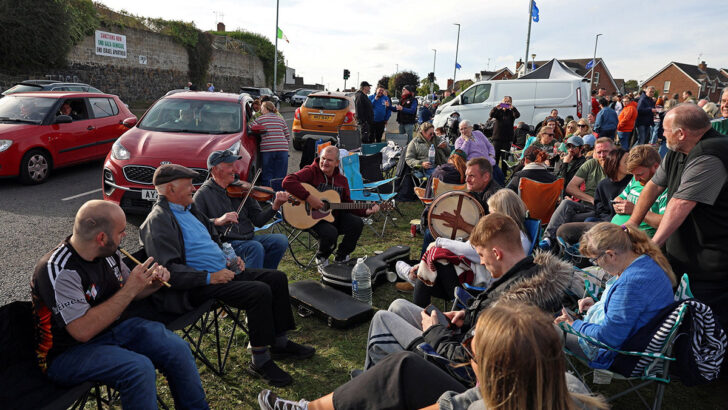 Residents of Garvaghy Road in Portadown, Northern Ireland, protest September 28, 2026, against the Orange Order’s annual Drumcree parade. Photos: OSV News / Cathal McNaughton, Reuters.
 There will be, no doubt, many sequelae to the Garvaghy Road events last weekend. Perhaps some will be good – a renewed desire for peace, and a resolve to make the shaky Stormont arrangements work. Perhaps some will be unintended – affecting the reputation of politicians in Dublin as well as in the North.
There could be a new energy in ecumenism, as Catholic and Protestant bishops and clergy work together to build bridges – as they are doing.
But there could, also, be an amplification of historical sectarianism, as old wounds are recalled and old injustices revived.
Another outcome might well be a deepening of cultural divisions between the 26 counties and the Six.
Differences
Some reaction in the Republic included sarky comments about whether “we” want to take on “them” in a future United Ireland.
The unhappy scenes prompted me to remember how differently southern Protestants were regarded, in contrast to their northern brethren.
I often heard the idea expressed – even if in a roundabout way – that “our” Protestants were of another ilk to “their” Protestants.
The Irish state was in the majority Catholic, but we felt it had tolerantly accommodated its Protestant minority”
“Our” Protestants included Yeats, O’Casey, Synge and Douglas Hyde – so many distinctive Irishmen who had fully identified as Irish, and even embraced Irish nationalism, going back to Tone and Emmet.
Whereas “their” Protestants consisted of hard characters like Brookborough – who wouldn’t employ Catholics – harsh bigots like Paisley, and aggressive Orangemen who intimidated Catholic communities.
The Irish state was in the majority Catholic, but we felt it had tolerantly accommodated its Protestant minority. Although not all Protestants felt comfortable, and there was an exodus of Southern Unionists in the 1920s, there was also a Free State Senate which deliberately provided a status and a platform for “our” Protestants. In crafting the Constitution of 1937, De Valera consulted Protestant and Jewish leaders.
While “their” Protestants were a very different tribe.
Didn’t Brendan Behan once quip (somewhat snobbishly): “The southern Protestant is an English gentleman; the northern Protestant is a Scottish artisan.”
Stereotyping
There’s an element of stereotyping in all this, and since the Good Friday Agreement, many felt we were moving away from such stereotypes, despite petty quarrels over issues like the Irish language.
But now I wonder if, having ascended the ladders of reconciliation, we’ve slid back down the snakes of old grievances.
Hopefully not. And thankfully, there’s been no actual violence. But the Garvahy Road is significant, and will have outcomes, some of which are still shrouded from our view.
===
Christa Pike and capital punishment
The appalling case of Christa Pike, in Tennessee, has revived commentary on the question of capital punishment.
Pike, aged 50, committed a heinous murder when she was 18, spent 31 years on death row, and was recently subjected to two botched attempts to execute her by fatal injection – surviving, but unconscious.
The death penalty is supported in many legislatures, from China to Texas, but the Pope has made it clear that we cannot sanction deliberate killing by the state – a guideline which extends to all forms of euthanasia.
Britain’s most famous hangman, Albert Pierrepoint – who was also hired by Irish governments to carry out executions at Mountjoy jail – did his job professionally for 25 years, hanging perhaps 600 people. Pierrepoint would have been appalled by events in Tennessee – because of the incompetence of the executioners.
He believed he was acting compassionately by despatching his charges as swiftly as possible. He executed Ruth Ellis, the last woman to hang in Britain, in eight seconds flat.
He was hugely critical of the American executioners at Nuremberg, post World War Two – some convicted Nazis took 20 minutes to die by hanging, instead of ten seconds.
Pierrepoint was more concerned with process – how well the job was done – than the morality of the procedure. Yet at the end of his life, he concluded that capital punishment had no deterrent effect against criminal homicide. Its only purpose was vengeance (and saving the taxpayer the expense of supporting lifetime prisoners).
===
Recently, the aperture to the fuel tank in my little old Renault got jammed shut, so I couldn’t fill up with petrol.
I asked a woman friend, a very experienced driver, what I should do. Should I just force open the vent?
Take it to the repair garage, she said. Actually, the vehicle was due a service a fortnight hence, but would my petrol gauge run empty before that?
I subsequently asked a male neighbour for advice. He examined the car, researched the issue on YouTube, fiddled about with the aperture cover patiently, dug out some WD-40 oil – and eventually got the gadget to spring open.
This confirmed my belief in the difference between men and women. Men often like being given a problem to solve, particularly a mechanical one. Women are less interested in widgets, more interested in people.
Of course there are many individual exceptions. But the general rule still holds!