

 Peter Costello
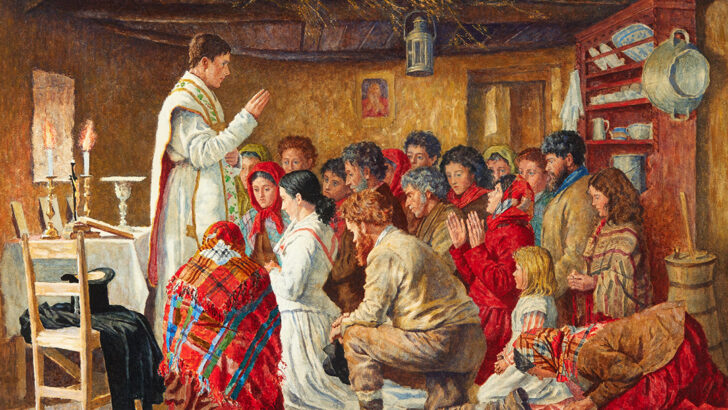 ‘Mass in a Connemara Cottage’, water colour by Aloysius O’Kelly. Photo: Courtesy of Whytes.com, Dublin.
 Some weeks ago, a weekend paper carried a large notice of an art auction due to be held on May 25 in Dublin. One of the pictures caught my wife’s eye: it was a familiar yet different image, a version in water colour of the large oil painting ‘Mass in a Connemara Cottage’ by Aloysius O›Kelly, now in the National Gallery on loan from its owners, the Parish of St Patrick, in the Cowgate, Edinburgh.
“Surely,” she exclaimed, “the National Gallery is not selling that picture.”
On inquiry it turned out the Gallery was not selling anything. What was on offer was a smaller water colour version on paper of the oil painting, perhaps a preliminary version to be scaled up. There also exists a monochrome grey wash drawing which would have been prepared for making an engraving for a periodical; this was bought for €7,500 at a Dublin sale in 2023.
Contact was made with her and with the National Gallery in Dublin, and the great painting moved from darkness into the brilliant light of recognition”
In August 2001 the now familiar oil painting was ‘recovered’, so to speak, by chance by Fr Robert Reid, a Redemptorist working in the parish. After a discussion of the painting which had been hanging on the dining room wall of the parish house of St Patrick’s, he was prompted to make a casual internet search only to discover it was a famous work of Irish art which had ‘lost’ for over a century, according to an article he found online by Prof. Niamh O’Sullivan. Contact was made with her and with the National Gallery in Dublin, and the great painting moved from darkness into the brilliant light of recognition.
It was thought it might have come to St Patrick’s through Canon Edward Hannan, a Limerick-born priest who was parish priest there until his death in 1891.
The artist himself has also received proper attention, thanks to the lengthy and detailed research of Dr Niamh O’Sullivan, who had written her doctoral thesis on O’Kelly. She drew attention as well to the reportage that O’Kelly had done for the Illustrated London News on Ireland in the 1880s, in the days of the Land League.
Aloysius O’Kelly and his brother James, an avowed atheist, who was eventually an Irish Parliamentary Party MP for Roscommon, were active in both the Irish republican movement and the Land League.
The two brothers also went out to Africa to cover for the British press the Mahdi’s revolt against his Egyptian overlords in 1882/4, which arose from the earlier Ottoman influence over Egypt and Sudan and which lead to the death of General Gordon in Khartoum in 1885 – a great shock to the British Empire, that was joy to Irish nationalists.
O’Kelly moved in French socialist circles in the Third Republic who were supportive of the Mahdi, when the French Republic was attempting to expand its own influence in a broad band across central Africa, from Dakar to Djibouti. As in South Africa Irish people supported ‘my enemy’s enemy’ with little regard for the rights of the natives.
Enchanted
But O’Kelly was enchanted by Cairo and the opportunities for his art in the bustling streets and alleys of the ancient city. This as yet is also a neglected aspect of his work.
“Orientalism”, the “colonialist” imaging of the Near East by European artists, got a bad name from the late Edward Said, who vociferously denounced it in his book Orientalism (1978). But in more recent decades these works from the 18th century onwards have come to attract the interest of wealthy Arabs and have vastly increased in price and in intellectual interest. They have now become the object of cultural interest across the world and are collected in museums.
But it has to be said that mystery surrounds much of the later career of O’Kelly. He migrated to the United States in 1895, where he took out citizenship in 1901, married and continued his career as a painter, largely of rural scenes, which have not yet attracted the same interest as his Irish or French works. He also at times exhibited as “Arthur Oakley”, a more anglicised formulation of his name, used perhaps to gain buyers who might not want to purchase an Irish artist.
Here in Ireland, we are perhaps more focused on O’Kelly’s work here; but it is likely that his paintings from France, Africa and America will rise in interest”
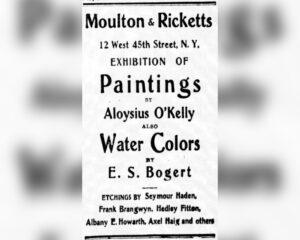
He certainly exhibited at prestigious galleries in New York, such as Moulton & Ricketts in 1912 and Snedecor’s in 1916; and painted portraits of contemporary luminaries such as President Wilson and the Mayor of New York in 1917.
Here in Ireland, we are perhaps more focused on O’Kelly’s work here; but it is likely that his paintings from France, Africa and America will rise in interest. O’Kelly’s reputation faded in the first decades of the 20th century, Prof. O’Sullivan thinks, because he simply “went out of fashion” in the days of the post-impressionists and the young Picasso.
But to return to the water colour that was sold on May 25. This was originally in a Catholic presbytery in New York but came by gift from a retired priest of the parish to a friend who had often admired it when he visited the priest. The condition is so fine that James Gorry believes it was not framed, but kept in a portfolio.
The new owner offered it for sale through the Gorry Gallery in March 2005. For the present sale it had a guiding estimate of €20,000 to €30,000; and in the event it sold for €40,000 to a private collector.
Whatever about the history of both the oil painting and the water colour, ‘Mass in a Connemara Cottage’ as a whole is an image that needs more explication”
The oil painting was exhibited at the Paris Salon in 1884, and four years later in London. It was after this that it perhaps went to Edinburgh.
Whatever about the history of both the oil painting and the water colour, ‘Mass in a Connemara Cottage’ as a whole is an image that needs more explication.
This painting is sometimes said to show mass being said in “penal times”: this is not the case. It shows a celebration of the sacrament in a family home about the time it was painted, long after Catholic Emancipation in 1829. By the 1880s far from being persecuted, the Catholic Church was the most influential social organisation in Ireland.
But it is a painting that suggests not oppression, but frugal comfort of the kind admired by de Valera. In the corner there is a butter churn, which implies the ownership of a small herd of cows. On the dresser there is a blue serving platter large enough to hold a roasted goose, geese going with the hens and ducks out in the haggard.
In the foreground a kneeling man wears a pair of sturdy leather boots. While in the centre of the picture there is a black-haired young woman in a fashionable white dress: I cannot help but wonder if she, rather than the young newly ordained priest, is the real focus of interest. Could she be a postulant nun, perhaps a sister of the young priest, preparing to enter a convent – which implies, too, enough money in the family for her “dowry” to the convent.
Assertive
So it is not an image of an oppressed people, but of an assertive faith, on its knees to the Church, but not to the Empire. We must remember that since the Famine there had been an extraordinary rise of church building across the island by the Catholic Church, with millions raised at home and abroad; many of the edifices we see today are a product of this period.
The priest is newly ordained, and perhaps one of the extended family before him. In the Illustrated London News O’Kelly had drawn the figure of a mature parish priest, at a moment of political crisis, talking to a small group of country people on a street corner, captioned “Consulting the Priest” – the very image of influence wearing his top hat.
What is shown in the oil is a more homely scene. There are eight men in the room, a small enough number to represent a single family, with their women folk and children.
Oddly enough, the novelist Rosa Mulholland, writing about the painting in the influential Jesuit publication the Irish Monthly in September 1889, was uncertain about it.
She would have preferred it to have a more sentimentalised image of Irish religious life. She was bothered by the strict realism of O’Kelly’s observation.
But it is just that sense of real observation, in rural Ireland, in Kilmainham Gaol, in Connaught towns, and in the streets of Cairo that makes him such an important painter, whether in or out of fashion.