

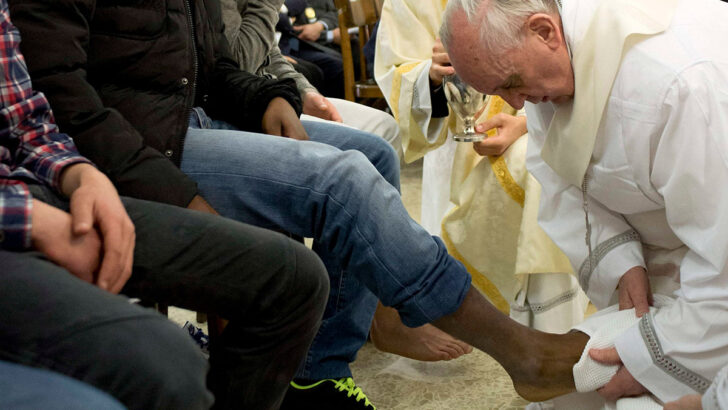
 Pope Francis washing the foot of a young inmate during the Holy
Thursday Mass at Rome’s Casal del Marmo youth prison. The gesture
captures the Gospel logic of humility and service. Photo: CNS photo/
L’Osservatore Romano via Reuters.
Pope Francis washing the foot of a young inmate during the Holy
Thursday Mass at Rome’s Casal del Marmo youth prison. The gesture
captures the Gospel logic of humility and service. Photo: CNS photo/
L’Osservatore Romano via Reuters. Apologetics: the missing dimension of evangelisation
Dear Editor, One necessary dimension of evangelisation seems absent from the articles of Fr Eamonn Conway and Fr Billy Swan in The Irish Catholic (March 12) – that of apologetics. Two scenarios indicate its necessity.
Firstly, one quotation from Nicholas Cuddihy’s article (p. 17) concerning schools designated as Catholic: “You can have a group of nonbelieving parents sending their nonbelieving children to a school where they are taught about faith by a teacher who is also a nonbeliever.” Secondly a recent vox pop on RTE radio in a provincial town revealed that six of the eight nominal Catholics interviewed had no interest nor felt any need, or reason or duty to attend Mass.
These realities do not necessarily convey total opposition to Catholic faith, but show little likelihood that the obedience of faith would be considered rational. The purpose of apologetics is to convey to people 1) that it is reasonable to have faith, 2) it is reasonable to hold this specific faith and this specific belief and 3) that one doesn’t have to throw one’s brain in the rubbish bin to affirm 1) and 2). Allied to this is the Catholic belief that the natural structure of human existence aspires to a supernatural end.
Defending or promoting the rational nature of faith cannot be done by the light of faith arguing from faith. People defending the rationality of faith cannot presuppose faith. It is necessary to speak the language of the person holding viewpoints contrary to faith and to know how to lead the interaction towards faith, confident of a response to an inner call on the part of the other.
Apologetics is a necessary and skilled, albeit one dimension of evangelisation and requires relevant appropriate skills cultivation in seminaries and parishes. Indeed some practising Catholics would welcome inputs on apologetics.
Yours etc,
Neil Bray
Cappamore, Co. Limerick
Being mindful of attending Mass while sick
Dear Editor, The practice of people turning up at mass when they know they are dying of a cold or flu should be strongly discouraged by the clergy. Church services are communal areas where people spread airborne and physical germs widely and rapidly and children choking with flus and coughs and colds, instead of having their parents bringing kids along which should be in bed.
At the very least they should be at home and not at mass or service where people are sitting right beside each other and touching common surfaces. Community acquired pneumonia is quite a common reason for serious illness and death among older people with lesser immune systems. One can see older people nestling alongside radiators sniffling into hankies as they shiver with the colds and viruses.
The psychology of ‘I have to go to mass’ must be debunked. Or any other public place people with flus and viruses should avoid. If people are not well enough to go, they by all means should not go, instead of spreading viruses of various kinds all over the community. It’s about time members of the clergy gave a sermon to their flock on this common sense.
Yours etc,
Maurice Fitzgerald,
Shanbally, Co. Cork
How can we celebrate Ireland without mention of our native language?
Dear Editor, Día agus Muire duit!
As a regular reader of The Irish Catholic I found it ironic that your St Patrick’s Day edition contained scarcely a word of the Gaeilge.
Fr Gregory Pine OP wisely exhorted us to “rediscover the real St Patrick”. Well, St Patrick – an immigrant and victim of human trafficking – preached in Irish, and wrote that he had to adapt to “the tongue of a stranger”. David Quinn asked the question, “What does it mean to be Irish anymore?” Yet his article – which spoke of our emigrants and Ireland’s role in world politics – made no mention of our native tongue!
I would say that the values that we inherited from St Patrick – regardless of world politics – are timeless. As the Good Lord said, “Heaven and earth may pass away, but my words will never pass away.” (Luke 21:33). And how lovely it is to hear His words as Gaeilge: Dia agus Muire duit agus Pádraig!
Another Patrick – Pearse – said “Tír gan teanga, tír gan anam.” Whatever his politics, Pearse was a deeply spiritual man. Sadly, some explanations of his dictum are rather miserable, making no allusion to spirituality.
So, The Irish Catholic has a most valuable role, but it needs to up its game with the Gaeilge!
Beannachtaí na Féile Cásca chugat!
Yours etc,
Proinsias Ó Luachra
Navan, Co. Meath
In the spirit of synodality
Dear Editor, I write concerning the proposal by the Archbishop of Dublin Dermot Farrell to close St Mary’s Cathedral for a two year €25 million refurbishment.
It is not clear, at present, who in the Dublin Diocese has been consulted about this plan. While one can only admire the relentless fundraising in recent years by Archbishop Farrell which has been accompanied by warnings about the perilous state of diocesan finances it now appears there is no problem getting the money for this work.
But this refurbishment raises other questions. What efforts, if any, have been made by the Dublin Diocese to see if the Church of Ireland would hand over one of its Dublin cathedrals or at least share them with us. The present situation has the potential to allow a great ecumenical act to emerge which many Dubliners would greatly appreciate.
Who has been consulted about all of this? In so far as I am aware there has, for example, been no consultation with the people of the parish that I attend, namely The Parish of St Columba and St Gall in Milltown.
On the face of it the manner in which Archbishop Farrell is proceeding does not correspond with the spirit and teaching of Pope Francis on synodality. Accordingly I urge him to immediately put a break on this €25 million project until there has been full and proper consultation with all parishioners in Dublin.
Yours etc,
Garrett Sheehan
Clonskeagh, Dublin 14
Understanding Luther and his relevance to the world today
Dear Editor, Maurice Keily in his article ‘Luther and the beginning of the Reformation’ (The Irish Catholic, February 26 2026) recalls his standing looking up at the dome of St Peter’s Basilica and thinking that it was ironic as its building was the immediate cause of the Protestant Reformation. A Dominican John Tetzel was preaching and selling indulgences. The money collected was given to Prince Albrecht, Archbishop of Magdeburg, to pay off his debts and to the Pope to finance the building of St Peter’s Basilica.
Prof. Owen Chadwick wrote that at the beginning of the 16th century everyone that mattered in the Western Church was crying out for reform. The book Martin Luther – His Challenge Then and Now by Fr Fintan Lyons OSB of Glenstal Abbey is relevant. Fr Lyons states that a study of the phenomenon of Luther, and his effects on Church and State, leads in the end to recognising that the issues that existed then are endemic to Christianity in every century.
The Book of the Year in 2017 was Martin Luther – Renegade and Prophet in which Prof. Lyndal Roper of Oxford University presents a flesh-and-blood figure of Luther and reveals the psychological forces that drove Luther forward in his battle against the Church. The beginning of the Reformation is interesting but its development and consequences are fascinating. Fr Lyons and Prof. Roper provide a good basis to understand Luther and how he is relevant to the world today.
Yours etc,
Daithi O’Muirneachain
Drumcondra, Dublin 9
‘Washing of the feet’: a humble yet significant ritual
Dear Editor, It is a great pity that the “washing of the feet” has been dropped from the Holy Thursday Liturgy in so many Churches. It is a symbolic ritual but one of great significance.
Pope Leo recently stated that the titles we bear in the Church are not important, but that we be grafted into Christ.
Humble service of one another is at the core of Christian life. “The washing of the feet” is an acting out of this truth.
Yours etc,
Judith Leonard
Raheny, Dublin 5
Trump and Havana negotiate amid economic blockade
Dear Editor, Cuba is reeling from the oil crisis amid direct talks with Donald Trump. Canada’s largest airline has suspended flights to Cuba due to a shortage of aviation fuel on the island; a move that comes amid a US orchestrated squeeze on the country’s oil supply that has also forced Havana to ration health, transport and school services.
The illegal US economic blockade has stymied oil and essential products from reaching Cuba, creating an unprecedented humanitarian crisis for 10 million people on the Caribbean Island which I have visited. The US embargo has forced the shutdown of public transport, waste collection while children have fallen victim to Dengue fever and malnutrition. Cuba, reeling from an oil shortage, has commenced direct talks with the USA in an effort to solve “bilateral differences” between the two countries, Cuban President Miguel Díaz-Canel broadcast nationwide in Cuba confirmed negotiations between the Trump administration and Havana.
The US and Cuba have been ferocious adversaries for 70 years, since Fidel Castro’s revolution toppled the US-backed dictator Fulgencio Batista. Donald Trump has been ratcheting up pressure on Cuba’s communist government, choking off oil supplies to the island and threatening military action against its leaders. The Caribbean island is barely surviving with rolling blackouts and severe shortages of food, medicine and gasoline. Cuba does not have a choice. Cuba’s deepening energy crisis had forced Havana to the negotiating table. But what the Trump administration hopes to achieve in the negotiations is unclear.
Yours etc,
Gerry Coughlan
Kilnamanagh, Dublin 24