

 Mary Kenny
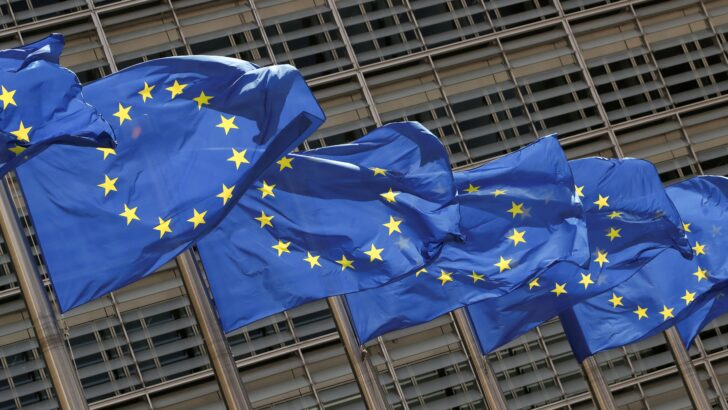 European Union flags flutter outside the EU headquarters in Brussels July 15, 2021. Photo: CNS/Yves Herman, Reuters.
There was, understandably, much grumbling about the massive shut-down of Dublin for the EU summit during the past week. Obviously, people were greatly inconvenienced and businesses complained they didn’t have sufficient time to prepare.
But in this case, I’m with the Government, which defended the security measures for “the bigger picture.” Thomas Byrne, Minister for European Affairs, was – with other TDs – sent out to bat for the greater good of the State.
Their line was that this summit was a significant platform for Ireland, showing the meaningful role we now play in the European Union. And all the big knobs from the Continent were coming to visit, as well as Andy Burnham from the UK and Mark Carney from Canada.
Ireland is front and centre to the European tradition, and it’s appropriate that Ireland’s ‘brand’ should be underlined in this way.
I only wish more Irish people – and especially younger people – were more aware that Ireland’s links with Europe are also intrinsically linked with its Christian and Catholic heritage.
From the monastic age to the Penal Times, the shared faith values have been a key aspect of the relationship. When Irish Catholics were barred from education in their own country, Continental Europe provided schools and colleges from Louvain to Salamanca.
The Irish were amongst the first pilgrims to Lourdes, and Aer Lingus pioneered flights there”
Daniel O’Connell’s own story illustrates that thread. Unable, as a Catholic, to access education at home, he was sent by his uncle to Saint-Omer in France.
Irish women of genteel families often went to convent boarding school in Belgium, and there developed a tradition of Irish girls as governesses in Spain – the novelist Maura Laverty wrote about this with insight in Never No More.
Irish devotional practice was linked with France, Italy and Iberia. Devotion to the Sacred Heart – instigated by St Margaret-Mary Alacoque – to St Thérèse of Lisieux, and to the Miraculous Medal of St Catherine Labouré were all strongly part of everyday Irish life. The Irish were amongst the first pilgrims to Lourdes, and Aer Lingus pioneered flights there.
There was also Fatima, Assisi, Medjugorje and the Camino di Santiago – all attracting Irish pilgrims.
Alas, there is little likelihood that these historic spiritual associations with the EU countries will be made known, let alone highlighted. Economic policy, transport and climate issues are seen as the main point of connection with the EU (and perhaps more problematic questions about defence). These are important and legitimate aspects of common European concerns, as are other matters on the agenda.
But relationships between nations are also built on a deposit of culture and history, and Ireland should not forget or erase how meaningful the heartfelt links between this island and the wider Continent have been.
====
St Martin of Tours
Last Wednesday, November 11, was the feast-day of St Martin of Tours, the French bishop who is the patron saint of so many locations all over Europe.
He is seen as a key evangelising figure, and the father of monasticism in France. (He died in 397 AD)
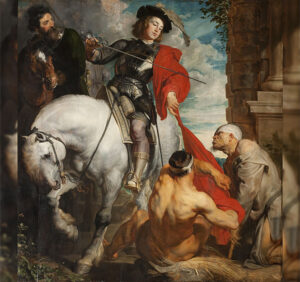
He is also one of the most frequently painted figures in European art history – Van Dyck and El Greco both painted his celebrated gesture of giving half his cloak to a beggar. There have been very many popular illustrations of the episode.
It has been taught as a feature in economics, too. A flatmate of mine, attending her first day’s course at the secular London University, came back praising St Martin as a pragmatic distributionist. Her lecturer had explained that by dividing his cloak in half, Martin had benefited two people – the giver and the recipient. If he had donated his whole cloak, only one person would have benefited.
I’d be surprised if economic theory is still taught by reference to St Martin – Ireland’s most famous economist David McWilliams is unlikely to do so. Yet the paintings illuminate how Martin inspired practical charity through the ages.
===
On Brand
Reactions to the Russell Brand rape trial – the celebrity comedian has been convicted of rape and sexual assault – have been so alarmed that compulsory safeguards to protect women may now be imposed on British broadcasting channels.
The culture secretary Lisa Nandy has warned that offending such as Brand’s “is probably happening today” in the entertainment and media industries and must be deterred.
If the late Mary Whitehouse is in Heaven, how wryly her spirit must be reacting to this. Again and again, she warned that pornography and the excesses of the sexual revolution would result in the degradation of women, and the exploitation of the young.
She was mocked and jeered at by broadcasting bosses as a prude and a narrow-minded Christian. Sometimes her targets were petty – she objected to bad language on air – but her overall analysis was spot-on. And now it seems guardrails are to be introduced in reaction to the coarsening of the culture which she so acutely critiqued.