

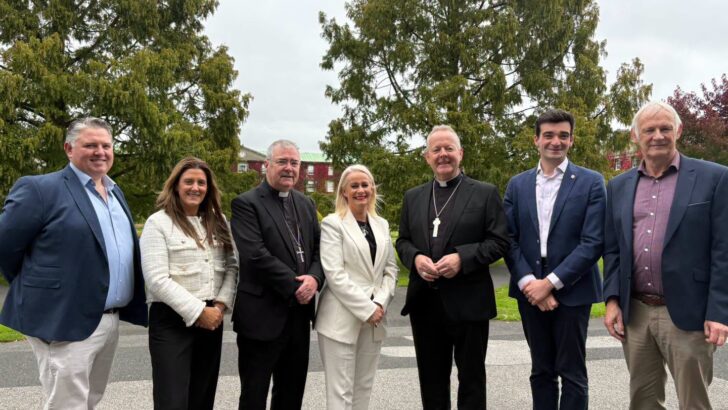
 Church and academic leaders at the ‘Living Magnifica Humanitas’ conference at St Patrick’s College, Maynooth, which explored the challenges posed by artificial intelligence. Photo: Irish Bishops’ Conference
 At the ‘Living Magnifica Humanitas’ conference in St Patrick’s College, Maynooth, Archbishop Eamon Martin asked the conference participants in his opening address to keep in mind the question, “Who has the power to call the current conversation about AI, and whose voice is missing from the room?”
Archbishop Martin referenced Magnifica Humanitas’ emphasis on interdisciplinary conversations around AI as the next step in addressing its challenges, and affirmed the Church’s capacity in convening these varying perspectives.
“Clearly scientists and developers need to be at the table. So do philosophers, theologians and ethicists. But the conversation also needs teachers, parents and young people; workers whose employment may change; people living with disability; artists and communicators; those experiencing isolation; and those who will live with decisions made by algorithms without ever having had a voice in designing them,” said the archbishop.
At the Service of Prayer for the Opening of the Academic Year for Trinity College, Auxiliary Bishop of Dublin Paul Dempsey pointed to Magnifica Humanitas as guiding light for academia’s attitude towards AI, referring to the pontiff’s encyclical as an invitation to the “human community into a conversation about the challenges AI poses.”
Like Archbishop Martin, Bishop Dempsey brought up Pope Leo’s assertion that conversation around AI must include a variety of perspectives, and described it as a “profoundly university-like idea”.
“The university, at its best, is a place where different kinds of knowledge meet. All of them need one another because no single discipline contains the whole truth,” he continued.
Writing about the Maynooth conference in this newspaper, columnist David Quinn notes that among those taking part in the conference was Head of OpenAI Ireland Emma Redmond. Mr Quinn shares his surprise that a leading AI company would be involved in a conference hosted by the Church.
“In some ways, you might have expected these companies to more or less ignore the Church,” he writes, comparing the ancientness of the Church to the newness of AI, and its direction into the future. Questioning why OpenAI would choose to have a presence at the Maynooth conference, Mr Quinn writes that a potential reason could be the genuine worry of AI developers about the “growing capabilities of AI”.
“Developers write software code for AI, but who is going to write the moral code? This is where the Church, and others with expertise in moral ethics, come in,” he continues. By pointing out the growing reliance of AI developers on ethical scholars and institutions, Mr Quinn makes the same assertion that Pope Leo made, that AI cannot be addressed without interdisciplinary perspectives.