

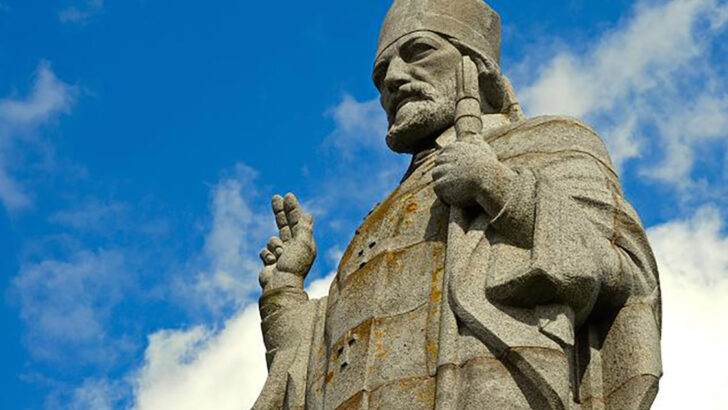
 tatue of St Patrick near Saul, Co. Down. Photo: Albert Bridge / geograph.ie.
 We celebrate the feast of St Patrick this year, conscious of the approaching centenary of his arrival in Ireland. Although we don’t know for certain the precise year of Patrick’s arrival and knowing that he certainly wasn’t the first Christian in Ireland, the date of 432 will be forever associated with the arrival of the Christian faith on this island. In 2032, we will celebrate the 16th centenary of Patrick’s coming which will be an opportunity to re-discover the person, witness and mission of the Apostle to the Irish, to reflect on how Christianity has shaped our country and culture in that time and to evaluate Christian faith today. The following year, 2033, will be another Jubilee Year that marks the 20th centenary of the death and resurrection of Jesus Christ.

For Irish Christians, the national commemoration of Patrick and the faith he brought paves the way for the universal celebration of Christ’s death and resurrection the year after. Both celebrations can be seen as organically related because the proclamation of Christ’s saving death and resurrection was at the heart of Patrick’s evangelisation of the Irish in the fifth century. It was a message proclaimed with the boldness and courage of the Apostles and yet, it was one that was given by Patrick who was a witness of God’s transforming love himself.
Unfortunately, a true appreciation of Patrick as a human being and as a Christian, has been impeded by layers of legends and caricature. Yet the real man lived a life that contained categories that we all can identify with still – religious indifference, the human experience of displacement, suffering, loneliness, risk, redemption, meaning, mercy and the response to a vocation that transformed countless lives. In all he lived through, Patrick found God whom he learned to trust and who directed his path in a providential way and directed his mission to the Irish people who had stolen his youth in slavery. In words that challenge any dry or formulated preaching of the Gospel, Patrick says that his mission to the Irish flowed from ‘holy mercy’ in his heart.
For these reasons and many more, the 16th centenary of Patrick’s arrival is timely for inviting the Irish Church to return to basics, to return to our original kerygmatic origins and to re-connect with the missionary spirit that was within Irish Christianity from the very beginning. In the words of Pope Benedict XVI, it will be an opportunity, not to impose Christianity as a world view, but to re-propose the basic facets of the Christian faith and how it continues to speak powerfully to the human heart that longs for fulfilment and joy. I am convinced that the vast majority of people are still open to be won over to faith in a God that knows and loves them.
The concern that many could have for a renewed missionary push at this time is the wound of scandal. Will all the baggage of past scandals be over and definitively dealt with by 2032? Probably not. In many ways, the wounds of the past will always be open. But rather than impeding us from new efforts to evangelise, Patrick’s story also contains hurt, betrayal, forgiveness and redemption. His story is one of hope for all – both victims and those who accompany them towards healing and hope.
In this sense, 2032 will celebrate the gift of saving faith brought to us by Patrick and that is still a powerful message today. 2033 will celebrate the giver, the source and well-spring of that paschal faith that comes to us from God through Christ and in the Spirit.
2032 and 2033 will be occasions that we need to prepare for and plan. To begin to prepare now, six years away, is not too early.
====
Pope Leo’s prayer intention for March
Although it was written long before the attacks on Iran, the following prayer from Pope Leo is prophetic and timely. For ‘Disarmament and Peace’, Leo invites us to pray with him: “Lord of Life, you shaped every human being in your image and likeness. We believe you created us for communion, not for war, for fraternity, not for destruction….Disarm our hearts of hatred, resentment, and indifference, so we may become instruments of reconciliation. May every kind word, every gesture of reconciliation, and every choice for dialogue be seeds of a new world. Amen.”