

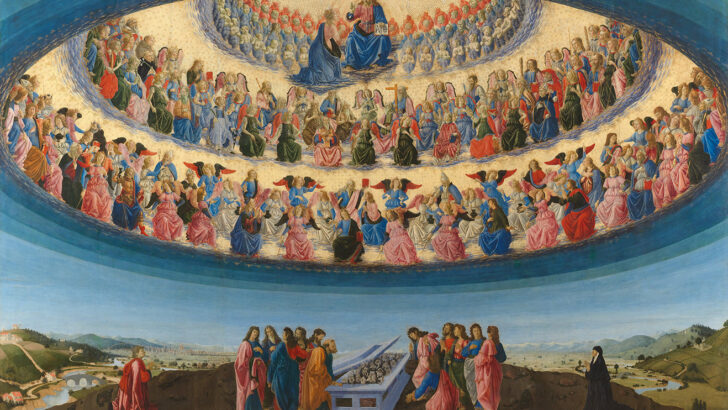
 27 - Heaven and earth meet in Francesco Botticini’s ‘The Assumption of the Virgin’, c.1475–76. Photo: Wikimedia Commons / Public Domain.
 In Heaven our union with God will be constant and have no disruption, writes Johnny Higgins
The ultimate destination for a follower of God is as mysterious as it is captivating. Each day with our human limitations we attempt to carry our own cross in prayer and deeds to prove ourselves worthy of entering this Kingdom but rarely discuss the beauty and details of Heaven. The good news of Heaven which was professed to us by the prophets of the Old Testament and by Christ in the New Testament is in sync with the knowledge espoused by the Pagan philosopher Socrates that the soul is eternal and is destined for a new realm beyond that of Earth.
The fact that one must be righteous to be in Heaven can be seen in the expulsion of any wrongdoers by virtue of victory over the evil one and his followers by the Archangel Michael ensuring a Kingdom only for pure hearted souls. Once the souls of those who occupy Heaven are clarified, one can then turn to the writings available to gain an understanding of this holy domain.
One first reflects on the works of St Thomas Aquinas who after experiencing a vision of Heaven, felt his writings on the subject were insignificant and could not do justice to what he saw, however, St Thomas Aquinas’ works remain amongst the pinnacle of scholarly insight on the Kingdom. Aquinas articulated that in Heaven one can see God in his actual beatific form, this is a spiritual vision where one sees the ultimate truth of God.
The Catechism instructs that while in Heaven our union with God will be constant and have no disruption”
As well as this, he states that we will receive new bodies that cannot be corrupted and are purified from the physical toils in this life. The saint also makes the point that God will reward us with varying degrees of his grace and glories in Heaven based on how we conduct ourselves on Earth and there is no one size fits all. He argued that the state of purgatory is when one is withheld from the beatific vision of God until their sins are cleansed.
The Catechism teaching on Heaven echoes the vision of God proclaimed by Aquinas in that we see God “as he is” in a face to face like manner in the company of Saints and purified souls. The Catechism instructs that while in Heaven our union with God will be constant and have no disruption differing from the mere momentary experiences which we share with God in this mortal life full of distractions.
Ahead
Additionally, we know Heaven will subject us to God’s glory and fruits as he has already opened up Heaven to his followers due to the Son’s death and resurrection. By appearing to us on earth in the form of Jesus Christ, God gave us an image which we could comprehend of him in this life but will be of a different guise and illustration in the next.
The Apostle John in the Book of Revelation also offers an inspiring image of what is ahead for us if we remain loyal to the words of Christ. John writes at a time when Christians were facing persecution by Pagan Roman rule which he had first-hand experience of in the attempt to boil him to death in oil by order of Emperor Domitian. The Apostle uses symbolism which would have resonated with an audience largely consisting of recently converted Jews hence his description of the twelve tribes of Israel inscribed on the twelve gates of the New Jerusalem which all 144,000 inhabitants of Heaven had descended from.
St Thomas Aquinas’ and the Apostle John’s interpretations of Heaven are different but equally valid and wholly sincere”
He reinforces Aquinas’ and the Catechism’s teaching of being present with the Father and Christ in Heaven but has a divergent image of Christ as a lamb who is the only one worthy of opening the scroll containing God’s plan. One is also shown reference to musical beauty in the angel’s blowing of the trumpet as well as God’s power of nature by the flashes of lightening, thunder and earthquake’s which occur once Heaven opens and it is time for humanity to be judged.
The majesty of the New Jerusalem is communicated in the treasure of precious metals and gemstones such as the walls made of jasper and the great street of the city made of pure gold. John’s vision also states that there are no temples in Heaven as the temple is the presence of the Lamb and the Lord Almighty.
It must be stressed that St Thomas Aquinas’ and the Apostle John’s interpretations of Heaven are different but equally valid and wholly sincere. The catechistic teaching is rightly open ended as it is true no human being can describe Heaven as it is a realm that whilst in this life is beyond our comprehension, However, we can take solace in the fact that these two behemoths of Catholic teaching and doctrine had vision’s which were truly divine so much so that the Apostle John kissed the feet of the Angel who afforded him the privilege to have the sighting.
One does not need to forecast what Heaven will look like as this will be revealed in the fullness of time, however, the guarantee is the peace, glory and tranquillity which God will grant us there. In the here and now, we must strive to live in accordance with the teachings of our saviour Jesus Christ each God given day.