

![Hearers of the word Exodus 34:4-6, 8-9; Ps [= Dan 3:52-56]; 2 Corinthians 13:11-13; John 3:16-18](https://www.irishcatholic.com/wp-content/uploads/2026/05/39_01-728x410.jpg) Henry Ossawa Tanner’s ‘Nicodemus Visiting Jesus’ depicting the night-time encounter in which Christ tells Nicodemus: “God so loved the world that he gave his only Son.” Photo: Wikimedia Commons / Public Domain.
Henry Ossawa Tanner’s ‘Nicodemus Visiting Jesus’ depicting the night-time encounter in which Christ tells Nicodemus: “God so loved the world that he gave his only Son.” Photo: Wikimedia Commons / Public Domain. For God so loved the world that he gave his only Son

The Gospel
John 3:14 And just as Moses lifted up the serpent in the wilderness, so must the Son of Man be lifted up, 15 that whoever believes in him may have eternal life.
John 3:16 For God so loved the world that he gave his only Son, so that everyone who believes in him may not perish but may have eternal life.
John 3:17 Indeed, God did not send the Son into the world to condemn the world, but in order that the world might be saved through him.
John 3:18 Those who believe in him are not condemned; but those who do not believe are condemned already, because they have not believed in the name of the only Son of God.
John 3:19 And this is the judgment, that the light has come into the world, and people loved darkness rather than light because their deeds were evil.
John 3:20 For all who do evil hate the light and do not come to the light, so that their deeds may not be exposed.
John 3:21 But those who do what is true come to the light, so that it may be clearly seen that their deeds have been done in God.”
Initial observations
The prescribed reading is very familiar and often quoted. In order to understand so familiar a passage more clearly, verses before and after have been included in italics. In John 3:16, we touch one of the best-known and best-loved passages in the whole Bible. Not everyone understands and/or likes what comes before and after – the imagery in vv. 14-15 is difficult for us and the exclusionary tone of vv. 17-21 disturbs us today. The community context of the time of writing can be of some help because of the extent of divisions, even schisms, in the Johannine community.
Kind of writing
The passage is a composite meditation, reflecting the teaching of the Johannine community, taking us to the end of chapter 3. The story starts with Nicodemus and continues with Jesus’ speaking, but these words are really the theology of the later community.
Old Testament background
Light is often used in the OT for God’s guidance and word (see the Psalms especially). However, the “big” background to our passage is (i) Abraham and the sacrifice of Isaac and (ii) Moses in the desert.
(i) Isaac. The wording in John 3:16 echoes the story of the (not actually required) sacrifice of Isaac, one of the “texts of terror” from the Bible. It is echoed here for an extraordinary effect: Abraham was tested to see if he had the heart to give his longed-for son back to God, in an apparently immoral and incomprehensible, even contradictory and absurd request. In the Fourth Gospel, the writer turns it around: we learn that God has the heart to give his beloved Son with the added shock that the sacrifice is carried through and the Son of God is to die on the cross. The centrality of the cross and resurrection John was one of the causes of the split both from Judaism and within the Johannine community itself. Abraham was in everybody’s mind: mentioned by Jesus, Paul, Hebrews and all four Gospels at different times.
(ii) Moses. In the book of Numbers ch. 21, there is a mysterious story of the people’s rebellion and God’s punishment by snake bites. “And the Lord said to Moses, ‘Make a poisonous serpent, and set it on a pole; and everyone who is bitten shall look at it and live.’ So Moses made a serpent of bronze, and put it upon a pole; and whenever a serpent bit someone, that person would look at the serpent of bronze and live.” (Numbers 21:8-9) For our purposes, the symbolism lies in the paradoxical fact that the cure resembles the disease. This paradox holds in a good deal of psychological treatment and even in the use of pharmaceuticals: healing involves facing the root cause of the complaint. The use of it in today’s Gospel carries the meaning that the “cure” for the death of each human is Jesus’ facing death on our behalf.
New Testament foreground
(i) The language used in the verses added here echoes the words of Jesus in the Synoptic gospels: “No one after lighting a lamp hides it under a jar, or puts it under a bed, but puts it on a lamp stand, so that those who enter may see the light. For nothing is hidden that will not be disclosed, nor is anything secret that will not become known and come to light.” (Luke 8:16-17) “No one after lighting a lamp puts it in a cellar, but on the lamp stand so that those who enter may see the light. Your eye is the lamp of your body. If your eye is healthy, your whole body is full of light; but if it is not healthy, your body is full of darkness. Therefore consider whether the light in you is not darkness. If then your whole body is full of light, with no part of it in darkness, it will be as full of light as when a lamp gives you light with its rays.” (Luke 11:33-36)
(ii) There is extensive use of light symbolism in the Fourth Gospel: “He came as a witness to testify to the light, so that all might believe through him. He himself was not the light, but he came to testify to the light. The true light, which enlightens everyone, was coming into the world.” (John 1:7-9) “As long as I am in the world, I am the light of the world.” (John 9:5) Jesus said to them, “The light is with you for a little longer. Walk while you have the light, so that the darkness may not overtake you. If you walk in the darkness, you do not know where you are going. While you have the light, believe in the light, so that you may become children of light.” (John 12:35-36) “I have come as light into the world, so that everyone who believes in me should not remain in the darkness.” (John 12:46)
St Paul
But now apart from the law the righteousness of God (which is attested by the law and the prophets) has been disclosed– namely, the righteousness of God through the faithfulness of Jesus Christ for all who believe. For there is no distinction, for all have sinned and fall short of the glory of God. But they are justified freely by his grace through the redemption that is in Christ Jesus. God publicly displayed him at his death as the mercy seat accessible through faith. This was to demonstrate his righteousness, because God in his forbearance had passed over the sins previously committed. This was also to demonstrate his righteousness in the present time, so that he would be just and the justifier of the one who lives because of Jesus’ faithfulness. (Romans 3:21–26 NET)
Brief commentary
From the First Letter of St John, it seems clear that the community for which he was writing experienced tremendous division and schism – a rejection of the spiritual guide of the community and his teaching. See 1 John 5:10.
Verse 14 In this gospel, “lifting up” means both the cross (physical) and the resurrection (spiritual) at the same time.
Verse 15 Faith / belief is very much at the heart of the Fourth Gospel, where the verb occurs 98 times. The last beatitude in 20:18 reflects things. “Blessed are those who have not seen and yet have come to believe.” (John 20:29)
Verse 16 The key words are “loved”, “gave” and “believe.” Eternal life means life now in Jesus, and not simply a future reality. Authentic life from and in Christ might be a good translation.
Cf. “And this is eternal life, that they may know you, the only true God, and Jesus Christ whom you have sent.” (John 17:3; see also John 3:15-16, 36; 4:14, 36; 5:24, 39; 6:27, 40, 47, 54, 68; 10:28; 12:25, 50; 17:2-3).
Verse 17 The deeply positive purpose of God. Behind the words used stands the image of Abraham and the (near) sacrifice of Isaac.
Verse 18 These are they who once believed and then consciously and therefore culpably rejected life in Christ. It doesn’t mean just anyone without faith.
Verse 19 The Gospel writer will return to this difficult theme in chapter 5. “Very truly, I tell you, anyone who hears my word and believes him who sent me has eternal life, and does not come under judgment, but has passed from death to life.” (John 5:24) The image of light is full of potential (John 1:4-5, 7-9; 3:19-21; 5:35; 8:12; 9:5; 11:9-10; 12:35-36, 46); it is matched in this Gospel with the language of darkness and night (John 1:5; 3:2, 19; 6:17; 8:12; 9:4; 11:10; 12:35, 46; 13:30; 19:39; 20:1; 21:3).
Verse 20 An echo of Jesus’ sayings in the Synoptic gospels, as noted above.
Verse 21 The positive conclusion to the whole teaching also echoes synoptic material.
Pointers for prayer
- Jesus speaks of himself being lifted up, a term that can mean a physical lifting, or also exaltation. By this play on words the evangelist explains to us that Jesus’ gift of himself in the passion was a glorious revelation of love, despite all its injustice and brutality. Bring to mind occasions when the love shown by Jesus in his passion was a sacrament of God’s love for you.
- It would be very cushy for us if we could be a source of life to others without cost to ourselves. The true life-givers know that they need the generosity of being lifted up by giving their lives so that others may have life. Recall when you have had that generosity and give thanks for others who have been like that for you.
- We receive life from God when our faith enables us to trust in God’s love for us. We give life to one another when the love between us is trustworthy. Recall memories of that kind of trustworthy love. For whom have you been able to be a ‘Jesus person’ and give a love that another could trust? Who has shown that kind of love to you and been for you a sacrament of God’s love?
- People loved darkness rather than light…so that their deeds may not be exposed. Judgment and condemnation are very inhibiting forces and we easily slip into them. Occasionally we meet someone who is non-judgmental, who does not come into the world to condemn the world but in order that the world might be saved. What has it been like for you when you met a non-judgmental person? What has it been like for you, and for other people, when you have been able to adopt a non-judgmental approach them?
Prayer
Merciful and gracious Father, you showed the fullness of your love when you gave your only Son for our salvation and sent down upon us the power of your Spirit.
Complete within us the work of your love, that we who have communion in Christ may come to share fully the undying life he lives with you, in the unity of the Holy Spirit, God for ever and ever. Amen.
Thought of the day
The Trinity is not first of all a puzzle, which in principle could be solved, bur rather a mystery, a relationship which is first of all lived, never exhausted and only inadequately spoken of in words. This is true of any of the significant relationships in our lives and true, therefore, all the more so of God. Within the mystery of that relationship, we recognise God, from whom we come, in whom we live and move and have our being. We recognise the Son, the way, the truth and the life. We recognise the Spirit, who helps us to pray when we do not know how to pray as we ought.
Prayer
The grace of our Lord Jesus Christ, the love of God and the fellowship of the Holy Spirit be upon us all. Amen.
**
The grace of the Lord Jesus Christ, the love of God and the fellowship of the Holy Spirit be with you all
The first reading
2 Cor 13:11 Finally, brothers and sisters, farewell. Put things in order, listen to my appeal, agree with one another, live in peace; and the God of love and peace will be with you.
2 Cor 13:12 Greet one another with a holy kiss. All the saints greet you.
2 Cor 13:13 The grace of the Lord Jesus Christ, the love of God, and the communion of the Holy Spirit be with all of you.
Initial observations
While the reading is chosen for its apparent reference to the doctrine of the Trinity as later developed in the Christian church, in the historical context of 2 Corinthians Paul’s final instruction and prayer are intended very practically indeed, as we shall see below.
Kind of writing
Canonical 2 Corinthians ends in 12:14-13:13, in effect a series of final admonitions and an intense appeal.
While Trinitarian in form and theological in tone, the final greeting is immensely practical, given the context of divisions and animosity which marked the Corinthians correspondence as a whole. It is, perhaps, good to remember that conflict is actually normal. What is Christian is how we deal with it.
Origin of the reading
2 Corinthians shows marks of editing and compilation. At the very least, chapters 1-9 and 10-13 cannot have been originally in the one letter. Trying to make sense of the composite nature of 2 Corinthians calls for close reading and careful assessment of the data. The hypotheses are myriad and difficult for the non-specialist to master.
For instance, our short reading may very well have been the final greeting of one of the letters which went into our canonical 2 Corinthians. In the course of the fraught and very fast moving relationships with the Corinthians, a “letter of reconciliation” was eventually sent, which can be reconstituted from our 2 Corinthians as follows: 1:3-2:13; 7:5-16 and 13:11-13. This letter of roughly four chapters — the base text for our 2 Corinthians — is quite short and the reader may like to glance at just those verses to get the feel of what was at stake. As such, it makes for very attractive, inspiring reading. It terms of timing, this penultimate communication (the short one) may have followed some ten months after 1 Corinthians.
Related passages
Now the Lord is the Spirit, and where the Spirit of the Lord is, there is freedom. (2 Cor 3:17)
Go therefore and make disciples of all nations, baptising them in the name of the Father and of the Son and of the Holy Spirit, and teaching them to obey everything that I have commanded you. And remember, I am with you always, to the end of the age. (Matt 28:19–20)
Indeed, even though there may be so-called gods in heaven or on earth—as in fact there are many gods and many lords— yet for us there is one God, the Father, from whom are all things and for whom we exist, and one Lord, Jesus Christ, through whom are all things and through whom we exist. (1 Cor 8:5–6)
Peter, an apostle of Jesus Christ, to the exiles of the Dispersion in Pontus, Galatia, Cappadocia, Asia, and Bithynia, who have been chosen and destined by God the Father and sanctified by the Spirit to be obedient to Jesus Christ and to be sprinkled with his blood: May grace and peace be yours in abundance (1 Pet 1:1–2)
Brief commentary
Verse 11 This verse contains five commands or imperatives. “Farewell” is a standard final greeting in letters of the period. It means literally however “rejoice!” and, bearing in mind the other imperatives here, it is probably more than a formula. Paul would really like them to rejoice. In his The New Testament for Everyone, Tom Wright has “celebrate”, which captures the mood accurately. “Put things in order” could also be rendered “mend your ways” (Jan Lambrecht). “Listen to my appeal” could be either “be encouraged” or “heed my appeal.” Wright has “strengthen one another,” using one of the possible meanings of parakaleo (whence paraclete). “Agree with one another” is literally “be of the same mind” as in Rom 12:16; 15:5; Phil 2:2 and 4:2. “Live in peace” is also found in Rom 12:18 and 21 Thess 5:13. It is evident that these appeals / commands are not at all haphazard but address directly, even sharply, the Corinthian situation. Paul promises that the fruit of such effort will be the God of love and peace. Oddly, this is the only time in the New Testament that the expression “the God of love” is to be found.
Verse 12 It is hard to say whether the holy kiss was an innovation of Paul’s or simply part of the worship practice. In any case, it serves to link their social reconciliation with their worship. The “sign of peace” enacts the reconciliation.
Verse 13 This final prayer lacks a verb in Greek, but it is understood and easily supplied. Precisely because of the raw relationships and the recently achieved reconciliation, each word is intensely apt. Grace: behind the Greek stands the Hebrew hesed, meaning God’s gracious covenant love, freely given so that we may freely give. The love of God echoes the previous phrase, the God of love. This is the Christian agape, meaning to choose the wellbeing of the other without regard to oneself. Communion/fellowship or koinonia is a key expression for the Pauline assemblies. Scholars debate whether “of the Holy Spirit” should read “fellowship with the holy spirit.” If all the genitives are the same (i.e. “of”), then we have here a fine Trinitarian formula. Not accidentally, the final phrase is “with all of you” — that is, grace, love and communion must be real, however challenging.
Pointers for prayer
- Take any of the five imperatives and apply it to your life…what comes up?
- We would all love to have the God of love and peace in our lives: what am I doing to allow that to take place?
Prayer
God of love and peace, today we need more than ever your presence, your love and your peace. As we receive these gifts from you, let us share them with all we meet so that love and peace may be the marks our communities of life and faith. Through Christ our Lord. Amen.
**
A God merciful and gracious, abounding in love and faithfulness
The second reading
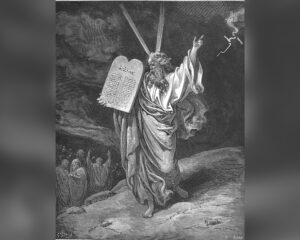
Exod 34:4 So Moses cut two tablets of stone like the former ones; and he rose early in the morning and went up on Mount Sinai, as the Lord had commanded him, and took in his hand the two tablets of stone.
Exod 34:5 The Lord descended in the cloud and stood with him there, and proclaimed the name, “The Lord.”
Exod 34:6 The Lord passed before him, and proclaimed, “The Lord, the Lord, a God merciful and gracious, slow to anger, and abounding in steadfast love and faithfulness.…”
Exod 34:8 And Moses quickly bowed his head toward the earth, and worshipped.
Exod 34:9 He said, “If now I have found favour in your sight, O Lord, I pray, let the Lord go with us. Although this is a stiff-necked people, pardon our iniquity and our sin, and take us for your inheritance.”
Initial observations
For the feast, a classical text of Old Testament theology is proclaimed. It constitutes part of the response to the “incident” of the Golden Calf and amounts to a fresh declaration of monotheism and a consequent rejection of idolatry. The text reconfirms the affirmation of the First Commandment. (It is easy to see why v.7 has been omitted in the lectionary.)
Kind of writing
The large section (33:18-34:28) is a complex of different sources, very carefully intercalated to reflect on the presence and identity of God once again. The parallels between it and Exodus 3-4 have led commentators to suggest that the sections were composed in light of each other. In religious discourse, nothing is more important that the presence of God, both elusive and immediate, the mysterium tremendum et fascinans.
Origin of the reading
Exodus 32-34 The incident of the Golden Calf as its aftermath.
32:1-6 The Golden Calf
32:7-13 Anger and judgment
33:1-6 Command to leave Sinai
33:7-11 The Tent of Meeting
33:12-17 A prayer for mercy
33:18-34:9 YHWH’s response
34:10-28 Renewal of the Covenant
Our reading comes from 33:18-34:9. To feel the force of the lectionary excerpt, it would be good to read all of Exodus 32-34 or at the very least Ex 33:12-17, the emotional and theological centre of the narrative.
Old Testament background
Three OT passages suggest themselves:
God said to Moses, “I Am Who I Am.” He said further, “Thus you shall say to the Israelites, ‘I Am has sent me to you.’” (Exodus 3:14)
You shall not make for yourself an idol, whether in the form of anything that is in heaven above, or that is on the earth beneath, or that is in the water under the earth. You shall not bow down to them or worship them; for I the Lord your God am a jealous God (Exodus 20:4–5)
“I will make all my goodness pass before you, and will proclaim before you the name, ‘The Lord’; and I will be gracious to whom I will be gracious, and will show mercy on whom I will show mercy.” (Exodus 33:19)
Brief commentary
Verses 1-3 The apparently practical tone of these instructions should not conceal the build up of tension and suspense. This encounter will be an awesome one, a meeting with God who is totaliter aliter, totally other, in the old Latin tag.
Verses 4-5 Again, the apparently literal fulfilment of God’s instructions raises the suspense even higher. The reader may notice the quiet build-up of verbs: cut, rose, went, took. The reader may also notice that our lectionary excerpt (JB translation) seems to omit significant phrases here. Here is the New Jerusalem Bible version:
And Yahweh descended in a cloud and stood with him there and pronounced the name Yahweh. Then Yahweh passed before him and called out, ‘Yahweh, Yahweh, God of tenderness and compassion etc. (Exodus 34:5–6)
There is an ambiguity in 5b: who is the speaker, YHWH or Moses? It seems best to assign the acclamation in 5b to the Lord himself and to see v.6 as an amplification, in parallels which echo Ex 3:14. The holiness of the name in Biblical tradition makes the passage all the more powerful.
Verse 6 The repetition of the divine name identifies God as both beyond (transcendence) and active (immanence). It reminds us of Ex 3:14, where the veiled unveiling of the divine name is a prelude to divine action in the Exodus. Who this “lord” is is expounded in vv. 6b-7.
Verse 7 This is omitted in the lectionary (it would distract) but it is, at the same time, a very standard kind of affirmation / threat, most likely of very ancient origin. The deep meaning is still good: God means to be a consistent lover and he expects the same after the covenant is renewed again.
Verses 8-9 The body language says it all and when Moses does find words they simply confirm the gracious offer made by YHWH. God’s election in grace is the key. Cf. Now therefore, if you obey my voice and keep my covenant, you shall be my treasured possession out of all the peoples. Indeed, the whole earth is mine, but you shall be for me a priestly kingdom and a holy nation. (Exodus 19:5–6)
Pointers for prayer
- In the wider setting, Moses encounters God as the Lord always ready to relent, always ready to forgive. Perhaps you have some ordinary experience of this in your relationships? Perhaps in faith, too, you have discovered this tremendous grace?
- Can you name the moment(s) or time(s) in your life when the absolute otherness of God became apparent to you, a time when words no longer “worked”? And yet, in this totally other “mystery”, we live and move and have our being!
- The desire to have the Lord in your life is a key moment in the development of faith. In the Emmaus story, it takes the form of “stay with us Lord”. In our first reading, Moses says, “Let the Lord go with us.” Amen!
Prayer
O God merciful and gracious, slow to anger, and abounding in steadfast love and faithfulness, help us to know you by placing our lives in your hands. Go with us that we may come to love you, with all our heart, all our soul and all our might. Amen.
**
The Liturgy
The first and third readings
Our first reading brings to expression the heart of the Old Testament theology of God. The reading from John 3 functions for many believers in exactly the same way—an easily remembered and well-loved confession of the love of God.
The responsorial Psalm
The text is taken from Daniel 3, a hymn of praise which joyfully celebrates the otherness of God, as expressed in Exodus 34.
Sunday introductions
First reading
Exodus 34:4-6, 8-9;
Who is “god” for you? In the classical tradition, God is beyond (greater than our minds) and yet within (closer to us than we are to ourselves). Though our reading is quite brief, it is deep, bringing out these two dimensions of our Emmanuel, God-with-us.
Second reading
2 Corinthians 13:11-13
Why do we believe in the Trinity? Because in our experience God is both origin and beyond (the Father), who spoke to us in history (the Son) and who lives in our hearts (the Spirit). The paradox of doctrine tries to hold this extraordinary reality.
Gospel
Jn 3:16-18
How do we know that anyone loves us? How do we know that God loves us? Not only “how” but “why” and “so what?” all come to mind as we hear this reassuring and yet unsettling reading.
Weekday introductions
Monday 1 June
St Justin, martyr
2 Peter 2:1-7
Each of us is in this reading today. Firstly, we are there as receivers of great gifts from God. Secondly, as people called upon to live up to these great gifts.
Mark 12:1-12
It is important not to leave this parable safely in the past. Have I heard the teaching of the prophets? Am I open to the coming of God’s Son today?
Tuesday 2 June
Sts Marcellinus and Peter, martyrs
2 Peter 3:11-15,17-18
Our attitude to time says a lot about us. The reading today asks us to see each day as a gift and an opportunity.
Mark 12:13-17
It is easy to recognise what “belongs to Caesar”? What about what “belongs to God”? What is God asking of me, personally, right now?
Wednesday 3 June
St Kevin, Abbot
2 Timothy 1:1-3,6-12
There are sentiments in this reading that make it sound like it was written for us today: am I sometimes ashamed of the Gospel myself? Do I need to fan into a flame the calling I have received?
Mark 12:18-27
Some Sadducees present Jesus with a fairly absurd argument. Notice, however the force of the present tense in Jesus’ response: I am the God of Abraham, the God of Isaac, the God of Jacob. He is God, not of the dead, but of the living.
Thursday 4 June
St Charles Lwanga and companions, martyrs
2 Timothy 2:8-15
At the centre of our reading today, the writer quotes some poetic lines from an early Christian hymn. The affirmations are powerful and, at the same time, unsettling.
Mark 12:28-34
It is really good to ask ourselves from time to time what is at the very heart of our faith, what is at the centre. Jesus’ response still speaks to us today.
Friday 5 June
St Boniface, bishop and martyr
2 Timothy 3:10-17
In the course of a call to every greater fidelity, the writer reminds us that “All scripture is inspired by God and can profitably be used for teaching, for refuting error, for guiding people’s lives and teaching them to be holy. This is how the man who is dedicated to God becomes fully equipped and ready for any good work.” The return to scripture is the foundation for any authentic renewal.
Mark 12:35-37
This compressed exchange may sound strange to the ordinary listener. It revolves around a discussion about the identity of Jesus: is he more than “the son of David”. It was assumed at the time that David was the author of all the Psalms. In the course of a messianic prophecy in Psalm 110, David calls the Messiah “Lord”, hence Jesus is more than a son of David. Such argument from Scripture would have been enough to silence objections.
Saturday 6 June
St Jarlath, bishop
2 Timothy 4:1-8
The reading from 2 Timothy — written in the name of Paul but not by him — expresses the feeling of loss after the death of the great apostle, something we can all empathise with. At the same time, it reflects the later time of “institutionalisation” in language foreign to Paul. The faith is now a sort of deposit to be kept…quite different to Paul’s own world of understanding.
Mark 12:38-44
All religion is open to the charge of hypocrisy. In our Gospel, a severe warning is followed by a very moving illustration.