

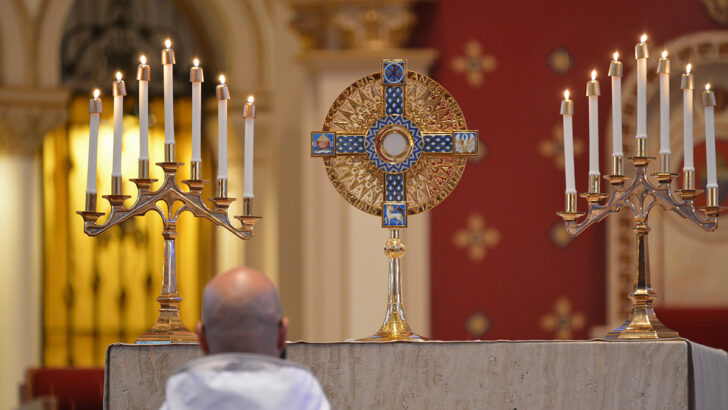
 A priest prays before the Eucharist during a Holy Hour. Photo: OSV News /Anne Marie Cox, Diocese of Des Moines.
 I am the living bread that came down from heaven. Whoever eats of this bread will live forever
The Gospel
John 6:51 [Jesus said:] “I am the living bread that came down from heaven. Whoever eats of this bread will live forever; and the bread that I will give for the life of the world is my flesh.”
John 6:52 The Jews then disputed among themselves, saying, “How can this man give us his flesh to eat?”
John 6:53 So Jesus said to them, “Very truly, I tell you, unless you eat the flesh of the Son of Man and drink his blood, you have no life in you.
John 6:54 Those who eat my flesh and drink my blood have eternal life, and I will raise them up on the last day;
John 6:55 for my flesh is true food and my blood is true drink.
John 6:56 Those who eat my flesh and drink my blood abide in me, and I in them.
John 6:57 Just as the living Father sent me, and I live because of the Father, so whoever eats me will live because of me.
John 6:58 This is the bread that came down from heaven, not like that which your ancestors ate, and they died. But the one who eats this bread will live forever.”
Initial observations
This passage comes towards the end of John 6, a very significant and important chapter in this Gospel. As is well known, this Gospel faces two problems regarding the celebration of the Eucharist: taking part without realising who Jesus is and taking part without any effect on your daily life. The writer tackles the latter in chapter 13, by making the radical choice of omitting the account of the Lord’s Supper at the Last Supper and replacing it with the washing of the feet. Clearly from that action, the Eucharist changes or should change the way we live. The writer tackles the first issue (taking part without a mature faith in Christ) in chapter 6. This chapter is made up of many sections but each section really climaxes with some point about the identity of Jesus. Peter’s rhetorical question at the end, “Lord to whom shall we go?”, points to the central teaching of chapter 6. In the middle of chapter 6, Jesus says “This is the work of God, that you believe in him whom he has sent.” (6:29).
Kind of writing
(i) It has been shown by scholarship (and fairly widely accepted) that the long speech in John 6 is based on a Christian homily using rabbinic homiletical style (midrash). It is first of all a Christian homily because it is primarily about Christ.
At the same time, it is rabbinic because it fulfils the rules for such a homily and follows the overall shape. The rules included presenting a two-part text, treating the first half of the text in the first part of the homily and the second part of the text in the second part of the homily. This is fulfilled here very clearly. The key text is “He gave them bread from heaven to eat”. The homily reflects on the topic of bread from vv. 35-51 and on the function of eating in vv. 52-58. That we are in a preaching context is proved by the final verse: “He said these things while he was teaching in the synagogue at Capernaum” (v. 59).
(ii) Where did the writer get the material? The writer of this Gospel is a person of deep prayer and reflection. Often he penetrates a teaching by reflecting in the context of his Bible (i.e. what Christians call the Old Testament). In our context, he is reflecting on both the identity of Jesus and the meaning of the Eucharist, using the bible story of the manna in the desert. What we have here is one of the writer’s poetic readings of the Jesus tradition, placed here on the lips of Jesus.
(iii) This writer often uses misunderstanding to trigger a deeper meaning. For instance, the Samaritan woman says “give me this water always” and it is clear she is still working on a material level. Likewise with Nicodemus when he wonders if a man can enter his mother’s womb to be born a second time (!). Here the misunderstanding is “must we eat this man’s flesh?” All these reactions are at the wrong level and something else is meant at another level. That something else is actually more shocking in some ways. Eat here means to be nourished by. Giving flesh and blood means, in this Gospel, the gift of the whole person of Jesus on the cross, i.e. the lifting up of Jesus. The challenge here is not first of all the literal or even sacramental eating of Jesus/his flesh, but rather being, in faith, nourished by his death on the cross. This was, as we know, the big stumbling block for Jews. It is not without difficulty even today for ourselves.
Old Testament background
The background is the story of manna in the desert from the Old Testament. This story is mentioned in Exodus, Numbers, Deuteronomy, Joshua, Nehemiah and Psalm 78. The repetition is a measure of its significance.
Ex 16:4 Then the Lord said to Moses, “I am going to rain bread from heaven for you, and each day the people shall go out and gather enough for that day. In that way I will test them, whether they will follow my instruction or not.
Ex 16:5 On the sixth day, when they prepare what they bring in, it will be twice as much as they gather on other days.”
Ex 16:6 So Moses and Aaron said to all the Israelites, “In the evening you shall know that it was the Lord who brought you out of the land of Egypt,
Ex 16:7 and in the morning you shall see the glory of the Lord, because he has heard your complaining against the Lord. For what are we, that you complain against us?”
Ex 16:8 And Moses said, “When the Lord gives you meat to eat in the evening and your fill of bread in the morning, because the Lord has heard the complaining that you utter against him—what are we? Your complaining is not against us but against the Lord.”
Ex 16:9 Then Moses said to Aaron, “Say to the whole congregation of the Israelites, ‘Draw near to the Lord, for he has heard your complaining.’”
Ex 16:10 And as Aaron spoke to the whole congregation of the Israelites, they looked toward the wilderness, and the glory of the Lord appeared in the cloud.
Ex 16:11 The Lord spoke to Moses and said,
Ex 16:12 “I have heard the complaining of the Israelites; say to them, ‘At twilight you shall eat meat, and in the morning you shall have your fill of bread; then you shall know that I am the Lord your God.’”
Ex 16:13 In the evening quails came up and covered the camp; and in the morning there was a layer of dew around the camp.
Ex 16:14 When the layer of dew lifted, there on the surface of the wilderness was a fine flaky substance, as fine as frost on the ground.
Ex 16:15 When the Israelites saw it, they said to one another, “What is it?” For they did not know what it was. Moses said to them, “It is the bread that the Lord has given you to eat.”
New Testament foreground
(i) There are two contexts for this material. The first context is a chain of stories in Mark, the sequence of which is closely followed here (see box).
This sequence is actually about the identity of Jesus and leads to the confession of Peter at Caesarea Philippi (Mk 8:37).
(ii) The second context is the Lord’s Supper and, especially, the words over the bread, “This is my body”, even though John does not give us the Lord’s Supper in John 13.
St Paul
Clean out the old yeast so that you may be a new batch, as you really are unleavened. For our paschal lamb, Christ, has been sacrificed. (1 Corinthians 5:7)
Brief commentary
Verse 51 The reference is to Exodus 16:4. “I am the bread of life” is one of the seven “I am” sentences in this Gospel. In the Fourth Gospel, all teachings/doctrines are “collapsed” into the person of Jesus. Moses gave bread; Jesus is bread. When does Jesus give his flesh in this Gospel, given that there is no Lord’s Supper? Jesus gives his flesh for the life of the world when he is lifted up on the cross. All the words are important: the gift is for the life of the world and all who eat it will live.
Verse 52 At the narrative level, his opponents take Jesus literally, evidently shocked by his proposal. This is a good example of crass misunderstanding, a technique of this Gospel. The material level is not where it is at.
Verse 53 Jesus pushes the misunderstanding to the extreme of apparent cannibalism. This first “explanation” is negative: you have no life in you. It should be noted that “to eat” means to be nourished by Jesus, that is to have faith in him.
Verse 54 The present effect (they will have eternal life) and the future result (I will raise them up) are presented. In both verses 53 and 54 what is meant is feeding by faith on the passion and resurrection of Jesus. There is a “definition” of eternal life in this Gospel: Very truly, I tell you, whoever believes has eternal life. (John 6:47) And this is eternal life, that they may know you, the only true God, and Jesus Christ whom you have sent. (John 17:3)
Verse 55 In the context of this Gospel, the “giving” takes place on the cross and the primary giving is the self-giving of Jesus. The word “true” is a clue: Jesus said to him, “I am the way, and the truth, and the life. No one comes to the Father except through me. (John 14:6)
Verse 56 Mutual indwelling is an important theme in the Fourth Gospel. The deceptively simple word “remain/abide” is used richly: Abide in me as I abide in you. Just as the branch cannot bear fruit by itself unless it abides in the vine, neither can you unless you abide in me. (John 15:4; cf. also John 1:32-33, 38-39; 2:12; 3:36; 4:40; 5:38; 6:27, 56; 7:9; 8:31, 35; 9:41; 10:40; 11:6, 54; 12:24, 34, 46; 14:10, 17, 25; 15:4-7, 9-10, 16; 19:31; 21:22-23)
Verse 57 “Just as” has powerful force in this Gospel. It means more than a formal parallel. Rather, the life from the Father passes through the Son to all who believe in him. The mission continues in us.
Verse 58 This forms an “inclusion” with the start of the homily; it also expresses a final negative contrast between the mother religion, Judaism, and its offspring, Christianity. However, it ends on a positive note: will live forever.
Pointers for prayer
- Jesus tells us that to have life we need more than physical nourishment. How have you been aware of deeper hungers? What has met that deeper longing in you?
- Jesus tells us that it is not just something he gives us which will give us life, but himself in his life, death and resurrection. How has your faith in the person of Jesus fed you?
- Jesus speaks about ‘drawing life’ from him. In day to day living what are the practices which support your faith and help you to draw life from Jesus?
- The Eucharist is one of the ways in which we draw life from Jesus. Recall with gratitude how the Eucharist has been a source of nourishment and life for you.
- Perhaps you can also think of human examples of people drawing life from one another. From whom have you drawn life? Who has been able to draw life from you?
Prayer
O God of pilgrims, you accompany us always on the road of life. You fed the people of Israel in the desert. Today, you feed your people through Jesus Christ, our living bread of life.
May this food so satisfy us that we may always hunger for that true life found in you alone. Amen.
Thought of the day
Jesus himself practised open table-fellowship, to express God’s unconditional love and acceptance. Before he died, he spoke words over the bread and wine, words which disclosed the meaning of his death and resurrection. When St Paul wrote to the Corinthians about the Lord’s Supper, he had to remind them that the sacrament is meant to be a communion among all who celebrate it and to have a practical affect in our lives. As Benedict XVI wrote: A Eucharist which does not pass over into the concrete practice of love is essentially fragmented (God is Love).
Prayer
Lord, as gather around your table, help to recognise you in the breaking of the bread and in each other. May we live the communion we receive by practicing both service and reconciliation. Amen.
**
Because there is one bread, we who are many are one body
The First reading
1 Cor 10:16 Is not the cup of blessing that we bless a sharing (koinonia) in the blood of Christ? Is not the bread (loaf) that we break a sharing in the body of Christ?
1 Cor 10:17 Because there is one bread (loaf), we who are many are one body, for we all share (metechomen) the one bread (loaf).
Initial observations
Our very brief excerpt from 1 Corinthians is part of a much longer argument which sheds light on vv. 16-17. The question behind the question, so to speak, is a question for us today as well: how can we live our Christian faith, in all its distinctiveness, while living in the world, when values and changes in society challenge our faith. It touches, therefore, our capacity to bear witness socially and ethically in our society at large. Paul gives a very rich answer to a seemingly innocent, practical question
Kind of writing
Paul takes up the simple question posed and amplifies it at length in 8:1-11:1.
8:1-6 What believers and should know.
8:7-13: Caution with some believers.
Digression
9:1-77: Paul’s own self-restraint.
10:1-13: Israel’s failures in the past.
10:14-22: Fellowship—Baptism and the Lord’s Supper.
10:23-11:1: Conclusion, summary and final appeal.
Before answering a single question, Paul often places the issue into a wider context of consideration before giving his advice. This is what happens here. The simple question about food sacrificed to idols is considered in a much wider setting. As part of that argument, Paul affirms in vv.16-17 our true communion in Christ. This serves as a counterweight to communion with so-called demons and also as motive to maintain our Christian fellowship at all costs. The related texts below are more than usually significant.
Context in the community
The presenting question is about food sacrificed to idols. Is it okay to eat it? It would have been difficult to resist because the differing craft associations all had their own sacred meals and, in any case, people were free to buy it and a believer might find him or herself offered such food at a friend’s house. A believer is faced with a dilemma. There are no idols and so in one sense the Christian is free and may eat anything. Hence, as to the eating of food offered to idols, we know that “no idol in the world really exists,” and that “there is no God but one.” (1 Cor 8:4) On other hand, eating may send the wrong message either to “pagan” neighbours and friends or indeed to fellow believers, with less robust consciences. Thus, in the end Paul counsels self-restraint when it comes to exercising the true freedom of the believers.
Related passages
Do you not know that those who are employed in the temple service get their food from the temple, and those who serve at the altar share in what is sacrificed on the altar? (1 Cor 9:13)
No, I imply that what pagans sacrifice, they sacrifice to demons and not to God. I do not want you to be partners with demons. (1 Cor 10:20)
For I received from the Lord what I also handed on to you, that the Lord Jesus on the night when he was betrayed took a loaf of bread, and when he had given thanks, he broke it and said, “This is my body that is for you. Do this in remembrance of me.” In the same way he took the cup also, after supper, saying, “This cup is the new covenant in my blood. Do this, as often as you drink it, in remembrance of me.” For as often as you eat this bread and drink the cup, you proclaim the Lord’s death until he comes. (1 Cor 11:23–26)
For just as the body is one and has many members, and all the members of the body, though many, are one body, so it is with Christ. (1 Cor 12:12)
Brief commentary
Verse 16 Paul will return more fully to the Lord’s Supper in 11:17-34. Meal sharing is always to some degree sacred: all the more so with the Eucharist. The cup of blessing reminds the Corinthians of the Passover meal. It can also mean the blessing or saying of grace over everyday food and drink as well. Technically, Jews did not bless the cup in the sense of making it holy; instead, they blessed (praised) God the giver. Sharing translates an important Pauline word and concept: koinonia, which can be variously rendered as association, partnership, sharing and fellowship.
It may seem curious that Paul mentions first the cup and then the bread, contrary to his own description of the Last Supper. In this, he resembles The Didache, which places the cup first. More likely, he has in mind gift and consequence. The blood is the sacred life-principle in human beings and thus points, in a covenant context, to Jesus’ gift of himself on the cross and in the resurrection. Our becoming the body of Christ is a consequence of that gift and so naturally it takes second place for this argument. Because we have received from Jesus’ self-gift, therefore we are his body. “Bread” could be better translated as loaf — it is not that we all eat the same general bread but the one concrete loaf. Later in chapter 11, Paul will accuse the Corinthians of not recognising the body — not the sacramental body in this case but the social body of Christian believers. Here too the emphasis is on our belonging to Christ and to one another. Even the appearance of any other kind of belonging or communion is to be rejected. Hence, so then, my dear friends, flee from idolatry. (1 Cor 10:14)
Verse 17 Paul draws the obvious conclusion: the one bread makes of us all one body. Note the repetition of one in this verse. The image of the body (borrowed from the Stoics) is explored fully in 1 Corinthians 12 and Romans 12. V. 18 goes on to take up the image of sharing at the altar from Israelite history, as a confirmation of communion, excluding “other” communions. V. 19 represents a clear point of arrival in Paul’s teaching here. Visible self-restraint is what is required for the sake of both insiders and outsiders.
Pointers for prayer
- When did I myself become deeply aware of my communion with Christ and fellowship with Christians?
- Do I experience any equivocation in my practice, when my witness is not as evident as it could be?
Prayer
God of harmony and communion, it is your will that we should all be one in Christ. Help us to work towards true fellowship by setting aside anything contrary to it. Help us to use our freedom in Christ for the building up of his body.
**
The Lord fed you in the wilderness with manna
The second reading
Deut 8:2 Remember the long way that the Lord your God has led you these forty years in the wilderness, in order to humble you, testing you to know what was in your heart, whether or not you would keep his commandments.
Deut 8:3 He humbled you by letting you hunger, then by feeding you with manna, with which neither you nor your ancestors were acquainted, in order to make you understand that one does not live by bread alone, but by every word that comes from the mouth of the Lord.
Deut 8:12 When you have eaten your fill and have built fine houses and live in them,
Deut 8:13 and when your herds and flocks have multiplied, and your silver and gold is multiplied, and all that you have is multiplied,
Deut 8:14 then do not exalt yourself, forgetting the Lord your God, who brought you out of the land of Egypt, out of the house of slavery,
Deut 8:15 who led you through the great and terrible wilderness, an arid wasteland with poisonous snakes and scorpions. He made water flow for you from flint rock,
Deut 8:16 and fed you in the wilderness with manna that your ancestors did not know, to humble you and to test you, and in the end to do you good.
Initial observations
The reading evokes the earlier story of the manna in the desert. Moses speaks about the manna and we begin to see here the reception of that story within the Bible itself.
Kind of writing
The wider context is a sermon, drawing out the lessons of the time in the wilderness. The immediate context is really a warning to remember and not to forget.
Origin of the reading
Our reading comes from a longer section, Dt 8:1-20, a passage which draws out the lessons from the wandering in the desert (Exodus 16 and Numbers 11). It shows the following noted in the box.
The “Song of the Land” stands at the centre; our excerpts come from the warning sections, vv. 2-4 and vv. 12-16.
Related readings
Water from the rock: Exodus 17:1–7
The manna: Numbers 11:7–9
Early Jewish tradition: Instead of these things you gave your people food of angels, and without their toil you supplied them from heaven with bread ready to eat, providing every pleasure and suited to every taste. For your sustenance manifested your sweetness toward your children; and the bread, ministering to the desire of the one who took it, was changed to suit everyone’s liking. (Wisdom 16:20–21)
Philo of Alexandria continues this tradition, making an allegorical reading of the manna as the Word of God, which satisfies each according to their need. He writes: Again this heavenly food of the soul which Moses calls manna, the word of God divides in equal portions among all who are to use it; taking care of equality in an extraordinary degree. And Moses bears witness to this where he says, “He who had much had not too much, and he who had but little was in no want;” since they all used that wonderful and most desirable of proportion.
Brief commentary
Verse 2 The time of wandering was classically read as a time of testing. In this context, “heart” really means mind and heart, the whole interior attitude of the Israelites towards God.
Verse 3 Suffering is interpreted as discipline, an attitude found in the Wisdom literature of the Bible. Cf. My child, do not despise the Lord’s discipline or be weary of his reproof, for the Lord reproves the one he loves, as a father the son in whom he delights. (Proverbs 3:11–12)
Verses 12-13 It is often observed that material well-being can corrode faith and this was true in the past as much as today. These verses seem to look back from a time of outstanding prosperity and perhaps we are meant to think of the 8th century bc, when the prophet Amos was working.
Verse 14 In effect, remember where you came from and who it was who set you free. The one who “brought you out of the land of Egypt” is almost a name for YHWH in the tradition. Earlier, in v. 11, there is a startling equation of the Lord and the Law, YHWH and his Torah: Take care lest you forget the Lord your God and fail to keep His commandments, His rules, and His laws, which I enjoin upon you today. (Deuteronomy 8:11, Jewish Publication Society translation.)
Verse 15-16a A summary of all they experience in the desert, both threat and danger, as well as guidance and grace. A picture of God emerges: the one who set them free, the one who guided them, the one who gave them water and the one who fed them.
Verse 16b This final part of verse 16 is not in the reading but very much worth holding onto nevertheless. Yes, it was difficult, yes, it was a test but the real motive is “in the end to do you good.”
Pointers for prayer
- Remembering is a powerful theme across all of Deuteronomy. Memory is the gift of consistent identity. Who am I? What has God done for me in my life? What happens to me when I forget the Lord and his teaching?
- Difficult experiences are painful at the the time. It is usually only later that we can see whatever good has come of them. Do I find this to be true in my own life? Does such wisdom help me at present? Do I realise that, all along, God’s intention was “in the end to do me good”?
- Times of well-being are welcome, of course, but can easily lead to spiritual amnesia and a profound loss of even my own identity. Have I been able to keep faith alive in the good times? What are the risks at present?
Prayer
God, our guide and our hope, we know that we cannot live by bread alone but by your every word. When we are tempted to forget you, draw us back to you, the true spring of living water, the source and giver of heavenly nourishment. Nourish us that we may always hunger and thirst for you alone. Amen.
**
The Liturgy
Readings 1 and 3
It would have been easy to have chosen the manna story from Numbers to match the Gospel and not Deuteronomy. However, the link between being fed and faithfulness to the Law has its own vital significance. Worship and ethics, adoration and faithful living can be distinguished but cannot be separated.
The responsorial Psalm
Psalm 147 makes a great response. This is not only for the words in the Psalm (he established peace on your borders, he feeds you with finest wheat) but also because it recalls the covenant, which is just about to be renewed.
Sunday introductions
First reading
Deut 8:2-3, 14b-16a
The context of this reading is Moses’ final speech and he reminds the Israelites of their experience of God. It may seem remote but is actually very close to our experience: well-being often leads to spiritual amnesia, then and now.
Second reading
1 Corinthians 10:16-17
All communities have tensions and divisions, as does every parish. Conflict is normal! This was true also of the ancient Corinthians. That is why Paul reminds them that our sharing in Christ is both real and deeper than any apparent division. One bread, one cup, one body.
Gospel
John 6:51-58
John’s Gospel has many striking “I am” sentences on the lips of Jesus. “I am the bread of life” can best be heard by recalling your own faith in Jesus, who nourishes us and gives us life. Peter’s answer can help us here: “Lord, to whom can we go? You have the words of eternal life. We have come to believe and know that you are the Holy One of God.” (John 6:68–69) This is the faith we celebrate when we come to the Lord’s Supper.
Weekday introductions
Monday 8 June
St Colman, bishop
Kings 17:1-6
Our story is the first of three “testings” of Elijah. In itself, the story is slight enough but Elijah was highly significant right up to the time of Jesus. As a result, some stories about Jesus ought to be read in the light of Elijah traditions.
Matthew 5:1-12
Even non-religious people are attracted by the vision and ideals of the Sermon on the Mount. The beatitudes make a great opening to the Sermon—after all, who does not want to be happy? And yet, the path to happiness is highly paradoxical, right from the very start. We know this is true to our experience, but often we do not recall such wisdom.
Tuesday 9 June
St Columba, abbot and missionary, secondary patron of Ireland
Romans 12:1-2,9-13
St Paul begins to draw practical conclusions from his teaching: renewal and transformation of the whole person and the practice of love.
Matthew 8:18-27
The reading is chosen to reflect something of the dislocated life of Columba.
Wednesday 10 June
St Ephrem, deacon and doctor of the church
1 Kings 18:20-39
Here we have a drama, with inherently comic aspects. It is, therefore, to be enjoyed and should be read aloud as such. For us today, with our many idolatries, the reading invites us to recognise that “the Lord is God.” The responsorial psalm picks up the same theme and enriches it.
Matthew 5:17-19
The first Christians were greatly exercised by one question: how much of the previous religious tradition should be retained and how much of it loses its importance in light of Christ. Paul is very liberal. Matthew—rather more traditional—seems to rein in such Pauline freedom. In Matthew’s mind, however, Jesus brings the law to completion (lit. fulfilment, an eschatological term). This takes us beyond mere repetition or observance to a new, radical view illustrated in the next verses.
Thursday 11 June
St Barnabas, apostle
Acts 11:21-26, 13:1-3
Barnabas is appropriately mentioned in today’s reading from the Acts. He was a close collaborator of Paul, until they had a major row and separated (Acts 15:39).
Matthew 10:7-13
Matthew’s Gospel offers us a very generous picture of evangelisation: “you received without charge, give without charge.” Many people do exactly that, even today.
Friday 12 June
Most Sacred Heart of Jesus
Deuteronomy 7:6-11
Notice in the reading the references to consecration and heart, making this a very inspiring reading for the feast.
1 John 4:7-16
A favourite “definition” of God stands at the centre of this reading: God is love. This builds on the centrality of love of God and love of neighbour but takes it further into God’s very being.
Matthew 11:25-30
This is an extraordinary passage, being both pastorally inviting and theologically deep.
Saturday 13 June
The Immaculate Heart of Mary
Isaiah 62:19-11
This wonderful reading suits the feast: the joyful proclamation of the Good News.
Luke 2:41-51
This short vignette — unique to Luke’s Gospel — serves a double purpose. The child Jesus foreshadows his future ministry and role. At the same time, the portrait of Mary shows us how to respond to the wonderful things God has done.