

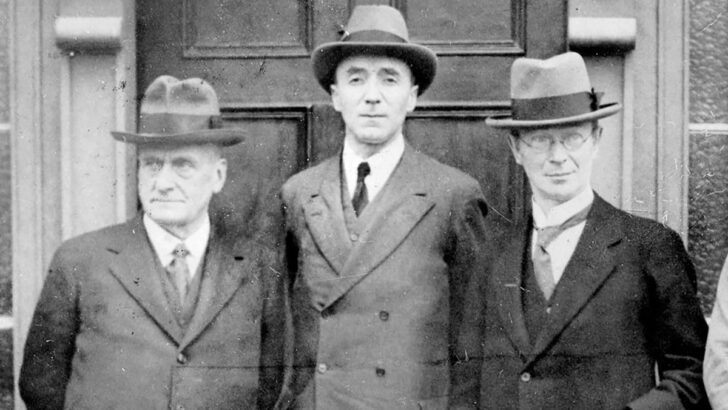
 The Irish Boundary Commission: (left to right) Joseph Fisher, Justice Richard Feetham and Prof. Eoin MacNeill. Photo: National Library of Ireland.
 The Root of All Evil: The Irish Boundary Commission, by Cormac Moore
(Irish Academic Press, €22.99 / £20.00)
In the negotiations between Irish and British leaders in 1921 that brought the War of Independence to an end and culminated in the Treaty that created the Irish Free State, there were two central issues: the extent of its sovereignty; and whether it would include the six counties of Northern Ireland that had been partitioned off and granted self- government within the United Kingdom under the Government of Ireland Act 1920.
The British were inflexible on sovereignty, insisting that the Free State remain within the Empire, with the King as sovereign, while enjoying the independence of a dominion such as Canada. This was important as a guarantee that the Irish would not ally themselves with an enemy, as its rebel leaders had done in 1916. The British negotiators knew their public opinion was with them on this.
Partition was more problematic. They did not want the talks to break down on this issue, as they were not confident of public support to resume an unpopular war just to retain within Northern Ireland predominantly Catholic areas on its fringe.
Prime Minister Lloyd George’s initial preference was that Northern Ireland should join the Irish Free State, but he could not get Tory coalition colleagues to agree to coerce Ulster unionists against their will. He then got the Irish delegation to sign up to a Boundary Commission to determine the boundaries between Northern Ireland and the Free State.
Members
The Commission was to have three members, one each nominated by the Free State and Northern Ireland governments, and a chairman chosen by the British. Their binding determination was to be made “in accordance with the wishes of the inhabitants in so far as may be compatible with economic and geographic conditions.”
Recent election results were evidence of fairly narrow nationalist majorities in the border counties of Fermanagh and Tyrone, Derry City and some other areas near the existing border. The Irish delegation allowed themselves to be convinced that the Commission would so reduce Northern Ireland that it would not be viable and have to join the Free State.
Even the Republicans, who were to oppose the Treaty in arms, seem to have accepted this, as they focused their opposition on its giving up the Republic by staying in the Empire.
Northern Ireland Prime Minister James Craig, who had not been consulted on the Treaty, objected to the Boundary Commission, which he described as “the root of all evil.” He was determined to yield “not an inch” of the existing six counties of Northern Ireland. He refused to nominate a member of the Commission; legislation had to be enacted enabling the British government to nominate a commissioner to reflect Unionist opinion.
This, and the Civil War in the Free State, ensured that the Commission did not come into existence until 1925. The Free State government nominated Eoin MacNeill, a government minister from Antrim, while the British nominated Joseph Fisher, a hard line Ulster unionist, to represent Northern Ireland, and, as chairman, a well-meaning South African judge Richard Feetham.
They would have reduced the Catholic population of Northern Ireland by some 35,000 or 6%, and added to Northern Ireland a predominantly Protestant area of east Donegal”
Feetham dominated. He relied on interviews and refused to hold local plebiscites to ascertain wishes of inhabitants. He invoked the requirement that these wishes had to be compatible with economic and geographic conditions to disregard them when they would have resulted in inconvenience; as a result, the adjustments recommended were minor. They would have reduced the Catholic population of Northern Ireland by some 35,000 or 6%, and added to Northern Ireland a predominantly Protestant area of east Donegal.
This fell far short of nationalist expectations. When the contents of the report were leaked to the High Tory Morning Post, the Free State government was aghast, especially at the prospect of ceding some of Donegal. Its premier, W. T. Cosgrave, hurried to London and persuaded the British to suppress the report. Chancellor of the Exchequer Winston Churchill feared the frustration of nationalist expectations would endanger the Cosgrave government, of which he was protective, having been one of the main authors of the Treaty.
Liability
He displayed generosity (which moved Cosgrave to express profuse gratitude), agreeing to relieve the Free State of a potentially crippling liability under the Treaty for a proportion of the existing British national debt. In return, the Free State accepted the existing border.
This well-researched, rather polemical book – Cormac Moore is both a historian and a columnist on the Irish News – berates British ministers for duplicity and accuses Feetham of bias. The author dismisses Cosgrave as naïve and a poor negotiator, and calls his abandonment of Northern nationalists contemptible; MacNeill’s performance is described as bizarre. This is harsh: they were dealt a bad hand by the imprecision of the Treaty; they may have made errors, but it is fanciful to believe that they could have achieved a better result by behaving differently.
The author is right that Craig “had won all down the line”. But it may have been a pyrrhic victory in the long run. The larger Catholic population is now making the future of Unionist Ulster more uncertain. The loss during the Troubles of so many lives in South Armagh, many of them security forces or Unionists, was the price of retaining it in Northern Ireland. The border recommended by the Boundary Commission would have been better all round than the one that survived.